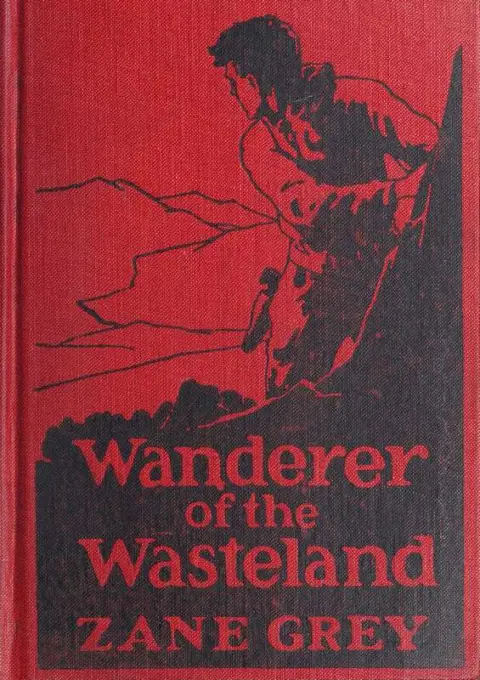
Wanderer of the Wasteland
Zane Grey
THE CLASSIC COLLECTION · 1919
"The Desert of Wheat" by Zane Grey is a novel written in the early 20th century, specifically the year 1919. The narrative explores the struggles of a young farmer, Kurt Dorn, who is caught in the tumult of World War I, dealing with personal conflict, familial obligations, and the challenges posed by an emerging labor movement in the agrarian landscape of the Columbia Basin. The story delves into themes of love, loyalty, and the harsh realities of life on a wheat farm during a time of national crisis. At the start of the novel, readers are introduced to the expansive and austere landscapes of the northwestern wheat fields, which serve as the backdrop to Kurt Dorn’s life. Kurt is deeply troubled, struggling against the expectations of his aging father, who is resistant to embracing the realities of war and harbors a fierce German nationalism. As Kurt navigates his desire to enlist, he grapples with an impending financial crisis due to debt, the threat of labor unrest from the I.W.W. (Industrial Workers of the World), and the complex feelings he harbors for Lenore Anderson, the daughter of a wealthy rancher. Their delicate interactions set the stage for a deeper exploration of commitment to family and country amidst the chaos of societal upheaval.
Introduction adapted from the source catalogue; source summaries may be automatically generated.
Free to read · English · 117,848 words · No account needed
MAKE TIME FOR A GOOD BOOK
On by default. Untick to stop anonymous reading totals. Each page counts after 10 seconds in view. How this works.
Anonymous counting is on unless you have switched it off.
"Lenore, I reckon your talk 'll be more interesting than mine," he said, dryly. "I'll go see Dorn an' get this business over."
"I'd rather go with you," hurriedly replied Kurt; and then, as though realizing a seeming discourtesy in his words, his face flamed, and he stammered: "I--I don't mean that. But father is in bad mood. We just quarreled.--I told you--about the war. And--Mr. Anderson,--I'm--I'm a little afraid he'll--"
"Well, son, I'm not afraid," interrupted the rancher. "I'll beard the old lion in his den. You talk to Lenore."
"Please don't speak of the war," said Kurt, appealingly.
"Not a word unless he starts roarin' at Uncle Sam," declared Anderson, with a twinkle in his eyes, and turned toward the house.
"He'll roar, all right," said Kurt, almost with a groan. He knew what an ordeal awaited the rancher, and he hated the fact that it could not be avoided. Then Kurt was confused, astounded, infuriated with himself over a situation he had not brought about and could scarcely realize. He became conscious of pride and shame, and something as black and hopeless as despair.
"Haven't I seen you--before?" asked the girl.
The query surprised and thrilled Kurt out of his self-centered thought.
"I don't know. Have you? Where?" he answered, facing her. It was a relief to find that she still averted her face.
"At Berkeley, in California, the first time, and the second at Spokane, in front of the Davenport," she replied.
"First--and--second?... You--you remembered both times!" he burst out,
incredulously.
"Yes. I don't see how I could have helped remembering." Her laugh was low, musical, a little hurried, yet cool.
Dorn was not familiar with girls. He had worked hard all his life, there among those desert hills, and during the few years his father had allowed him for education. He knew wheat, but nothing of the eternal feminine. So it was impossible for him to grasp that this girl was not wholly at her ease. Her words and the cool little laugh suddenly brought home to Kurt the immeasurable distance between him and a daughter of one of the richest ranchers in Washington.
"You mean I--I was impertinent," he began, struggling between shame and pride. "I--I stared at you.... Oh, I must have been rude.... But, Miss Anderson, I--I didn't mean to be. I didn't think you saw me--at all. I don't know what made me do that. It never happened before. I beg your pardon."
A subtle indefinable change, perceptible to Dorn, even in his confused state, came over the girl.
"I did not say you were impertinent," she returned. "I remembered seeing you--notice me, that is all."
Your reading position is saved on this browser. Take it to another device with a library code. Reading pages adapt to text, rather than matching a printed edition.
Zane Grey
Zane Grey
Zane Grey
Zane Grey
BEHIND THE BOOK
This eBook is for the use of anyone anywhere in the United States and most other parts of the world at no cost and with almost no restrictions whatsoever. You may copy it, give it away or re-use it under the terms of the Project Gutenberg License included with this eBook or online at www.gutenberg.org. If you are not located in the United States, you will have to check the laws of the country where you are located before using this eBook. Read the source licence.
The original source file, including credits and licence, is retained by this library. Request an original-format copy at no charge. Please include the book title and Project Gutenberg identifier #10201.
KEEP YOUR CURIOSITY GOING
Cécile Tormay

Moritz Busch
Coulson Kernahan
John L. Ransom

Maurice Baring
Frances Wright