
The Writing of News A Handbook with Chapters on Newspaper Correspondence and Copy Reading
Charles G. (Charles Griffith) Ross
THE CLASSIC COLLECTION · 1880
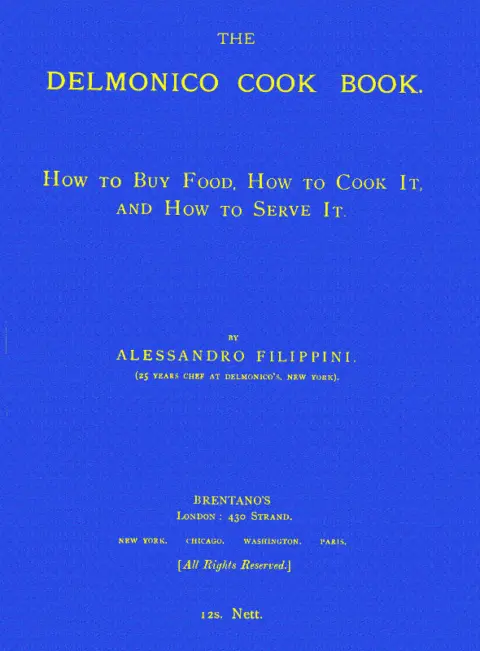
"The Delmonico Cook Book: How to Buy Food, How to Cook It, and How to Serve It" by Alessandro Filippini is a culinary guidebook written in the late 19th century. This comprehensive volume offers insights into the art of gastronomy, emphasizing the importance of selecting quality ingredients, mastering cooking techniques, and serving dishes elegantly. It serves as a resourceful companion for both aspiring cooks and seasoned chefs, providing a depth of knowledge that reflects the sophistication of American dining during that era. At the start of this cook book, the author introduces the pleasures associated with fine dining, highlighting the complexities of meal preparation and presentation. Filippini shares his experience from working at Delmonico's, a renowned restaurant in New York, as he discusses the abundant variety of foods available in the markets and their protagonist roles on the modern American table. The initial chapters focus on essential knowledge, such as choosing fresh ingredients from local markets, understanding seasonal produce, and tips for setting a well-organized dining table, laying the groundwork for the recipes and menus that follow in the subsequent sections.
Introduction adapted from the source catalogue; source summaries may be automatically generated.
Free to read · English · 219,142 words · No account needed
MAKE TIME FOR A GOOD BOOK
On by default. Untick to stop anonymous reading totals. Each page counts after 10 seconds in view. How this works.
Anonymous counting is on unless you have switched it off.
Hawaiian Islands.
Raw Mullet.
Raw Gold-fish.
Shell Fish.
Broiled Taro.
Chili Peppers.
Small Onions.
Raw Liver.
Roast Pig.
Roast Fish.
Stewed Taro.
Papaias.
Cabbage.
Taro.
Sweet Potatoes.
Bananas.
Oranges.
Guavas.
Mangoes.
Apples.
Hawaiian Tea.
Kono Coffee.
Ookulian (pronounced O-ku-le-on).
Hawaiian Pipe of Friendship.
Among the Kanakas, the food eaten for breakfast, luncheon, and dinner is about the same, and consists chiefly of the native dish called “POI,” which is eaten whenever they (the Kanakas) are hungry.
“POI” is made from a root called “Taro,” and in shape and size resembles a raw beet, it has a dark skin, and the vegetable itself has a variety of colors--pink, gray, purple, and white.
The “Taro” is cooked in the ground, after the manner of a “New England clam-bake;” after obtaining the softness of a cooked potato it is peeled, and beaten with a large stone or iron, made for that purpose, into a pulp. It is then mixed with water until it forms the thickness of paste (and which makes very good paste, as it is often used for sticking bills, etc., when a theatrical company arrives), and after standing for a few days, to allow it to ferment, it is ready to be eaten.
The “Poi” is always eaten out of a “Calabash” (a large gourd about the size of a pumpkin), the natives always eating with their fingers, this being done by sticking the two fore-fingers into the “Calabash,” giving it one or two twists, and dexterously turning it around in front of their faces, until it looks like a ball of “taffy on a stick” (no pun intended).
“Taro” is sometimes cooked and eaten like potatoes and is considered
very wholesome food.
The next important dish is “Raw Fish,” which are caught along the coast and eagerly eaten by the natives. Fish is also cooked in the ground, and is served on large leaves about the size of palm-leaves, called “Ti” leaves. Raw meat, raw liver, and a fragrant sea-weed form delicate side-dishes.
Coffee, within the last few years, has to a great extent been drunk as a beverage, but not so much as the Hawaiian tea, which tastes and smells like medicine.
Vegetables are also eaten, but sparingly, comprising sweet potatoes, Irish potatoes, cabbages, etc.
Fruit, the product of the Islands, is very much eaten and relished, such as guavas, mangoes, bananas, mountain-apples, oranges, etc.
The Hawaiians when eating always sit on mats. All eat out of the same calabash. After eating, it is the custom to pass the pipe of friendship, which is a small pipe made from shark’s teeth.
Your reading position is saved on this browser. Take it to another device with a library code. Reading pages adapt to text, rather than matching a printed edition.
BEHIND THE BOOK
This eBook is for the use of anyone anywhere in the United States and most other parts of the world at no cost and with almost no restrictions whatsoever. You may copy it, give it away or re-use it under the terms of the Project Gutenberg License included with this eBook or online at www.gutenberg.org. If you are not located in the United States, you will have to check the laws of the country where you are located before using this eBook. Read the source licence.
The original source file, including credits and licence, is retained by this library. Request an original-format copy at no charge. Please include the book title and Project Gutenberg identifier #60285.
KEEP YOUR CURIOSITY GOING
Charles G. (Charles Griffith) Ross
Hannah Webster Foster

Emily Lawless
Edwin Hamlin Carr

Charles De Lano Hine
Andrew Ure