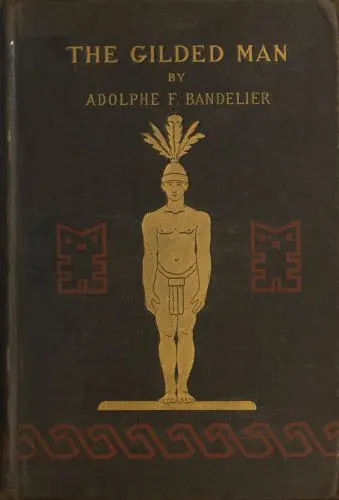
The Gilded Man (El Dorado) and other pictures of the Spanish occupancy of America
Adolph Francis Alphonse Bandelier
THE CLASSIC COLLECTION · 1890
"The Delight Makers" by Adolph Francis Alphonse Bandelier is a historical novel written in the late 19th century. The book focuses on the Pueblo Indians of New Mexico, especially emphasizing their traditions, culture, and the setting of their ancient cave-dwellings. The story unfolds through the experiences of its young characters, primarily Okoya and his younger brother Shyuote, as they navigate their lives intertwined with the rich historical tapestry of their ancestors. The beginning of "The Delight Makers" introduces the setting of the Tyuonyi, a valley home to the ancestors of the Queres tribe. It describes the geographical features of the area, detailing the natural beauty and the caves that served as dwellings for the Pueblo people. As the narrative opens, we meet Okoya, a young man engaged in fishing while interacting with his younger brother Shyuote, revealing their sibling dynamic and hinting at a deeper storyline involving cultural secrets and the influence of the Koshare—mischievous and revered figures in Pueblo society known to enact rituals. This opening sets the tone for a blend of historical insight and personal drama, aiming to explore the lives of the Pueblo Indians prior to European contact.
Introduction adapted from the source catalogue; source summaries may be automatically generated.
Free to read · English · 153,901 words · No account needed
MAKE TIME FOR A GOOD BOOK
On by default. Untick to stop anonymous reading totals. Each page counts after 10 seconds in view. How this works.
Anonymous counting is on unless you have switched it off.
He had no prayer-plumes with him. These painted sticks--to which feathers or down of various birds, according to the nature of the prayer they are to signify, are attached--the aborigine deposits wherever and whenever he feels like addressing himself to the higher powers, be it for a request, in adoration only, or for thanksgiving. In a certain way the prayer-plume or plume-stick is a substitute for prayer, inasmuch as he who has not time may deposit it hurriedly as a votive offering. The paint which covers the piece of stick to which the feather is attached becomes appropriately significant through its colours, the feather itself is the symbol of human thought, flitting as one set adrift in the air toward heaven, where dwell Those Above. But as in the present instance, the Indian has not always a prayer-plume with him. So he has recourse to an expedient, simple and primitive.
Two little sticks or twigs, placed crosswise and held to their place by a rock or stone, serve the same purpose in case of emergency. Such accumulations of rocks, little stone-heaps, are plentiful around Indian villages; and they represent votive offerings, symbolizing as many prayers. There were a number of them at the Rito around the big house, along the fields, and on the trails leading up to the mesa. Okoya went to the nearest one and placed two twigs crosswise on it, poising them with a stone. Then he scattered sacred meal, which he always carried with him in a small leather wallet, and thanked the Sanashtyaya, our mother, with an earnest ho-a-a, ho-a-a.
Then he turned homeward. The very thought of that home, however, made his heart heavy and sad. For more and more he became convinced that his mother was false to him. The assertion made by Tyope's wife that he was welcome in her house, and that Tyope would not object to his visiting there, worked another breach in the faith he was wont to place in his mother's words. Not that the invitation to join the Koshare had exercised any influence upon his opinion regarding that society of men and women. He mistrusted, he hated, he feared them as much as ever, but toward Tyope personally he felt differently. His thoughts were carried back to the gloomy subject; one by one his doubts and misgivings returned with them, and a longing after some friend to whom he might communicate his fears and whom he might consult with absolute confidence. As he was thus pondering and walking on, slowly and more slowly, he saw at some distance two men climbing up toward where the cave-dwellings of the Water clan lay. One of them was his father; he recognized him at once. Who was his companion? He stopped and looked. It was his father's brother, Hayoue; and with this it seemed as if a veil had suddenly dropped from his eyes. The tall, slender young man yonder, who was advancing up the declivity at such an easy gait, was the friend upon whom he could fully rely, the adviser who would not, at least purposely, lead him astray. Hayoue was but a few years older than Okoya. The relations between the two were those of two brothers and chums, rather than those of uncle and nephew. Hayoue was not a member of his clan, consequently not exposed to any influence which his mother, through her father, Topanashka, might attempt to exert. Hayoue, he knew, disliked the Koshare as much as he disliked them himself, and Hayoue was thoroughly trustworthy and discreet, though very outspoken if necessary, and fearless. Yes, Hayoue was the friend in need he so anxiously desired to find, and now that he had found him he resolved to seize upon the first opportunity of consulting him on the subject that so seriously troubled his mind. He was so delighted at this sudden discovery, as it might be called, that he attributed it to an inspiration from above, and stood for a moment in doubt whether he should not return to the stone-heap and offer another prayer of thanks to the mother above, for what he considered to have been a gift of her goodness to him. But the house was too near, and he bethought himself of Shyuote and what the mischievous urchin might have done since he had left him. He entered the front room of his mother's dwelling with a lighter and easier mind than the day before, and what he saw at once diverted his thoughts into another widely different channel.
Your reading position is saved on this browser. Take it to another device with a library code. Reading pages adapt to text, rather than matching a printed edition.
Adolph Francis Alphonse Bandelier
Adolph Francis Alphonse Bandelier
Adolph Francis Alphonse Bandelier
Adolph Francis Alphonse Bandelier
BEHIND THE BOOK
This eBook is for the use of anyone anywhere in the United States and most other parts of the world at no cost and with almost no restrictions whatsoever. You may copy it, give it away or re-use it under the terms of the Project Gutenberg License included with this eBook or online at www.gutenberg.org. If you are not located in the United States, you will have to check the laws of the country where you are located before using this eBook. Read the source licence.
The original source file, including credits and licence, is retained by this library. Request an original-format copy at no charge. Please include the book title and Project Gutenberg identifier #18310.
KEEP YOUR CURIOSITY GOING
Cécile Tormay

Moritz Busch
Coulson Kernahan
John L. Ransom

Maurice Baring
Frances Wright