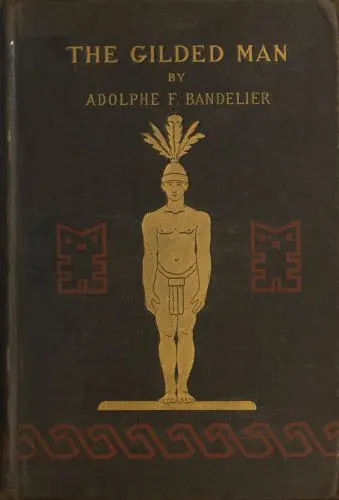
The Gilded Man (El Dorado) and other pictures of the Spanish occupancy of America
Adolph Francis Alphonse Bandelier
THE CLASSIC COLLECTION · 1890
"The Delight Makers" by Adolph Francis Alphonse Bandelier is a historical novel written in the late 19th century. The book focuses on the Pueblo Indians of New Mexico, especially emphasizing their traditions, culture, and the setting of their ancient cave-dwellings. The story unfolds through the experiences of its young characters, primarily Okoya and his younger brother Shyuote, as they navigate their lives intertwined with the rich historical tapestry of their ancestors. The beginning of "The Delight Makers" introduces the setting of the Tyuonyi, a valley home to the ancestors of the Queres tribe. It describes the geographical features of the area, detailing the natural beauty and the caves that served as dwellings for the Pueblo people. As the narrative opens, we meet Okoya, a young man engaged in fishing while interacting with his younger brother Shyuote, revealing their sibling dynamic and hinting at a deeper storyline involving cultural secrets and the influence of the Koshare—mischievous and revered figures in Pueblo society known to enact rituals. This opening sets the tone for a blend of historical insight and personal drama, aiming to explore the lives of the Pueblo Indians prior to European contact.
Introduction adapted from the source catalogue; source summaries may be automatically generated.
Free to read · English · 153,901 words · No account needed
MAKE TIME FOR A GOOD BOOK
On by default. Untick to stop anonymous reading totals. Each page counts after 10 seconds in view. How this works.
Anonymous counting is on unless you have switched it off.
She lifted her head angrily, with the manifest intention of rebelling, but as soon as her eyes met the cold, determined glance of the war-chief, she felt a chill, rose, and left the room. Hoshkanyi Tihua drew a sigh of relief; he was grateful to his visitor for having so summarily despatched his formidable spouse. Then he said,--
"Umo, I have sent for you because a speech has been spoken here in this house, which belongs to my mother. That speech may be good and it may not be good, and I cared not to tell my thoughts until I had spoken to you, nashtio. The matters of which it treated belong before the council, but I do not know whether to say to you, the nashtio of the Zaashtesh, Call them together, or not." He was manifestly troubled, and fastened an uncertain glance upon the face of the other.
Topanashka very composedly answered,--
"You are as wise as I, umo; you know what your duties are. Whenever you say to me, Go and call together the council, I shall do it. If you do not tell me to do so, I shall not."
Hoshkanyi moved in his seat; the reply did not suit him. After some
hesitation he continued,--
"I know, father, that you do as the customs of the Zaashtesh require,"--he held himself erect with an attempt at pride, for he felt that in the present instance his personality and word represented customs which were law,--"but I do not know that I shall tell you so or not. Do you understand me, umo?"
"I understand your words, Tapop, but you know that I have only to act, whereas it is your office to speak."
The cool reply exasperated the little man. He retorted sharply,--
"And yet you have often spoken in the council, when your hanutsh wanted
something!"
Topanashka lifted his eyes and gazed fully, calmly, at the other; he
even suppressed a smile.
"Then it is your hanutsh, Shyuamo, that wants something this time?"
Hoshkanyi felt, as the saying is, very cheap. His secret was out; and his plan to obtain an expression of opinion from the maseua ere he came to a conclusion himself, a total failure. The latter added in a deprecating way,--
"If you do not know what to do, ask the Hotshanyi. He will give you good advice." This was just what the governor wished to avoid, but he knew that when Topanashka had once expressed his opinion it was useless to attempt to dissuade him.
After an interval of silence the civil chief looked up and said,--
Your reading position is saved on this browser. Take it to another device with a library code. Reading pages adapt to text, rather than matching a printed edition.
Adolph Francis Alphonse Bandelier
Adolph Francis Alphonse Bandelier
Adolph Francis Alphonse Bandelier
Adolph Francis Alphonse Bandelier
BEHIND THE BOOK
This eBook is for the use of anyone anywhere in the United States and most other parts of the world at no cost and with almost no restrictions whatsoever. You may copy it, give it away or re-use it under the terms of the Project Gutenberg License included with this eBook or online at www.gutenberg.org. If you are not located in the United States, you will have to check the laws of the country where you are located before using this eBook. Read the source licence.
The original source file, including credits and licence, is retained by this library. Request an original-format copy at no charge. Please include the book title and Project Gutenberg identifier #18310.
KEEP YOUR CURIOSITY GOING
Cécile Tormay

Moritz Busch
Coulson Kernahan
John L. Ransom

Maurice Baring
Frances Wright