THE CLASSIC COLLECTION✦An outlaw’s diary: the CommuneCLASSIC FREE BOOKS
An outlaw’s diary: the Commune
Cécile Tormay
THE CLASSIC COLLECTION · 1915
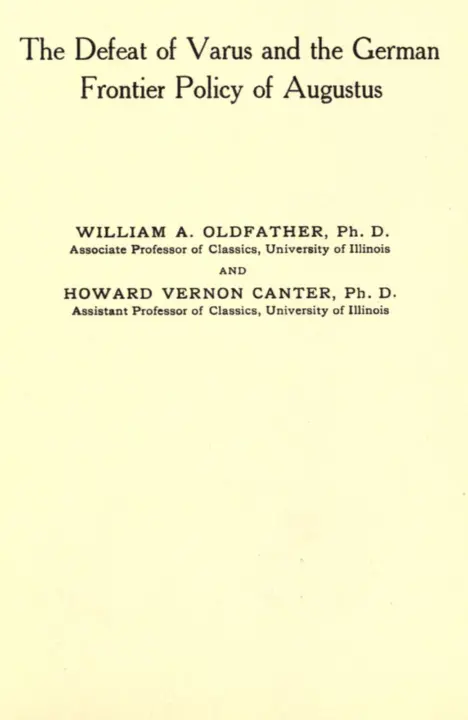
"The Defeat of Varus and the German Frontier Policy of Augustus" by W. A. Oldfather et al. is a historical account written in the early 20th century. This monograph revisits and critiques the well-established narratives surrounding the significant Roman defeat at the Battle of Teutoburg Forest in 9 A.D. It seeks to offer a new interpretation of the events leading to this battle and its implications for Augustus's policies towards the Germanic tribes. The opening of the work introduces the authors' motivations and perspectives on the historical narrative surrounding the defeat of Varus, emphasizing their dissatisfaction with traditional interpretations. They outline their objectives and methodology, reiterating the influences of past scholarship on the current understanding of the conflict. They express intent to analyze historical sources critically, revealing inconsistencies and biases in the accounts from ancient historians, and aim to establish that Augustus’s actual intentions with respect to Germanic conquest were more nuanced than commonly perceived. Overall, it sets up a detailed study focused on unraveling the complexities of Roman-Germanic relations and the long-term consequences of Varus's defeat.
Introduction adapted from the source catalogue; source summaries may be automatically generated.
Free to read · English · 46,184 words · No account needed
MAKE TIME FOR A GOOD BOOK
On by default. Untick to stop anonymous reading totals. Each page counts after 10 seconds in view. How this works.
Anonymous counting is on unless you have switched it off.
[1] Augustus und seine Zeit, Leipzig, 1891, I, p. 1069.
[2] Röm. Gesch., V. p. 24 (6th ed. 1909); cf. Die germanische Politik des Augustus (originally in Im Neuen Reich, 1871, pp. 537-556), p. 14: “Die Unterwerfung Germaniens, kräftig begonnen, und sieben Jahre hindurch beharrlich ... geführt.” Other representative expressions of opinion among recent writers may be found: R. von Poehlmann (in Pflugk-Harttung’s Weltgeschichte, 1910, I, p. 516); E. Kornemann (in Gercke-Norden’s Einleitung in die Altertumsw., 1912, III, p. 208); E. Kornemann, “Zu dem Germanenkriege unter Augustus,” Klio, IX (1909), p. 449. On the basis of Tiberius’ campaigns (4-6 A. D.) he speaks also of “die gewaltigen Anstrengungen Roms zur Unterwerfung Germaniens”; H. F. Pelham, Outlines of Roman History, 1905, p. 460; H. Stuart Jones, The Roman Empire, 1913, p. 34; C. H. Hayes, Sources Relating to the Germanic Invasions, 1909, p. 64.
[3] Ibid., p. 28. So J. Beloch, Griech. Gesch.², I, 1 (1912), Einleit., p. 14, says that not only was the attempt made but that Germany was actually subjugated: “Denn Augustus hat diese Eroberung ja versucht trotz der Verfassung, die er dem Reiche gegeben hatte, und er hatte die Eroberung des Landes bis an die Elbe vollendet, als in der Teutoburger Schlacht alles Errungene zusammenbrach.”
[4] Ibid., p. 40.
[5] Ibid., p. 50.
[6] See the chapter “Die Unterwerfung Germaniens durch die Römer” in his Geschichte der Kriegskunst im Rahmen der politischen Geschichte, Berlin, 2nd edit., 1909, II, p. 47 f.
[7] Gesch. der röm. Kaiserzeit, Gotha, 1883, p. 221 f.
[8] Röm. Herrschaft in Westeuropa, Berlin, 1890, p. 110.
[9] Die Römer in Deutschland (Monographien zur Weltgeschichte, XXII), 1912, p. 8. Fischer (Armin und die Römer, Halle a. S., 1893, p. 4) is entirely correct in saying that Julius Caesar’s conflicts with the Germans were intended merely “die Germanen von Einfällen in Gallien abzuschrecken,” i. e. to frighten them and to flatter Roman pride. However, inconsistently enough, he adds that Augustus saw a hope of expansion in this direction, “und demgemäss sah er, als Adoptivsohn Cäsars, die Unterwerfung Germaniens als eine ihm vermachte heilige Pflicht an” (p. 25).
[10] See Kaiser Augustus (Monographien zur Weltgeschichte, XVII), 1902, p. 111: “bedrängte Drusus vom Unterrhein her die freien Germanen, und hatte sie bis zur Elbe unterworfen ... Tiberius ... vollendete dann in den beiden folgenden Jahren die Eroberung und ordnete die Verwaltung der neuen Provinz.”
Your reading position is saved on this browser. Take it to another device with a library code. Reading pages adapt to text, rather than matching a printed edition.
BEHIND THE BOOK
This eBook is for the use of anyone anywhere in the United States and most other parts of the world at no cost and with almost no restrictions whatsoever. You may copy it, give it away or re-use it under the terms of the Project Gutenberg License included with this eBook or online at www.gutenberg.org. If you are not located in the United States, you will have to check the laws of the country where you are located before using this eBook. Read the source licence.
The original source file, including credits and licence, is retained by this library. Request an original-format copy at no charge. Please include the book title and Project Gutenberg identifier #64462.
KEEP YOUR CURIOSITY GOING
Cécile Tormay

Moritz Busch
John L. Ransom
Frances Wright
Cécile Tormay

Mabel Potter Daggett