THE CLASSIC COLLECTION✦An outlaw’s diary: the CommuneCLASSIC FREE BOOKS
An outlaw’s diary: the Commune
Cécile Tormay
THE CLASSIC COLLECTION · 1915
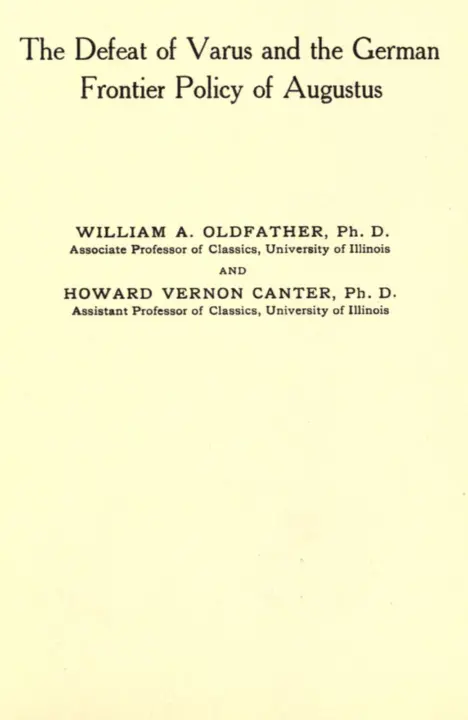
"The Defeat of Varus and the German Frontier Policy of Augustus" by W. A. Oldfather et al. is a historical account written in the early 20th century. This monograph revisits and critiques the well-established narratives surrounding the significant Roman defeat at the Battle of Teutoburg Forest in 9 A.D. It seeks to offer a new interpretation of the events leading to this battle and its implications for Augustus's policies towards the Germanic tribes. The opening of the work introduces the authors' motivations and perspectives on the historical narrative surrounding the defeat of Varus, emphasizing their dissatisfaction with traditional interpretations. They outline their objectives and methodology, reiterating the influences of past scholarship on the current understanding of the conflict. They express intent to analyze historical sources critically, revealing inconsistencies and biases in the accounts from ancient historians, and aim to establish that Augustus’s actual intentions with respect to Germanic conquest were more nuanced than commonly perceived. Overall, it sets up a detailed study focused on unraveling the complexities of Roman-Germanic relations and the long-term consequences of Varus's defeat.
Introduction adapted from the source catalogue; source summaries may be automatically generated.
Free to read · English · 46,184 words · No account needed
MAKE TIME FOR A GOOD BOOK
On by default. Untick to stop anonymous reading totals. Each page counts after 10 seconds in view. How this works.
Anonymous counting is on unless you have switched it off.
[13] That this was the custom followed for the socii and auxilia during the period of the republic is suggested by Pliny, N. H., 25, 33, 6, and the same general proportion seems to have been observed later, as Tacitus, Ann., IV, 5, in speaking of the “sociae triremes alasque et auxilia cohortium,” adds, “neque multo secus in numero virium.” Detailed information regarding the size of these auxiliary contingents is nowhere given. See Liebenam, art. “Exercitus,” Pauly-Wiss., VI, 1601, 1607. G. L. Cheesman (The Auxilia of the Roman Imperial Army, Oxford, 1914 p. 53 ff.) finds that the auxilia under Augustus were at least as numerous as the legionaries, and later became more so. He calculates 180,000 for the year 69 A. D., and 220,000 for the middle of the second century A. D. Cf. also Delbrück, op. cit., II, p. 203 (2nd ed.).
[14] Cf. Ed. Meyer, ibid., p. 909. The evidence for the enrollment of foreigners in the legions at this time is conveniently summarized by Liebenam, art. “Dilectus,” Pauly-Wiss., V, 611 ff.
[15] Mommsen, Eph. Epigr., V (1884), p. 159 ff.; Hermes, XIX (1884),
p. 1 ff., esp. p. 11.
[16] We must remember that this restriction in the recruiting sources of the legionaries was wholly an act of free choice on the part of Augustus, whatever the motive may have been. That suggested by Seeck, l. c., p. 611, does not seem very probable; it involved a change in the usage to which men had already become accustomed in the civil wars, and it was gradually but completely abandoned by his successors. There was nothing in the general conditions which required it.
[17] Rh. Mus., XLVIII (1893), p. 602 ff. His conclusions in part rest on none too certain foundations, and introduce an insufficiently motivated complexity in the system of levying troops, for Augustus at the beginning of his career used non-citizen soldiers freely, and after the defeat of Varus, of the two new legions which were raised one was a Galatian contingent, the Deiotariana, which was given citizenship and a place in the army (Mommsen, Res Gestae Divi Augusti, 2nd ed. (1885), p. 70; O. Seeck, Gesch. d. Untergangs d. ant. Welt, 3rd ed., I, p. 260), and the other was recruited from the non-citizen population of Rome (Tac., Ann., I, 31, “vernacula multitudo”; cf. Mommsen, Hermes, XIX (1884), p. 15, n. 1). Seeck’s statement of the system which he believes Augustus followed is: “Prätorianer und Stadtsoldaten rekrutirten sich aus Latium, Etrurien, Umbrien, und den frühesten Bürgercolonien; den übrigen Italikern sind die Legionen zugewiesen, den Bürgern der Provinz die Freiwilligencohorten; aus den Libertinen setzen sich die Mannschaften der Flotte und der Feuerwehr zusammen; die Nichtbürger bilden Cohorten und Alen und einen Theil der Flotte.”
Your reading position is saved on this browser. Take it to another device with a library code. Reading pages adapt to text, rather than matching a printed edition.
BEHIND THE BOOK
This eBook is for the use of anyone anywhere in the United States and most other parts of the world at no cost and with almost no restrictions whatsoever. You may copy it, give it away or re-use it under the terms of the Project Gutenberg License included with this eBook or online at www.gutenberg.org. If you are not located in the United States, you will have to check the laws of the country where you are located before using this eBook. Read the source licence.
The original source file, including credits and licence, is retained by this library. Request an original-format copy at no charge. Please include the book title and Project Gutenberg identifier #64462.
KEEP YOUR CURIOSITY GOING
Cécile Tormay

Moritz Busch
John L. Ransom
Frances Wright
Cécile Tormay

Mabel Potter Daggett