THE CLASSIC COLLECTION✦An outlaw’s diary: the CommuneCLASSIC FREE BOOKS
An outlaw’s diary: the Commune
Cécile Tormay
THE CLASSIC COLLECTION · 1915
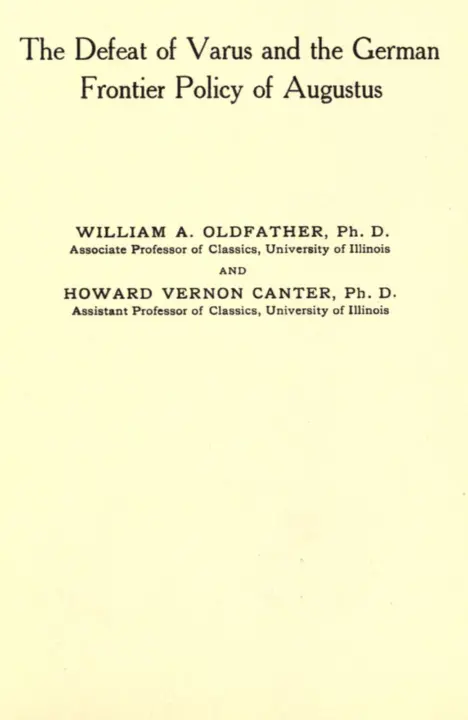
"The Defeat of Varus and the German Frontier Policy of Augustus" by W. A. Oldfather et al. is a historical account written in the early 20th century. This monograph revisits and critiques the well-established narratives surrounding the significant Roman defeat at the Battle of Teutoburg Forest in 9 A.D. It seeks to offer a new interpretation of the events leading to this battle and its implications for Augustus's policies towards the Germanic tribes. The opening of the work introduces the authors' motivations and perspectives on the historical narrative surrounding the defeat of Varus, emphasizing their dissatisfaction with traditional interpretations. They outline their objectives and methodology, reiterating the influences of past scholarship on the current understanding of the conflict. They express intent to analyze historical sources critically, revealing inconsistencies and biases in the accounts from ancient historians, and aim to establish that Augustus’s actual intentions with respect to Germanic conquest were more nuanced than commonly perceived. Overall, it sets up a detailed study focused on unraveling the complexities of Roman-Germanic relations and the long-term consequences of Varus's defeat.
Introduction adapted from the source catalogue; source summaries may be automatically generated.
Free to read · English · 46,184 words · No account needed
MAKE TIME FOR A GOOD BOOK
On by default. Untick to stop anonymous reading totals. Each page counts after 10 seconds in view. How this works.
Anonymous counting is on unless you have switched it off.
Nevertheless, from a careful consideration of the foregoing opinions, which have been selected merely as representative of a very large number of similar expressions, we may discover a strikingly universal belief that before the battle of the Teutoburg forest Augustus was attempting the conquest of Germany; that the disaster which overtook the legions of Varus in this battle caused him to give up his plans, and to renounce all hope of making Germany a province[22]. Most historians claim in addition that Arminius was the preserver of the German nationality, and that his victory over Varus was a turning point in the world’s history. So Seeck[23]: “Der Sieg des Armin hat es für alle Zeiten verhindert, dass auch die Germanen Bürger des Reiches wurden und so den Keim gerettet, aus dem künftig die Völkerwanderung und mit ihr eine neue Welt erwachsen sollte.” Gardthausen[24] states the same belief in still stronger terms: “Wenn wir daher jetzt, also beinahe nach 2000 Jahren, noch von einer deutschen Nation reden, wenn es noch heute eine deutsche Sprache gibt, so ist das ohne Frage, zum grossen Theile, das Verdienst des Arminius ... kurz, die Entwickelung der deutschen Geschichte und in beschränkterem Masse auch der Weltgeschichte wäre eine andere geworden, wenn Arminius nicht zur rechten Zeit den Kampf mit dem Varus aufgenommen und wenn er nicht später—was noch schwerer war—den Siegespreis der Freiheit gegen Germanicus vertheidigt hätte.” The debt of the German nation, and the world at large, to Arminius, is proclaimed again and again in monographs, remarkable as exhibitions of patriotic fervor, but at times wanting in scientific spirit and in the objective temper that should characterize estimates of historical significance.[25] Mommsen and Koepp may be cited as the most distinguished representatives of the view that the battle of the Teutoburg forest is a turning point in national destinies, an ebbing in the tide of Rome’s sway over the world, a shifting of the bounds of Roman rule from the Elbe to the Rhine and the Danube.[26] Koepp is the more guarded. He says[27], “Seit dieser Niederlage scheint Roms Macht, auf dieser Seite wenigstens, zurückzuebben, und wie ein Wendepunkt der Weltgeschichte erscheint diese Schlacht im Teutoburger Walde.” But this view has currency elsewhere than in the writings of German authors. Thomas Arnold voices it[28] with all the extravagance that characterizes rash generalizations: “The victory of Arminius deserves to be reckoned among those signal deliverances which have affected for centuries the happiness of mankind; and we may regard the destruction of Quintilius Varus, and his three legions, on the bank of the Lippe, as second only in the benefits derived from it to the victory of Charles Martel at Tours over the invading host of the Mohammedans.” We find it, as one might expect, in a text of such unscientific character as that of Creasy[29], the motto for whose discussion is an epigrammatic sentence taken from the epitomator Florus, “Hac clade factum, ut imperium quod in littore oceani non steterat, in ripa Rheni fluminis staret.” And we need feel no surprise that this view is perpetuated in such a compilation as that of P. V. N. Meyers.[30] Here and there, however, are to be found writers who warn against such a sweeping generalization. So Eduard Meyer, who has been quoted above.[31] Ferrero too shows a saner historical view when he says[32]: “Historians have long been accustomed to regard the defeat of Varus as one of the ‘decisive’ battles of the world, and as an event which may be said to have changed the course of history. It is said, that if Varus had not been overthrown, Rome would have preserved her grip upon the territory from the Rhine to the Elbe and would have romanised it as she did Gaul: the prospects of a Germanic nationality and civilization would have been as impossible as those of a Celtic nationality and civilization after the defeat of Vercingetorix. Thus the defeat of Teutoburg is said to have saved Germanism even as that of Alesia was the ruin of the old Celtic nationalism. This straightforward line of argument, however, touches the sinuous course of reality only at a few points, and those far distant from one another. It is always a dangerous task, in dealing with history, to say what might have happened, in view of the considerable difficulty involved in the attempt to explain what did happen.”[33] It should be observed also that such a generalization involves the assumption that the German nation developed as it did because of its liberation from Roman influence, whereas it may properly be argued that the so-called liberation was instrumental in separating Germany for centuries from civilizing contact with Rome. For it is a fact that the early Germans made no progress whatever, left no literature, no monument, no memory of themselves until they again came into relations with that great transmitter of civilization, Rome, in the person of Rome’s new representative, Charlemagne.[34]
Your reading position is saved on this browser. Take it to another device with a library code. Reading pages adapt to text, rather than matching a printed edition.
BEHIND THE BOOK
This eBook is for the use of anyone anywhere in the United States and most other parts of the world at no cost and with almost no restrictions whatsoever. You may copy it, give it away or re-use it under the terms of the Project Gutenberg License included with this eBook or online at www.gutenberg.org. If you are not located in the United States, you will have to check the laws of the country where you are located before using this eBook. Read the source licence.
The original source file, including credits and licence, is retained by this library. Request an original-format copy at no charge. Please include the book title and Project Gutenberg identifier #64462.
KEEP YOUR CURIOSITY GOING
Cécile Tormay

Moritz Busch
John L. Ransom
Frances Wright
Cécile Tormay

Mabel Potter Daggett