THE CLASSIC COLLECTION✦An outlaw’s diary: the CommuneCLASSIC FREE BOOKS
An outlaw’s diary: the Commune
Cécile Tormay
THE CLASSIC COLLECTION · 1915
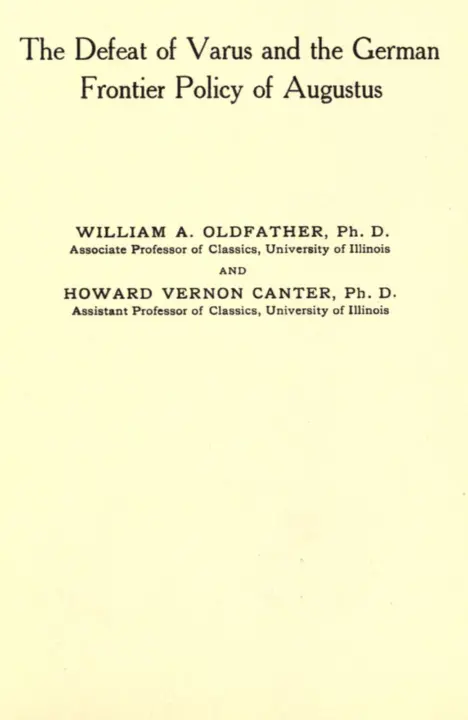
"The Defeat of Varus and the German Frontier Policy of Augustus" by W. A. Oldfather et al. is a historical account written in the early 20th century. This monograph revisits and critiques the well-established narratives surrounding the significant Roman defeat at the Battle of Teutoburg Forest in 9 A.D. It seeks to offer a new interpretation of the events leading to this battle and its implications for Augustus's policies towards the Germanic tribes. The opening of the work introduces the authors' motivations and perspectives on the historical narrative surrounding the defeat of Varus, emphasizing their dissatisfaction with traditional interpretations. They outline their objectives and methodology, reiterating the influences of past scholarship on the current understanding of the conflict. They express intent to analyze historical sources critically, revealing inconsistencies and biases in the accounts from ancient historians, and aim to establish that Augustus’s actual intentions with respect to Germanic conquest were more nuanced than commonly perceived. Overall, it sets up a detailed study focused on unraveling the complexities of Roman-Germanic relations and the long-term consequences of Varus's defeat.
Introduction adapted from the source catalogue; source summaries may be automatically generated.
Free to read · English · 46,184 words · No account needed
MAKE TIME FOR A GOOD BOOK
On by default. Untick to stop anonymous reading totals. Each page counts after 10 seconds in view. How this works.
Anonymous counting is on unless you have switched it off.
[1] The great interest in the story of Arminius and his victory has led to an examination of the sources by many investigators. The following is a partial list of the works of which use has been made:
Knoke, Die Kriegszüge des Germanicus in Deutschland, Berlin, 1887, pp. 4-17; 63-82. Knoke, Die Kriegszüge des Germanicus in Deutschland: Nachtrag, Berlin, 1889, pp. 19-31; 174-189. Knoke, Fleckeisens Jahrbr. f. Phil., CXXXIX (1889), pp. 361-368. Delbrück, Gesch. der Kriegskunst, II, p. 65 f. Koepp, Die Römer in Deutschland, p. 25 f. Koepp, Westfalen, I, p. 35. Von Ranke, Weltgeschichte, III, 2, p. 272 f. Höfer, Die Varusschlacht, Leipzig, 1888, pp. 133-166. Asbach, Rhein. Jahrbr., LXXXV (1888), pp. 14-54. Deppe, Rhein. Jahrbr., LXXXVII (1889), p. 53 f. Riese, Das rhein. Germanien in der antiken Litteratur, Leipzig, 1892, pp. 39-84. Riese, Forsch. zur Gesch. der Rheinlande in der Römerzeit, Frankfurt a. M., 1889. Mommsen, Röm. Gesch., V, 41. Gardthausen Augustus, II, 802. Wilisch, Neue Jahrbr. f. d. kl. Alter., XXIII (1909), p. 322 f. Hayes, Sources Relating to the Germanic Invasions, New York, 1909, p. 36 f. Wolf, Die That des Arminius, Berlin, pp. 9-13. Winkelsesser, De Rebus Divi Augusti in Germania Gestis, Detmold, pp. 42 f. Edmund Meyer, Untersuchungen über die Schlacht im Teutoburger Walde, Berlin, 1893, p. 56 f.
[2] For details of his life, and an estimate of Dio as a writer, see Schwartz, Pauly-Wissowa, R. E., VI (1899), p. 1684 f.; Christ-Schmidt, Gesch. der griech. Literatur⁵, 1913, II, 2, p. 629 f.; Wachsmuth, Einleitung in das Studium der alten Gesch., 1895, pp. 596-601; Peter, Die gesch. Lit. über die röm. Kaiserzeit, 1897, II, 84-101.
[3] Schwartz, loc. cit.: “Die Schlachtbeschreibungen Dios sind ausnahmslos rhetorische Schildereien ohne jeden Wert.... Ein drastischer Beweis, wie unmöglich es dem im Praktischen verständigen Manne war, als Schriftsteller den Bann der Schultheorie zu durchbrechen.”
[4] As an example of this tendency Christ (l. c.) cites 40, 41, where Dio writes a whole chapter of rhetorically effective scenes on the surrender of Vercingetorix and his last meeting with Caesar, whereas his source, Caes., B. G., VII, 8, has only “Vercingetorix deditur.”
[5] For Velleius as a historian, see Schanz, Röm. Literaturgesch., II, 2 (1913), p. 255 f.; Wachsmuth, p. 60 f.; Peter, I, 382 f.
[6] Velleius, II, 104, 3.
[7] Norden, Antike Kunstprosa, I, p. 302: “Velleius ist für uns der erste, der, jedes historisches Sinnes bar, Geschichte nur vom Standpunkt des Rhetors geschrieben hat.”
[8] Rossbach, Pauly-Wissowa, R. E., VI, pp. 2761-70; Wachsmuth, p. 610 f.; Peter, II, 278 f.; Schanz, III (1896), p. 56 f.; Eussner, Philol., 37 (1872), pp. 130-136.
Your reading position is saved on this browser. Take it to another device with a library code. Reading pages adapt to text, rather than matching a printed edition.
BEHIND THE BOOK
This eBook is for the use of anyone anywhere in the United States and most other parts of the world at no cost and with almost no restrictions whatsoever. You may copy it, give it away or re-use it under the terms of the Project Gutenberg License included with this eBook or online at www.gutenberg.org. If you are not located in the United States, you will have to check the laws of the country where you are located before using this eBook. Read the source licence.
The original source file, including credits and licence, is retained by this library. Request an original-format copy at no charge. Please include the book title and Project Gutenberg identifier #64462.
KEEP YOUR CURIOSITY GOING
Cécile Tormay

Moritz Busch
John L. Ransom
Frances Wright
Cécile Tormay

Mabel Potter Daggett