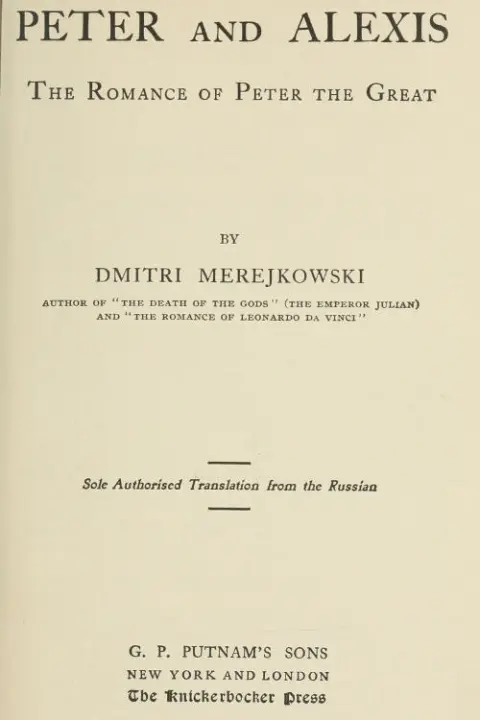
Peter and Alexis: The Romance of Peter the Great
Dmitry Sergeyevich Merezhkovsky
THE CLASSIC COLLECTION · 1901
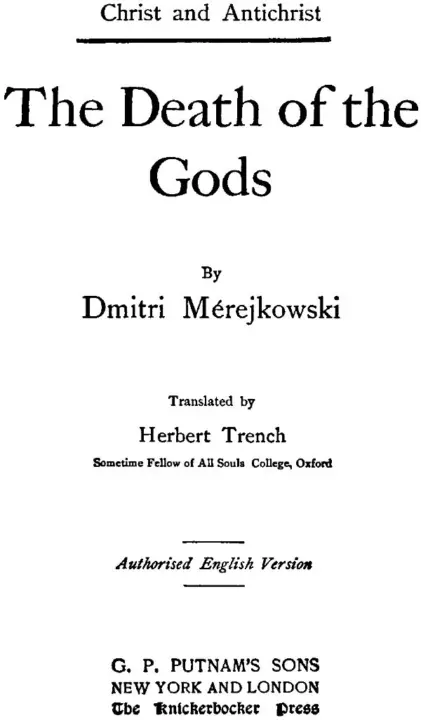
"The Death of the Gods" by Dmitry Merezhkovsky is a novel first published in 1895. It chronicles Roman Emperor Julian's doomed attempt to restore pagan worship against the rise of Christianity during his reign from 361 to 363. The first installment of "The Christ and Antichrist" trilogy, it explores the conflict between two truths: Christianity's heavenly spirituality and Paganism's earthly sensuality. Through Julian's spiritual struggle, Merezhkovsky examines humanity's suffering born from the clash between spirit and flesh, creating Russia's first Symbolist novel.
Introduction adapted from the source catalogue; source summaries may be automatically generated.
Free to read · English · 106,005 words · No account needed
MAKE TIME FOR A GOOD BOOK
On by default. Untick to stop anonymous reading totals. Each page counts after 10 seconds in view. How this works.
Anonymous counting is on unless you have switched it off.
And with a contemptuous smile he threw his surplice around him like the cynic mantle of Diogenes.
Some bishops were beginning to speak in favour of a universal creed in which mutual concession should be made, when the Arian Narcissus of Neronia, a profound expert in all statutes, creeds, and canons of the councils, intervened in discussion. He was a man little liked, suspected of adultery and usury, but admired by everyone for his theological erudition.
"That is a flat heresy!" he declared decisively.
"Why is it a heresy?" demanded several voices.
"Because the assizes of Paphlagonia have already so laid it down."
"The assizes of Paphlagonia?" repeated the desperate bishops; "we had clean forgotten them. What is to be done now?"
"May God have pity on us miserable sinners!" the good bishop Ozius was muttering; "I can no longer understand anything; I can't get out of the labyrinth; my head is buzzing, my ears singing with Greek words; I'm walking in a fog and don't know myself what I believe in and what I disbelieve; what is heresy and what is not.... Jesus help us!... We are falling into the snares of the Devil."
At that moment the hubbub and clamour ceased. The bishop Ursatius of Singidion, one of the Emperor's favourites, mounted the tribune. He was holding in his hand a long scroll of parchment. Two silentiarii, having mended their fine pens of Egyptian reed, got ready to write down the conciliar debate. Ursatius read out the message of the Emperor to the bishops--
"Constantius, the triumphant, glorious, and eternal Augustus, to all bishops assembled in this council...."
The Emperor demanded the dismissal of Athanasius, the patriarch of Alexandria, whom he called the most useless of men, the traitor, the accomplice of the insolent and abominable Magnentius.
The courtiers, Valentine, Eusebius, Axentius, hastened to sign the
scroll. But a murmur arose.
"It is all a damnable device; a trick of the Arians! We will not let
our patriarch suffer...."
"The Emperor calls himself eternal ... nobody is eternal but God! It is a mockery of holy things."
Constantius, lurking behind the curtain, heard this last speech distinctly. Thrusting the hangings roughly by, he pushed unexpectedly into the hall. The lances of the guard surrounded him. His face expressed anger. A heavy silence fell upon the throng.
"What is it, what is it?" the blind Ozius kept whispering in restless
perplexity.
"Fathers," the Emperor began, bridling his anger, "allow me, the servant of the Most High, to use my zeal under His providence to a successful issue. Athanasius is a rebel, the chief violator of universal concord and oecumenical peace."
Your reading position is saved on this browser. Take it to another device with a library code. Reading pages adapt to text, rather than matching a printed edition.
Dmitry Sergeyevich Merezhkovsky
BEHIND THE BOOK
This eBook is for the use of anyone anywhere in the United States and most other parts of the world at no cost and with almost no restrictions whatsoever. You may copy it, give it away or re-use it under the terms of the Project Gutenberg License included with this eBook or online at www.gutenberg.org. If you are not located in the United States, you will have to check the laws of the country where you are located before using this eBook. Read the source licence.
The original source file, including credits and licence, is retained by this library. Request an original-format copy at no charge. Please include the book title and Project Gutenberg identifier #46492.
KEEP YOUR CURIOSITY GOING
Cécile Tormay

Moritz Busch
Coulson Kernahan
John L. Ransom

Maurice Baring
Frances Wright