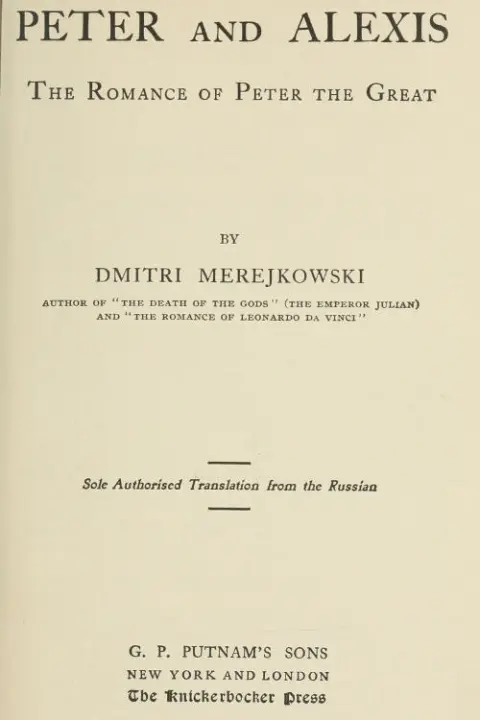
Peter and Alexis: The Romance of Peter the Great
Dmitry Sergeyevich Merezhkovsky
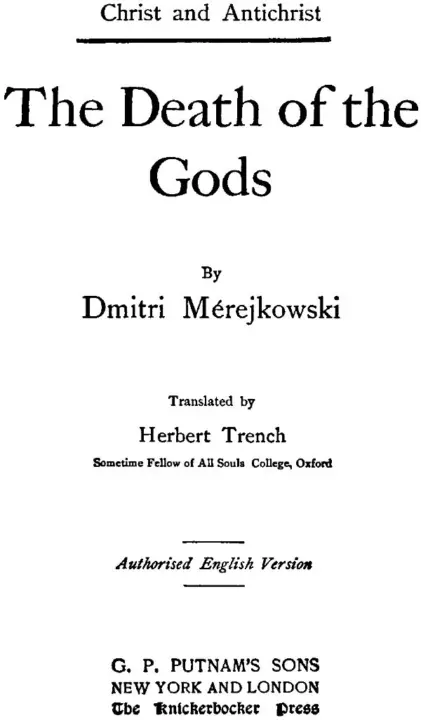
THE CLASSIC COLLECTION · 1901
"The Death of the Gods" by Dmitry Merezhkovsky is a novel first published in 1895. It chronicles Roman Emperor Julian's doomed attempt to restore pagan worship against the rise of Christianity during his reign from 361 to 363. The first installment of "The Christ and Antichrist" trilogy, it explores the conflict between two truths: Christianity's heavenly spirituality and Paganism's earthly sensuality. Through Julian's spiritual struggle, Merezhkovsky examines humanity's suffering born from the clash between spirit and flesh, creating Russia's first Symbolist novel.
Introduction adapted from the source catalogue; source summaries may be automatically generated.
Free to read · English · 106,005 words · No account needed
MAKE TIME FOR A GOOD BOOK
On by default. Untick to stop anonymous reading totals. Each page counts after 10 seconds in view. How this works.
Anonymous counting is on unless you have switched it off.
At his feet, in an uncomfortable but respectful attitude, a red-faced man sat, panting. His bald head was fringed with grey hair, brushed towards the temples. He was the centurion of the eighth centuria, Publius Aquila.
Farther off, twelve soldiers, stretched on the floor, were playing at
knuckle-bones.
"By Hercules!" cried Scuda, "I'd rather be the meanest beggar in Constantinople than the first man in a mouse-trap like this. Can you call this an existence, Publius? Answer me honestly. Is this living? To think that outside barracks and camps the future has nothing in store for one; that one must rot in this sickening marsh without ever catching a glimpse of the world again!"
"Yes," assented Publius; "it's a fact that life here isn't precisely gay; but on the other hand, it's peaceful!"
The knuckle-bones pre-occupied the attention of the old captain. Pretending to listen to the gossipings of his superior officer, and fully to agree with the drift of his remarks, he followed with an interested eye the game of the legionaries. He said to himself, "If the red aims well, he'll certainly win."
However, by way of politeness, Publius asked Scuda, with a show of
attention--
"Why, by the way, have you brought down on yourself the indignation of
the Prefect Helvidius?"
"A woman, a friend of mine, was at the bottom of it, a girl...."
And Marcus Scuda, in a fit of garrulous intimacy, confided to the ear of the old centurion that the Prefect, "that old goat of a Helvidius," had grown jealous on account of the special favours conferred on him, Marcus, by a certain frail lady, a Lydian.
Now Scuda wanted, by rendering some important service, to win back the good-will of the Prefect; and he had resolved upon a plan.
Not far from Cæsarea, in the fortress of Macellum, dwelt Julian and Gallus, the cousins of the reigning Emperor Constantius, and the nephews of Constantine the Great. These two were the last representatives of the luckless house of the Flavii. On his accession to the throne, fearing rivals, Constantius had assassinated his uncle, the father of Julian and Gallus, Julian Constantius, the brother of Constantine. But Julian and Gallus themselves had been spared, and imprisoned in the solitary castle of Macellum, where they lived oppressed by perpetual fear of death. In great perplexity, knowing that the new Emperor loathed the two orphans who reminded him of his crime, Helvidius, Prefect of Cæsarea, desired, but dreaded, to divine the will of his master.
Your reading position is saved on this browser. Take it to another device with a library code. Reading pages adapt to text, rather than matching a printed edition.
Dmitry Sergeyevich Merezhkovsky
BEHIND THE BOOK
This eBook is for the use of anyone anywhere in the United States and most other parts of the world at no cost and with almost no restrictions whatsoever. You may copy it, give it away or re-use it under the terms of the Project Gutenberg License included with this eBook or online at www.gutenberg.org. If you are not located in the United States, you will have to check the laws of the country where you are located before using this eBook. Read the source licence.
The original source file, including credits and licence, is retained by this library. Request an original-format copy at no charge. Please include the book title and Project Gutenberg identifier #46492.
KEEP YOUR CURIOSITY GOING
Cécile Tormay

Moritz Busch
Coulson Kernahan
John L. Ransom

Maurice Baring
Frances Wright