THE CLASSIC COLLECTION✦Karl GrierCLASSIC FREE BOOKS
Karl Grier
Louis Tracy
THE CLASSIC COLLECTION · 1910
"The de Bercy Affair" by Gordon Holmes is a fictional murder mystery written in the early 20th century. The story revolves around the tragic death of Mademoiselle de Bercy, a popular French actress, and the subsequent investigation led by Chief Inspector Winter and his colleague Inspector Clarke. As the narrative unfolds, suspicions are raised about various characters, including American millionaire Rupert Osborne, who was romantically linked to the deceased. The opening portion of the novel introduces readers to the tense atmosphere at New Scotland Yard, where Chief Inspector Winter is preoccupied with the disappearance of Inspector Furneaux and the investigation into the brutal murder. The details surrounding Mademoiselle de Bercy's death are chilling, as her body is discovered by a distressed housemaid, with signs of a violent struggle. Notably, a stone tool, which is later central to the investigation, is found at the crime scene. As the narrative progresses, various leads are explored, highlighting the complexities of the case and setting the stage for deeper investigations into the actress’s past and the people connected to her, including the mysterious Anarchists on the loose. The intricate plot is established early, ensuring the reader's intrigue as they anticipate the revelation of the murderer and their motives.
Introduction adapted from the source catalogue; source summaries may be automatically generated.
Free to read · English · 73,934 words · No account needed
MAKE TIME FOR A GOOD BOOK
On by default. Untick to stop anonymous reading totals. Each page counts after 10 seconds in view. How this works.
Anonymous counting is on unless you have switched it off.
The girl went on with her work, plying the paper-knife, now jotting down a memorandum, now placing two or more kindred letters together: for every hospital and institution wrote to Osborne, everyone who wanted money for a new flying machine, or had a dog or a hunter to sell, or intended to dine and speechify, and send round the hat.
"It's quite a large batch of correspondence," Furneaux remarked.
"Half of these," the girl said, "are letters of abuse from people who never heard Mr. Osborne's name till the day after that poor woman was killed. All England has convicted him before he is tried. It seems unfair."
"Yes, no doubt. But 'to understand is to pardon,' as the proverb says. They have to think something, and when there is only one thing for them to think, they think it--meaning well. It will blow over in time. Don't you worry."
"Oh, I!--What do I care what forty millions of vermin choose to say or
think?"
She pouted her pretty lips saucily.
"Forty--millions--of vermin," cried Furneaux; "that's worse than
Carlyle."
Hylda Prout's swift hands plied among her papers. She made no answer; and Furneaux suddenly stood up.
"Well, you will mention to the valet and the others how the matter stands as to Mr. Osborne. He is simply avoiding the crowd--that is all. Good-day."
Hylda Prout rose, too, and Furneaux saw now how tall she was, well-formed and lithe, with a somewhat small face framed in that nest of red hair. Her complexion was spoiled and splashed with freckles, but otherwise she was dainty-featured and pretty--mouth, nose, chin, tiny, all except the wide-open eyes.
"So," she said to Furneaux as she put out her hand, "you won't let me know where Mr. Osborne is? I may want to write to him on business."
"Why, didn't I tell you that he didn't write to me?"
"That was only a blind."
"Dear me! A blind.... It is the truth, Miss Prout."
"Tell that to someone else."
"What, don't you like the truth?"
"All right, keep the information to yourself, then."
"Good-by--I mustn't allow myself to dally in this charming room with the linnets, the sunlight, and the lady."
For a few seconds she seemed to hesitate. Then she said suddenly: "Yes, it's very nice in here. That door there leads into the morning room, and that one yonder, at the side----"
Her voice dropped and stopped; Furneaux appeared hardly to have heard, or, if hearing, to be merely making conversation.
"Yes, it leads where?" he asked, looking at her. Now, her eyes, too,
dropped, and she murmured:
"Into the museum."
Your reading position is saved on this browser. Take it to another device with a library code. Reading pages adapt to text, rather than matching a printed edition.
Louis Tracy
Louis Tracy
Louis Tracy
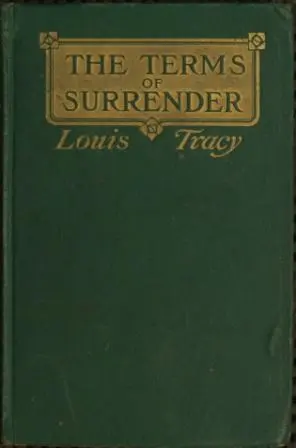
Louis Tracy
BEHIND THE BOOK
This eBook is for the use of anyone anywhere in the United States and most other parts of the world at no cost and with almost no restrictions whatsoever. You may copy it, give it away or re-use it under the terms of the Project Gutenberg License included with this eBook or online at www.gutenberg.org. If you are not located in the United States, you will have to check the laws of the country where you are located before using this eBook. Read the source licence.
The original source file, including credits and licence, is retained by this library. Request an original-format copy at no charge. Please include the book title and Project Gutenberg identifier #50705.
KEEP YOUR CURIOSITY GOING
Coulson Kernahan

Maurice Baring
Frances Wright
Cécile Tormay

Frederic Jesup Stimson

W. H. P. (William Henry Pope) Jarvis