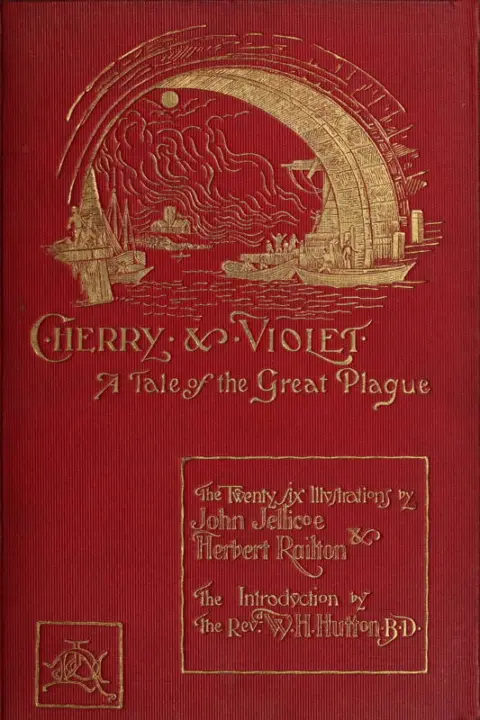
Cherry & Violet: A Tale of the Great Plague
Anne Manning
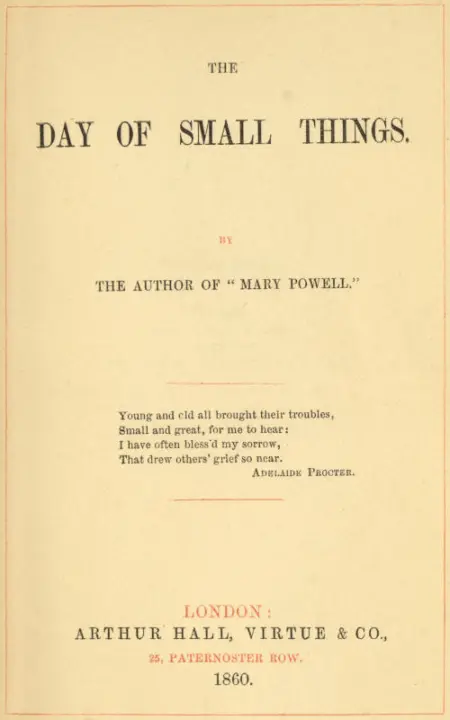
THE CLASSIC COLLECTION · 1860
"The Day of Small Things" by Anne Manning is a novel written in the mid-19th century. The story follows Mrs. Cheerlove, an invalid who reflects on her life as she engages in deep conversations and shared experiences with her maid, Phillis, and the young neighbors visiting her. The narrative emphasizes themes of resilience, the joys of quiet observations, and the significance of small blessings in a life touched by sorrow and loss. At the start of the narrative, Mrs. Cheerlove is confined to her sofa due to a long illness, yet she expresses gratitude for the simple pleasures and mercies she has received during her time of confinement. We see glimpses of her thoughtful character as she contemplates the beauty of her surroundings and the quiet company of Phillis. Their dialogues reveal their personalities, with Mrs. Cheerlove's reflective nature contrasting with Phillis's practical demeanor. The opening establishes a rich tapestry of pastoral life, social interactions, and the deeper emotional currents that flow through the lives of the characters, inviting readers to explore the themes of loss, companionship, and the appreciation of life's small things.
Introduction adapted from the source catalogue; source summaries may be automatically generated.
Free to read · English · 43,461 words · No account needed
MAKE TIME FOR A GOOD BOOK
On by default. Untick to stop anonymous reading totals. Each page counts after 10 seconds in view. How this works.
Anonymous counting is on unless you have switched it off.
“Not always, I dare say, being young and thin-skinned; but the less you annoy yourself that way, the better. So you think I am better off than you?”
“O yes, with this nice quiet room. You may smile, Mrs. Cheerlove, but really it’s no joke, when a fellow wants to do a bit of writing, to have a parcel of children swarming about him, making all sorts of noises. It has such an effect sometimes on me, I know, that I am ready to declare the supreme good to be, a quiet room and leisure to use it.”
“To write poetry in it—hey, Harry?”
“Well—perhaps—yes.”
“Meanwhile, the high stool in the office—”
“May better be filled by some one else, ma’am.”
“While you—
“‘Invoke the Muses, and improve your vein.’
Do you admire Coleridge?”
“Oh immensely! Did he make that line?”
“Ah, Harry, you betray your ignorance of your favourite craft! No; the
line is Waller’s.”
Harry blushed, and said, “You laid a trap for me.”
“Not intentionally, I assure you. But my transition was rather abrupt. I was going to direct your attention to a favourite passage of mine in Coleridge’s works.”
“Pray do,” said Harry, rising alertly and going to the book-case.
“Bring me the second of those two small volumes, lettered ‘Biographia
Literaria.’”
“Oh, it’s in prose!” said Harry, in disappointment.
“Prose by a poet, however—which, by-the-way, was the name of a pretty, though not very shining, little work by James Montgomery, that has now dropped out of sight. Here is the passage: it begins—‘Never pursue literature as a trade. With one exception’ (I think he means Southey) ‘I have never known an individual healthy or happy without some regular employment which does not depend on the will of the moment—’”
“Bah!” muttered Harry.
“‘But can be carried on so far mechanically that an average quantum of health, spirit, and intellectual exertion are requisite for its faithful discharge.’”
“I’m surprised Coleridge should say that.”
“Well, Harry, he was one of the many people who preach better than they practise. Hear me to the end—‘Three hours of leisure, unalloyed by any alien anxiety, and looked forward to with delight as a change and recreation, will suffice to realize in literature a larger product of what is truly genial than weeks of compulsion.’”
“Ay, I never write but when the fit is on me,” murmured Harry.
Your reading position is saved on this browser. Take it to another device with a library code. Reading pages adapt to text, rather than matching a printed edition.
Anne Manning
Anne Manning
Anne Manning
Anne Manning
BEHIND THE BOOK
This eBook is for the use of anyone anywhere in the United States and most other parts of the world at no cost and with almost no restrictions whatsoever. You may copy it, give it away or re-use it under the terms of the Project Gutenberg License included with this eBook or online at www.gutenberg.org. If you are not located in the United States, you will have to check the laws of the country where you are located before using this eBook. Read the source licence.
The original source file, including credits and licence, is retained by this library. Request an original-format copy at no charge. Please include the book title and Project Gutenberg identifier #62219.
KEEP YOUR CURIOSITY GOING
Coulson Kernahan

Maurice Baring
Frances Wright
Cécile Tormay

Frederic Jesup Stimson

W. H. P. (William Henry Pope) Jarvis