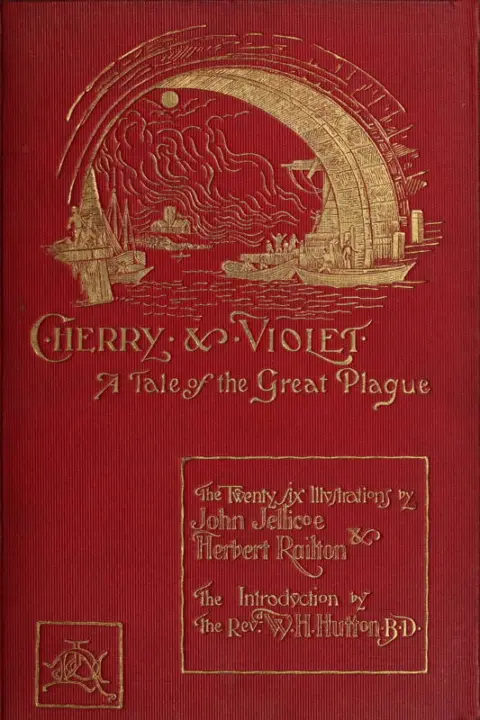
Cherry & Violet: A Tale of the Great Plague
Anne Manning
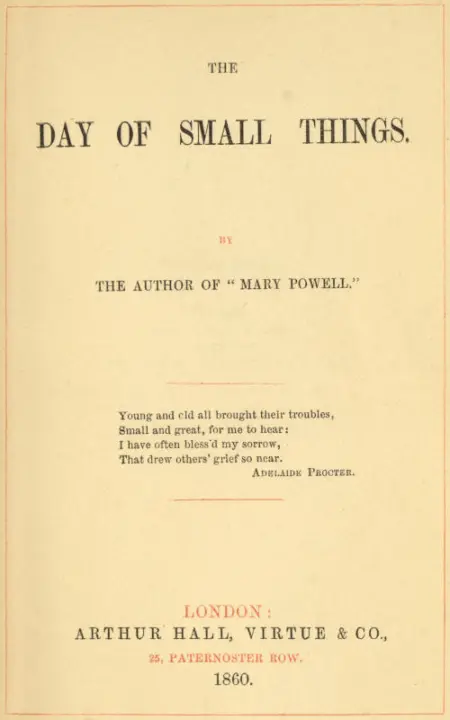
THE CLASSIC COLLECTION · 1860
"The Day of Small Things" by Anne Manning is a novel written in the mid-19th century. The story follows Mrs. Cheerlove, an invalid who reflects on her life as she engages in deep conversations and shared experiences with her maid, Phillis, and the young neighbors visiting her. The narrative emphasizes themes of resilience, the joys of quiet observations, and the significance of small blessings in a life touched by sorrow and loss. At the start of the narrative, Mrs. Cheerlove is confined to her sofa due to a long illness, yet she expresses gratitude for the simple pleasures and mercies she has received during her time of confinement. We see glimpses of her thoughtful character as she contemplates the beauty of her surroundings and the quiet company of Phillis. Their dialogues reveal their personalities, with Mrs. Cheerlove's reflective nature contrasting with Phillis's practical demeanor. The opening establishes a rich tapestry of pastoral life, social interactions, and the deeper emotional currents that flow through the lives of the characters, inviting readers to explore the themes of loss, companionship, and the appreciation of life's small things.
Introduction adapted from the source catalogue; source summaries may be automatically generated.
Free to read · English · 43,461 words · No account needed
MAKE TIME FOR A GOOD BOOK
On by default. Untick to stop anonymous reading totals. Each page counts after 10 seconds in view. How this works.
Anonymous counting is on unless you have switched it off.
Poor mamma, she wrote, was taken out more dead than alive. The guides, who were all goodness, made a kind of litter for her with their poles and ropes, and threw their jackets over it. But when papa lifted her on it, she thrilled all over, like a little bird that had fallen out of its nest; and Arbell turned her head away, for it made her feel quite sick. So then, as the litter shook her so much, they only took her at first to the nearest châlet, where there was a very kind bergere, and where they laid her on the heaps of hay for the cows; and a guide ran off to the inn for an English doctor, whose name they happened to have seen on the travellers’ book.
Meanwhile, poor mamma lay quite still; but her face was very cold. And once, when Arbell softly wiped the damp off it, and kissed her white lips, she whispered, “Good girl—dear Arbell!” so that she was ready to burst into tears, but knew she must not. And when the guide came back, he said the English doctor had gone up Mont Blanc; and Arbell could not help thinking, how stupid and wicked it was of him, to be running after such nonsense when he had better have been minding his own business. However, he brought back mamma’s maid, Kent, and a famous mountain doctor, who ordered a sheep to be killed, and mamma to be immediately wrapped in its skin, which they did. And, directly afterwards, a most benevolent-looking pasteur (such another as Oberlin must have been!) came in, with a face of kind concern; and, after a few words with papa, it was arranged that the guides should carry mamma, who seemed in a stupor, to the pasteur’s house, which was close at hand, and much quieter than the inn. So they did so; Arbell holding her vinaigrette to mamma’s nose all the way, though she could not be quite sure it was of any use. When they got there, such a neat old housekeeper came out, quite a Louise Schepler; for the pasteur, like Oberlin, was a widower. But he had no children, which was all the better, because the house was all the quieter. So they took dear mamma into the best bed-room, where everything was very poor and scanty, but very clean; and just then, the English doctor arrived, who had only gone a little way up the mountain after all, and, strange to say! had turned back under an unaccountable impression that he was wanted. And he said, as mamma was in the skin, she might as well remain in it, though it was queer practice; and then he gave her a very strong restorative from the pasteur’s medicine-chest, which made her open her eyes and look slowly round, without turning her head; and then he said “You’ll do, my dear madam, now;” and nodded and smiled, and went off talking to papa quite cheerfully. But, oh! he was quite mistaken; for, as soon as the effect of the restorative subsided, mamma felt herself rapidly sinking, and told papa she knew she was going to die. Then poor papa, who had returned quite hopeful, lost all his courage again, and cried bitterly; and called the pasteur, who came in, and knelt down, and offered, oh! such a heavenly prayer! Even Kent, who understood not one word of it, said the very tone was prayer. He began “Seigneur!”—and then made a great stop—and then began again, “Seigneur! Holy and just are all thy ways! Who shall not magnify thee, O God most holy?” And then went on. Arbell’s head was too confused for her to retain it in her memory, but it sank into her heart, and seemed to carry her up to heaven, quite away from all earthly, vexing cares. And when they rose from their knees, dear mamma was asleep, and slept for hours! Meanwhile, papa got some very strong jelly from the inn, and when she woke, he or Kent gave her a spoonful of it from time to time, which she seemed to like; for, when she wanted more, she opened her lips without speaking; and Arbell or Kent watched her lips all night long, taking it by turns to sleep a little on the ground. Poor papa got a little rest in the easy-chair in the parlour. The doctor—Dr. Thorpe—had come very early in the morning, and twice more in the course of the day, and was excessively kind, though at first he had seemed rather brusque. He said all the travellers, inn-people, and guides were deeply interested in mamma, and prayers were being offered up. (Poor Arbell’s writing was here smeared with tears). An English lady had sent Arbell a little text-book, which was a great comfort to her, and so were many hymns she remembered; but she had her little diamond Bible in her pocket already; there were parts in it that she thought she should never be able to read hereafter without their bringing to mind that little whitewashed room, with table, chairs, and drawers painted sea-green, and cold, uncarpeted floor. She was going to bed that night—papa insisted on it; but at four o’clock Kent would change places with her; the pasteur was going to sleep in the easy-chair. She would soon write to dear Miss Prout again.
Your reading position is saved on this browser. Take it to another device with a library code. Reading pages adapt to text, rather than matching a printed edition.
Anne Manning
Anne Manning
Anne Manning
Anne Manning
BEHIND THE BOOK
This eBook is for the use of anyone anywhere in the United States and most other parts of the world at no cost and with almost no restrictions whatsoever. You may copy it, give it away or re-use it under the terms of the Project Gutenberg License included with this eBook or online at www.gutenberg.org. If you are not located in the United States, you will have to check the laws of the country where you are located before using this eBook. Read the source licence.
The original source file, including credits and licence, is retained by this library. Request an original-format copy at no charge. Please include the book title and Project Gutenberg identifier #62219.
KEEP YOUR CURIOSITY GOING
Coulson Kernahan

Maurice Baring
Frances Wright
Cécile Tormay

Frederic Jesup Stimson

W. H. P. (William Henry Pope) Jarvis