
Cherry & Violet: A Tale of the Great Plague
Anne Manning
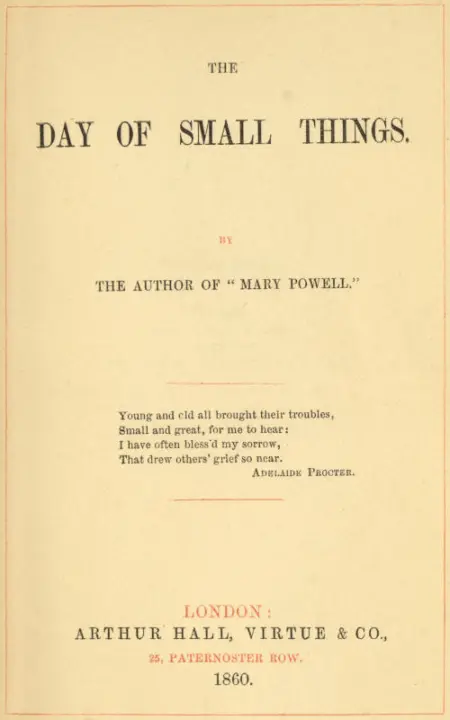
THE CLASSIC COLLECTION · 1860
"The Day of Small Things" by Anne Manning is a novel written in the mid-19th century. The story follows Mrs. Cheerlove, an invalid who reflects on her life as she engages in deep conversations and shared experiences with her maid, Phillis, and the young neighbors visiting her. The narrative emphasizes themes of resilience, the joys of quiet observations, and the significance of small blessings in a life touched by sorrow and loss. At the start of the narrative, Mrs. Cheerlove is confined to her sofa due to a long illness, yet she expresses gratitude for the simple pleasures and mercies she has received during her time of confinement. We see glimpses of her thoughtful character as she contemplates the beauty of her surroundings and the quiet company of Phillis. Their dialogues reveal their personalities, with Mrs. Cheerlove's reflective nature contrasting with Phillis's practical demeanor. The opening establishes a rich tapestry of pastoral life, social interactions, and the deeper emotional currents that flow through the lives of the characters, inviting readers to explore the themes of loss, companionship, and the appreciation of life's small things.
Introduction adapted from the source catalogue; source summaries may be automatically generated.
Free to read · English · 43,461 words · No account needed
MAKE TIME FOR A GOOD BOOK
On by default. Untick to stop anonymous reading totals. Each page counts after 10 seconds in view. How this works.
Anonymous counting is on unless you have switched it off.
“Ah, you are too sensible to do that! To make the best of untoward circumstances, even if they result from our own fault, is not only more prudent, but more noble, than to sit down in Ugolino-like despair.”
“‘Ugolino-like’ is the light in that sentence!” said he. “Excuse me, but you know I make a business of these things, and often have to insert them in heavy articles. That phrase will fix your saying in my memory, and I will endeavour to act upon it too—without which I know you won’t care a half-penny for my remembering, or even quoting it. Ah, Mrs. Cheerlove, you owe the world something from your pen. Why not try?” in a tone intended to be very insinuating.
“There are plenty in the field already,” said I.
“Plenty, such as they are,” responded he. “Plenty—and too many! Oh, if you knew the curiosities of literature that I hand over to my subeditor! Now, I’ll read you a morçeau I received this morning. I think I might defy you to make anything like it. The subject is the fancy bazaar our ladies are going to hold at Willington:—
“‘Come to Willington bazaar!
Enter, neighbours, near and far.
Pure delightsome harmony
Welcomes all friends cheerily;
Crops of pretty useful things,
Philanthropy to market brings;
Sympathy with ardour buys,
What industrial zeal supplies!’
Do you think you could have done that? No, I’m sure you couldn’t!”
And, in excellent humour with himself and with me, he took leave, waving his hand towards the book-case as he went, and saying:—
“An elegant sufficiency! content,
Retirement, rural quiet, friendship, books,
Progressive virtue, and approving heaven!”
Guido Sorelli beautifully says, “I learn the depth to which I have sunk, from the length of chain let down to updraw me.” Without inquiring into his wisdom in publishing his “Confessions,” (written for the public, apparently, and not for Silvio Pellico), they certainly have, as he says, a tendency to bring the reader to “a saddening contemplation of his own heart.” This sensitive Italian was converted by the Bible, which he, in the first instance, read for an hour daily, and completely perused in three months; never opening it without first praying for humility. Nor did he ever commence his daily seven hours’ task of translating “Paradise Lost,” without imploring divine assistance; and the last four years of his ten years’ labour of love, “bore the impress,” he tells us, “of a happiness almost beatific.” Such are the silent, satisfying rewards which high and virtuous art bestows on her children, wholly independent of fame or emulation. Like the exquisite fanatico per la musica, in La Motte Fouquè’s “Violina,” they “carry on their labour as a sweet secret, hardly knowing at the time whether they shall ever feel inclined to make it known.” The “last infirmity of noble minds,” is their seeking the confirmatory sentence of some master-spirit, whom the voice of the world, and their own cordial acknowledgment, place far above themselves. All beyond this opens the door to rivalry and uneasiness. Once know that you do a thing well, and the calm pleasure needs not to be augmented by everybody’s owning it.
Your reading position is saved on this browser. Take it to another device with a library code. Reading pages adapt to text, rather than matching a printed edition.
Anne Manning
Anne Manning
Anne Manning
Anne Manning
BEHIND THE BOOK
This eBook is for the use of anyone anywhere in the United States and most other parts of the world at no cost and with almost no restrictions whatsoever. You may copy it, give it away or re-use it under the terms of the Project Gutenberg License included with this eBook or online at www.gutenberg.org. If you are not located in the United States, you will have to check the laws of the country where you are located before using this eBook. Read the source licence.
The original source file, including credits and licence, is retained by this library. Request an original-format copy at no charge. Please include the book title and Project Gutenberg identifier #62219.
KEEP YOUR CURIOSITY GOING
Coulson Kernahan

Maurice Baring
Frances Wright
Cécile Tormay

Frederic Jesup Stimson

W. H. P. (William Henry Pope) Jarvis