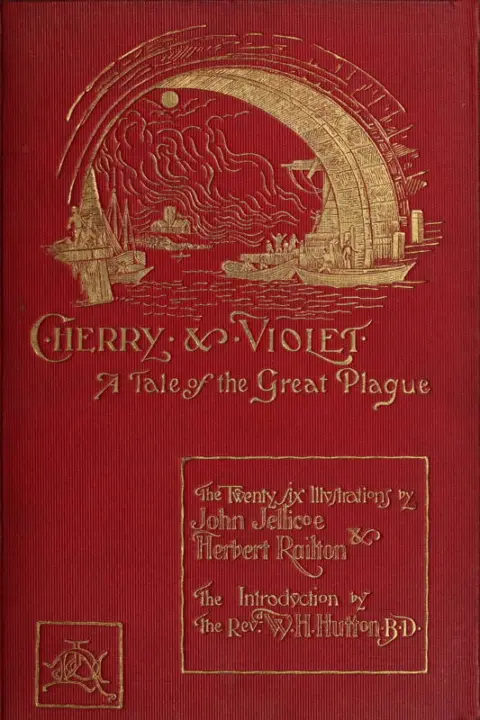
Cherry & Violet: A Tale of the Great Plague
Anne Manning
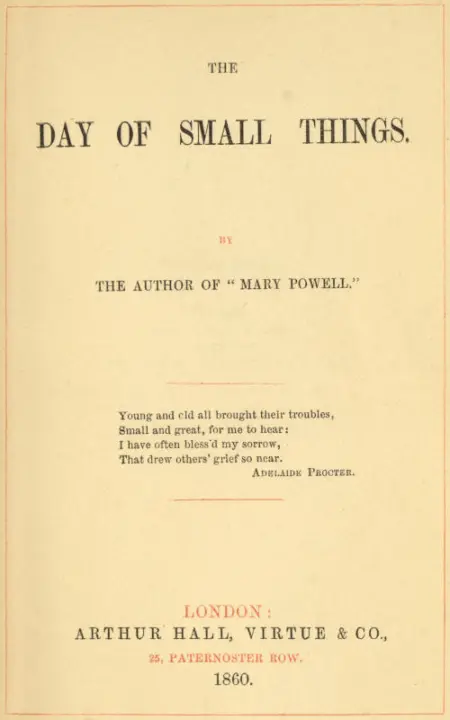
THE CLASSIC COLLECTION · 1860
"The Day of Small Things" by Anne Manning is a novel written in the mid-19th century. The story follows Mrs. Cheerlove, an invalid who reflects on her life as she engages in deep conversations and shared experiences with her maid, Phillis, and the young neighbors visiting her. The narrative emphasizes themes of resilience, the joys of quiet observations, and the significance of small blessings in a life touched by sorrow and loss. At the start of the narrative, Mrs. Cheerlove is confined to her sofa due to a long illness, yet she expresses gratitude for the simple pleasures and mercies she has received during her time of confinement. We see glimpses of her thoughtful character as she contemplates the beauty of her surroundings and the quiet company of Phillis. Their dialogues reveal their personalities, with Mrs. Cheerlove's reflective nature contrasting with Phillis's practical demeanor. The opening establishes a rich tapestry of pastoral life, social interactions, and the deeper emotional currents that flow through the lives of the characters, inviting readers to explore the themes of loss, companionship, and the appreciation of life's small things.
Introduction adapted from the source catalogue; source summaries may be automatically generated.
Free to read · English · 43,461 words · No account needed
MAKE TIME FOR A GOOD BOOK
On by default. Untick to stop anonymous reading totals. Each page counts after 10 seconds in view. How this works.
Anonymous counting is on unless you have switched it off.
“Just so; I lose all sense of fatigue and crossness.”
“Can’t you hear a mental trumpet?”
“What?”
“Something within, that shall cheer you along your path.”
“Ah! I fear I can’t.”
And the poor little woman, gushing into grief, told me, the acquaintance of an hour, such a tale of woe, that my tears flowed with hers. She was comforted by my sympathy, and said, clasping her hands—
“Oh that I could see my path clear!”
“I think you will,” said I, though my hope was not very sanguine.
“Sometimes I think I’ll write to mamma. I sit down and write her such long letters, and after all, don’t send them.”
“Excellent!” said I.
She looked surprised.
“Your plan is excellent,” I pursued. “By pouring out your griefs to your dearest and earliest friend, you relieve your own mind; and, by not sending your letter, you give no pain to hers.”
“But it is merely from irresolution,” said she.
“Never mind what it is from. The plan is excellent. Continue to write to her—write often—pour out your whole heart—and then put the letter carefully away till the next day; enjoy the comfort of finding what a strong case you made out—and, having done so, burn it!”
“Are you joking?” said she.
“No, as serious as possible. It is no joking matter.”
“Well, I thought you were too kind to do so. And, dear me! I feel a great deal better for this talk. Things don’t look so dark; and yet they have not in the least altered.”
“Only a different hue is thrown over them. That makes all the difference sometimes;—and answers as well as if the things were altered; as long as we can make the hue last.”
“Only,” said she, beginning to chafe a little, again, “one cannot bear to
be put upon.”
“Ah,” said I, gently putting my hand on her arm, “the Christian will even bear to be put upon, be it ever so much, and, for his Master’s sake, bear it patiently; and when he has so far subdued his feelings as to be able so to do, how glorious the triumph, the happiness, and peace that will take possession of his heart!”[3]
“Oh!” said she, after a moment’s deep pause, “what a cordial! How could you say it? What a mind you must have!”
“Not at all,” stammered I, feeling dreadfully stupid and humiliated.
Your reading position is saved on this browser. Take it to another device with a library code. Reading pages adapt to text, rather than matching a printed edition.
Anne Manning
Anne Manning
Anne Manning
Anne Manning
BEHIND THE BOOK
This eBook is for the use of anyone anywhere in the United States and most other parts of the world at no cost and with almost no restrictions whatsoever. You may copy it, give it away or re-use it under the terms of the Project Gutenberg License included with this eBook or online at www.gutenberg.org. If you are not located in the United States, you will have to check the laws of the country where you are located before using this eBook. Read the source licence.
The original source file, including credits and licence, is retained by this library. Request an original-format copy at no charge. Please include the book title and Project Gutenberg identifier #62219.
KEEP YOUR CURIOSITY GOING
Coulson Kernahan

Maurice Baring
Frances Wright
Cécile Tormay

Frederic Jesup Stimson

W. H. P. (William Henry Pope) Jarvis