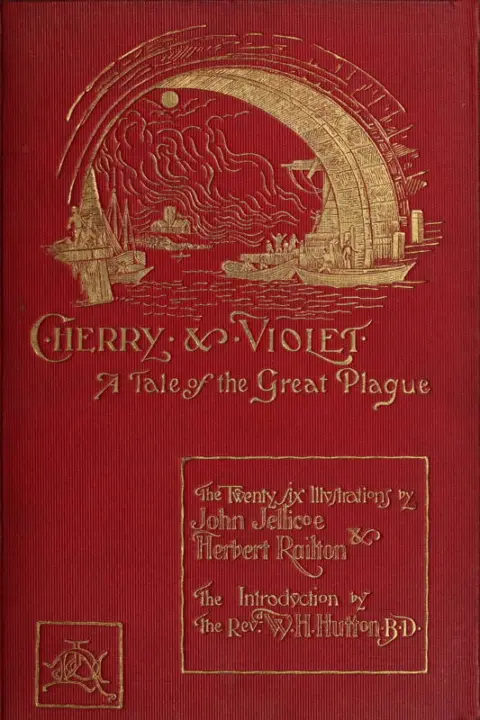
Cherry & Violet: A Tale of the Great Plague
Anne Manning
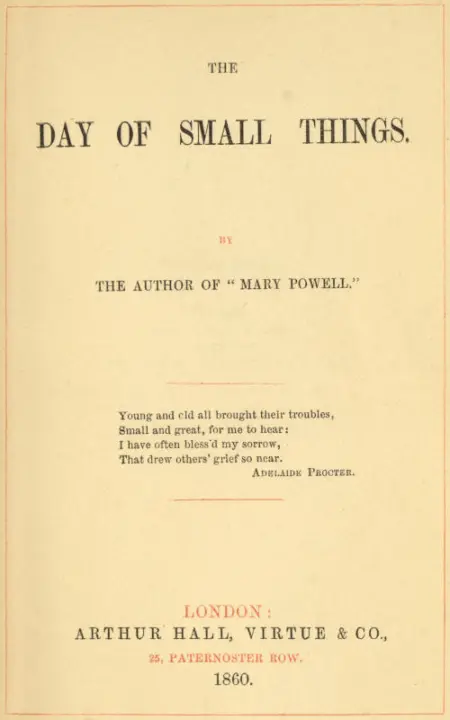
THE CLASSIC COLLECTION · 1860
"The Day of Small Things" by Anne Manning is a novel written in the mid-19th century. The story follows Mrs. Cheerlove, an invalid who reflects on her life as she engages in deep conversations and shared experiences with her maid, Phillis, and the young neighbors visiting her. The narrative emphasizes themes of resilience, the joys of quiet observations, and the significance of small blessings in a life touched by sorrow and loss. At the start of the narrative, Mrs. Cheerlove is confined to her sofa due to a long illness, yet she expresses gratitude for the simple pleasures and mercies she has received during her time of confinement. We see glimpses of her thoughtful character as she contemplates the beauty of her surroundings and the quiet company of Phillis. Their dialogues reveal their personalities, with Mrs. Cheerlove's reflective nature contrasting with Phillis's practical demeanor. The opening establishes a rich tapestry of pastoral life, social interactions, and the deeper emotional currents that flow through the lives of the characters, inviting readers to explore the themes of loss, companionship, and the appreciation of life's small things.
Introduction adapted from the source catalogue; source summaries may be automatically generated.
Free to read · English · 43,461 words · No account needed
MAKE TIME FOR A GOOD BOOK
On by default. Untick to stop anonymous reading totals. Each page counts after 10 seconds in view. How this works.
Anonymous counting is on unless you have switched it off.
Mrs. Ringwood came back, looking rather discomfited. “Dear me,” said she, “I can’t find my keys—Oh, here they are!” And carrying them off, and her cap at the same time, she presently returned with a glass of wine and a biscuit, saying, “You really must take this.”
In vain I assured her I was a water-drinker; I saw I should hurt her if I declined, and therefore took the glass, and put it to my lips, though I knew it would do me no good.
“I don’t know what I should do without a glass of wine sometimes,” said she. “I hope baby has not been troublesome.”
“O no! What a nice little fellow he is! How old is he?”
So then ensued some baby-talk, which seemed to make us much better
acquainted.
“He must be a great resource to you,” said I.
“Well, children are plagues as well as pleasures, sometimes,” said Mrs. Ringwood. “I often think people who have no families have no idea of what mothers go through.”
“That is true enough, I dare say,” said I. “But the maternal instinct is implanted to make us insensible to those troubles—or, at least, indifferent to them.”
“Oh, nobody can be indifferent to them, Mrs. Cheerlove! Duty is duty, and pleasure is pleasure; but they don’t amount to the same thing, for all that.”
This was said with an asperity which seemed to place us miles apart again. The next moment she added, “At least, time was—when I was very young, you know, and fresh married—when I believe I really did think them one and the same thing.” She gave a little laugh, to hide a tear.
“I don’t know how it may be with you,” said I, twining the baby’s little fingers round mine, “but I think in most people’s lives there are times when, all at once, they seem to break down under their burthens, and to need a friendly arm to set them up again.”
“Some have not that friendly arm,” said she, her mouth twitching. “I only wish I had. Oh my goodness, Mrs. Cheerlove!”—suddenly becoming familiar and voluble—“you’ve no idea what a life mine is! These four walls, if they had tongues, could tell strange stories!”
“Ah! what walls could not?” said I, hastening from particulars to generals. “We were not sent into this world to be happy——”
“Well, I think we were,” interrupted she; “and yours must be a strange, gloomy religion if it makes you think otherwise.”
Your reading position is saved on this browser. Take it to another device with a library code. Reading pages adapt to text, rather than matching a printed edition.
Anne Manning
Anne Manning
Anne Manning
Anne Manning
BEHIND THE BOOK
This eBook is for the use of anyone anywhere in the United States and most other parts of the world at no cost and with almost no restrictions whatsoever. You may copy it, give it away or re-use it under the terms of the Project Gutenberg License included with this eBook or online at www.gutenberg.org. If you are not located in the United States, you will have to check the laws of the country where you are located before using this eBook. Read the source licence.
The original source file, including credits and licence, is retained by this library. Request an original-format copy at no charge. Please include the book title and Project Gutenberg identifier #62219.
KEEP YOUR CURIOSITY GOING
Coulson Kernahan

Maurice Baring
Frances Wright
Cécile Tormay

Frederic Jesup Stimson

W. H. P. (William Henry Pope) Jarvis