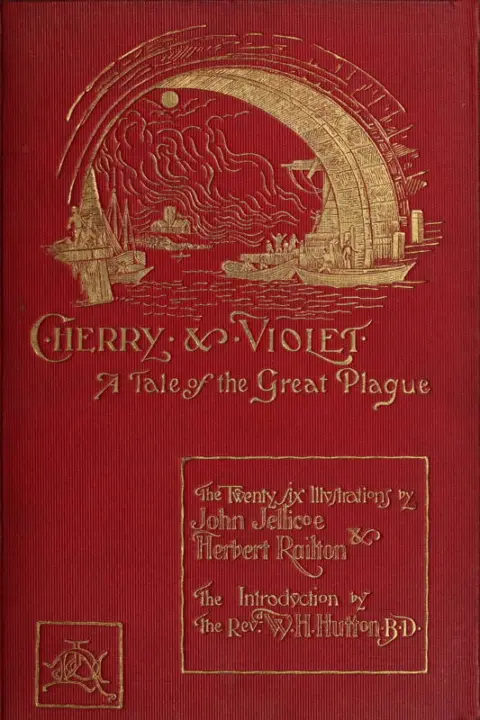
Cherry & Violet: A Tale of the Great Plague
Anne Manning
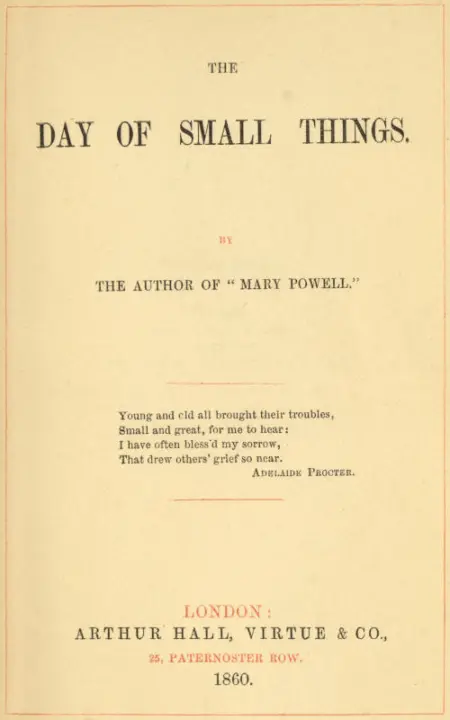
THE CLASSIC COLLECTION · 1860
"The Day of Small Things" by Anne Manning is a novel written in the mid-19th century. The story follows Mrs. Cheerlove, an invalid who reflects on her life as she engages in deep conversations and shared experiences with her maid, Phillis, and the young neighbors visiting her. The narrative emphasizes themes of resilience, the joys of quiet observations, and the significance of small blessings in a life touched by sorrow and loss. At the start of the narrative, Mrs. Cheerlove is confined to her sofa due to a long illness, yet she expresses gratitude for the simple pleasures and mercies she has received during her time of confinement. We see glimpses of her thoughtful character as she contemplates the beauty of her surroundings and the quiet company of Phillis. Their dialogues reveal their personalities, with Mrs. Cheerlove's reflective nature contrasting with Phillis's practical demeanor. The opening establishes a rich tapestry of pastoral life, social interactions, and the deeper emotional currents that flow through the lives of the characters, inviting readers to explore the themes of loss, companionship, and the appreciation of life's small things.
Introduction adapted from the source catalogue; source summaries may be automatically generated.
Free to read · English · 43,461 words · No account needed
MAKE TIME FOR A GOOD BOOK
On by default. Untick to stop anonymous reading totals. Each page counts after 10 seconds in view. How this works.
Anonymous counting is on unless you have switched it off.
“No one can say, my dear Mrs. Cheerlove, that that good and great man, Sir Isambard Brunel, lived in vain. Towards the close of his life, however, days of weakness and helplessness supervened, when he was drawn about his son’s garden in a Bath chair, on sunshiny mornings. Well, Lady Brunel told me that on those occasions he would often bid them bring him one of his favourite blue and white minor convolvuluses, and he would then examine it with his magnifying glass, till he espied the minute black insect which he was sure to find in it, soon or late. ‘See here,’ he would exclaim, ‘this little creature is so small as scarcely to be discernible, and yet the Almighty has thought it worth while to give it every function requisite for life and happiness.’ He did not think it lived in vain.”
Harry has had tea with me for the last time, though he does not go to London till the day after to-morrow. We have promised to correspond, which, I saw, pleased him; for, poor boy, he feels very homesick, now that he is actually going, and will be glad of any little glimpse of his family that I can give. I said, “How is it that you, who thought anything better than your monotonous life, are now sorry to leave home?”
“Ah! what can be more monotonous than a solitary lodging will be!” cried
Harry.
“But the romping of noisy children—the crying baby—”
“Don’t name them, please! I see now, they are not worthy to be named.”
—“Are destructive of the repose needful for literary composition,” said I, rather mischievously. “Then, Margaret’s daily practising—the surgery bell—”
“Will be sounds by distance made more sweet,” interrupted he. “Pray, Mrs. Cheerlove, have you ever taken the trouble to—ever found leisure to—dip into the little manuscript volume of poems I placed in your hands before our unhappy loss?”
Instead of giving him a straightforward answer, I opened a small book
beside me, and read:—
“‘In broad daylight and at noon,
Yesterday I saw the moon
Sailing high, but faint and white
As a schoolboy’s paper kite.
“‘In broad daylight yesterday
I read a poet’s mystic lay;
And it seemed to me, at most,
As a phantom or a ghost.’”
“Oh horrible, horrible!” cried Harry. “So then you think my verses poor and unreal? Not fire enough? or what—what is it?”
“Pause, and hear me,” continued I, reading on:—
“‘But, at length, the feverish day
Like a passion passed away;
And the night, serene and pale,
Fell on village, hill, and vale.
Your reading position is saved on this browser. Take it to another device with a library code. Reading pages adapt to text, rather than matching a printed edition.
Anne Manning
Anne Manning
Anne Manning
Anne Manning
BEHIND THE BOOK
This eBook is for the use of anyone anywhere in the United States and most other parts of the world at no cost and with almost no restrictions whatsoever. You may copy it, give it away or re-use it under the terms of the Project Gutenberg License included with this eBook or online at www.gutenberg.org. If you are not located in the United States, you will have to check the laws of the country where you are located before using this eBook. Read the source licence.
The original source file, including credits and licence, is retained by this library. Request an original-format copy at no charge. Please include the book title and Project Gutenberg identifier #62219.
KEEP YOUR CURIOSITY GOING
Coulson Kernahan

Maurice Baring
Frances Wright
Cécile Tormay

Frederic Jesup Stimson

W. H. P. (William Henry Pope) Jarvis