
Cherry & Violet: A Tale of the Great Plague
Anne Manning
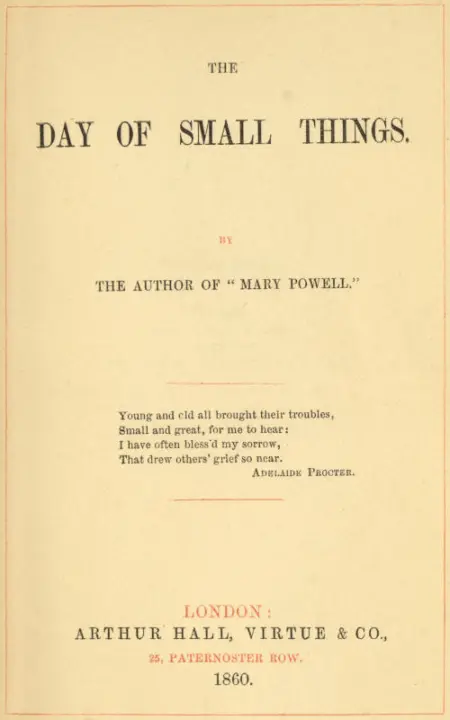
THE CLASSIC COLLECTION · 1860
"The Day of Small Things" by Anne Manning is a novel written in the mid-19th century. The story follows Mrs. Cheerlove, an invalid who reflects on her life as she engages in deep conversations and shared experiences with her maid, Phillis, and the young neighbors visiting her. The narrative emphasizes themes of resilience, the joys of quiet observations, and the significance of small blessings in a life touched by sorrow and loss. At the start of the narrative, Mrs. Cheerlove is confined to her sofa due to a long illness, yet she expresses gratitude for the simple pleasures and mercies she has received during her time of confinement. We see glimpses of her thoughtful character as she contemplates the beauty of her surroundings and the quiet company of Phillis. Their dialogues reveal their personalities, with Mrs. Cheerlove's reflective nature contrasting with Phillis's practical demeanor. The opening establishes a rich tapestry of pastoral life, social interactions, and the deeper emotional currents that flow through the lives of the characters, inviting readers to explore the themes of loss, companionship, and the appreciation of life's small things.
Introduction adapted from the source catalogue; source summaries may be automatically generated.
Free to read · English · 43,461 words · No account needed
MAKE TIME FOR A GOOD BOOK
On by default. Untick to stop anonymous reading totals. Each page counts after 10 seconds in view. How this works.
Anonymous counting is on unless you have switched it off.
“Then, if I felt very strong, I used to go on yet further, and climb quite up to the trees at the top. I used to call that (to myself), the Wood of the Holy Spirit.”
“I wonder you wasn’t afraid,” said Phillis.
“No, ‘the voice of the Lord’ seemed walking in the garden, and took away all fear. Of what should I be afraid?”
“Tramps,” said Phillis.
“I never met any.”
“That was a wonder, then,” said Phillis, “for they mostly come right away over that hill, to and from the Fox’s Hole.”
“Stay a minute, Phillis, and I will explain to you why I never was
afraid.”
“Dear me! and I’ve been awaiting and awaiting all this time,” cried Phillis, “to baste the chicken! I only stepped away from it for a moment, to give you your medicine!”
“Go, baste the chicken, then, Phillis. I beg your pardon for detaining you. I forgot how many things you have to do, and to think of. Go, Phillis, and baste the chicken.”
This is just the way she goes on from day to day. It is certainly very discouraging. An invalid finds it particularly hard to be without a sympathizer; or, at any rate, a companion that can understand one. As to calling me “ma’am,” she does not—and will not—once a week. But a Norway deal won’t take the polish of mahogany; and a rough, stout, country servant, will not convert into a Mrs. Flounce or a Mrs. Mincing. It is surprising what work she can get through—what weights she can lift. I am sure she could lift me.
The way I came to have Phillis was this. My nice maid, Hannah, married; and Jane, her successor, did not suit me at all. My energetic neighbour, Miss Burt, who is almost too bustling and busy for her friends, came in one day when I was very ill, and told me she had found me a “sterling creature,” who would suit me exactly. I had never empowered her to look out. And when I heard that this sterling creature had only lived in a farm, and afterwards with an old single gentleman, I did not feel very desirous to enter into treaty with her. Miss Burt, however, told me she had told her “there could be no harm in calling,” in which I did not quite coincide; and she enlarged so much on her fidelity, sobriety, honesty, cleanliness, and general proficiency, that I was somewhat overpowered, and agreed to see the young person when she called, if I were well enough. “Young! oh, she won’t see thirty again!” cried Miss Burt, as she swung out of the room; and indeed I believe several more years had been numbered by this “daughter of the plough.” But Phillis is exceeding sensitive on the subject. “My age is my own,” says she, shortly; “my age, and my name.” The latter, however, she told me one day, in an uncommon fit of good humour, had been given her by her father because it was in a favourite old song of his. “And when parson,” pursued Phillis, “objected that it wasn’t a Christian name, father said he should like to know whose business it was to choose the name, his or the parson’s. So there,” added Phillis, triumphantly, “I fancy father had the best on’t!”
Your reading position is saved on this browser. Take it to another device with a library code. Reading pages adapt to text, rather than matching a printed edition.
Anne Manning
Anne Manning
Anne Manning
Anne Manning
BEHIND THE BOOK
This eBook is for the use of anyone anywhere in the United States and most other parts of the world at no cost and with almost no restrictions whatsoever. You may copy it, give it away or re-use it under the terms of the Project Gutenberg License included with this eBook or online at www.gutenberg.org. If you are not located in the United States, you will have to check the laws of the country where you are located before using this eBook. Read the source licence.
The original source file, including credits and licence, is retained by this library. Request an original-format copy at no charge. Please include the book title and Project Gutenberg identifier #62219.
KEEP YOUR CURIOSITY GOING
Coulson Kernahan

Maurice Baring
Frances Wright
Cécile Tormay

Frederic Jesup Stimson

W. H. P. (William Henry Pope) Jarvis