Cherry & Violet: A Tale of the Great Plague
Anne Manning
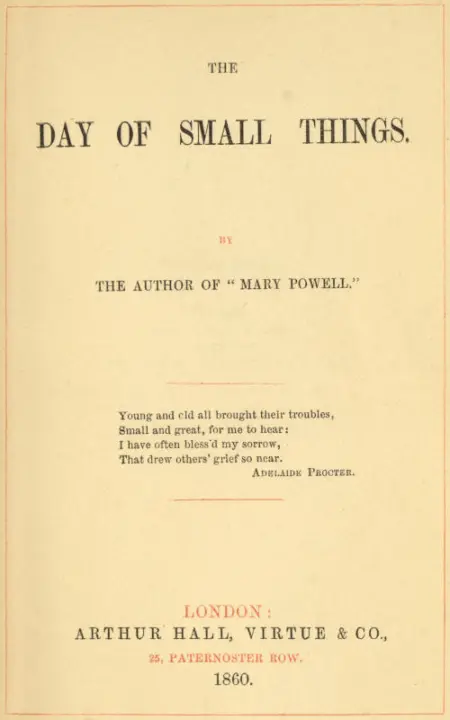
THE CLASSIC COLLECTION · 1860
"The Day of Small Things" by Anne Manning is a novel written in the mid-19th century. The story follows Mrs. Cheerlove, an invalid who reflects on her life as she engages in deep conversations and shared experiences with her maid, Phillis, and the young neighbors visiting her. The narrative emphasizes themes of resilience, the joys of quiet observations, and the significance of small blessings in a life touched by sorrow and loss. At the start of the narrative, Mrs. Cheerlove is confined to her sofa due to a long illness, yet she expresses gratitude for the simple pleasures and mercies she has received during her time of confinement. We see glimpses of her thoughtful character as she contemplates the beauty of her surroundings and the quiet company of Phillis. Their dialogues reveal their personalities, with Mrs. Cheerlove's reflective nature contrasting with Phillis's practical demeanor. The opening establishes a rich tapestry of pastoral life, social interactions, and the deeper emotional currents that flow through the lives of the characters, inviting readers to explore the themes of loss, companionship, and the appreciation of life's small things.
Introduction adapted from the source catalogue; source summaries may be automatically generated.
Free to read · English · 43,461 words · No account needed
MAKE TIME FOR A GOOD BOOK
On by default. Untick to stop anonymous reading totals. Each page counts after 10 seconds in view. How this works.
Anonymous counting is on unless you have switched it off.
“I told Arbell I wished she might be permitted to spend an hour or two with me some morning,” said I. “If I have more than one companion at a time, I can hardly do them or myself justice.”
“I am sure I wish she would come,” said Mrs. Pevensey, smiling sweetly.
“With your permission, I think she will,” said I. “May I claim it?”
“Ah, I shall be too happy,” said she; “but you don’t know Arbell.”
“Suppose, then, we say to-morrow,” said I, pertinaciously.
“To-morrow the hair-cutter is coming. Any other day.”
“The day after to-morrow, then?”
“With all my heart, if—I don’t know what Mademoiselle will say.”
“Mademoiselle seemed to think the same of you.”
“Of me? Oh, I’ve no voice in the matter! Mademoiselle has unlimited sway in the school-room. Mademoiselle is a most excellent creature. I have unbounded confidence in her. She is quite superior to her position—came to me from the Comtesse de St. Velay—has written an admirable essay on education—her brother is professor of foreign literature at Tarbes.”
“Perhaps Mademoiselle uses your name as a kind of authority.”
“Very likely,” laughing sweetly; “Mamma’s name is probably made free use of, in the school-room and nursery. I remember when, ‘I’ll tell your Mamma!’ was a terror to myself. Oh, we all go through these things in our turn. Poor, dear Arbell! there is excellent promise in her; but at present she is under a cloud. She lives in a world of her own, is proud and stubborn, and Mademoiselle says her spirit must be broken. It may be so, but I don’t wish to stand by and witness the operation.”
“I am sorry to hear you say that,” cried I, anxiously, “for I think the operation so extremely hazardous, that it ought only to take place under the mother’s eye.”
“It would affect me more,” answered she, very seriously, “than a surgical
case.”
“I can quite believe it,” replied I, with equal seriousness; “but possibly your sagacity and maternal affection united would enable you to discern that no such painful course was needed. If Arbell were a little more under your eye—”
“My dear friend,” interrupted she, “Arbell is constantly under my eye already. Do you imagine I shut myself up from my children? No, no! that would indeed be neglecting a mother’s first duty. Dry recapitulation of lessons, indeed, and endless practising, fall exclusively to the superintendence of the governess; but Arbell always learns her lessons and writes her exercises in the room with me, for hours every morning.”
Your reading position is saved on this browser. Take it to another device with a library code. Reading pages adapt to text, rather than matching a printed edition.
Anne Manning
Anne Manning
Anne Manning
Anne Manning
BEHIND THE BOOK
This eBook is for the use of anyone anywhere in the United States and most other parts of the world at no cost and with almost no restrictions whatsoever. You may copy it, give it away or re-use it under the terms of the Project Gutenberg License included with this eBook or online at www.gutenberg.org. If you are not located in the United States, you will have to check the laws of the country where you are located before using this eBook. Read the source licence.
The original source file, including credits and licence, is retained by this library. Request an original-format copy at no charge. Please include the book title and Project Gutenberg identifier #62219.
KEEP YOUR CURIOSITY GOING
Coulson Kernahan

Maurice Baring
Frances Wright
Cécile Tormay

Frederic Jesup Stimson

W. H. P. (William Henry Pope) Jarvis