THE CLASSIC COLLECTION✦The Day of Doom; Or, a Poetical Description of the Great and Last JudgementCLASSIC FREE BOOKS
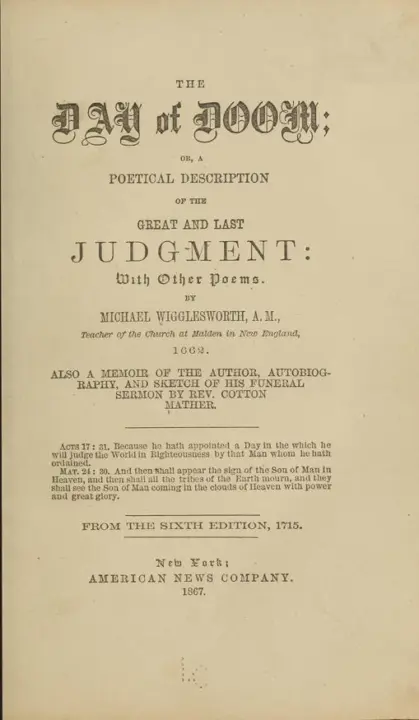
The Day of Doom; Or, a Poetical Description of the Great and Last Judgement
Michael Wigglesworth
THE CLASSIC COLLECTION · 1662
"The Day of Doom; Or, A Poetical Description of the Great and Last Judgment" by Michael Wigglesworth is a religious poem published in 1662. This Puritan bestseller depicts Judgment Day in vivid detail, describing how a vengeful God judges and sentences all mankind. The poem examines various categories of people who believe themselves excusable but are nonetheless condemned to Hell. Spanning 224 stanzas, it became phenomenally popular in colonial New England, with approximately one in twenty residents purchasing a copy.
Introduction adapted from the source catalogue; source summaries may be automatically generated.
Free to read · English · 23,376 words · No account needed
MAKE TIME FOR A GOOD BOOK
On by default. Untick to stop anonymous reading totals. Each page counts after 10 seconds in view. How this works.
Anonymous counting is on unless you have switched it off.
For what is Honor? what is Sovereignty,
Whereto men's hearts so restlessly aspire?
Whom have they crownéd with Felicity?
When did they ever satisfy desire?
The Ear of Man with hearing is not fill'd;
To see new sights still coveteth the Eye;
The craving stomach, though it may be still'd,
Yet craves again without a new supply.
All Earthly things man's cravings answer not,
Whose little heart would all the World contain,
(If all the World should fall to one man's lot)
And notwithstanding empty still remain.
The Eastern Conqueror was said to weep
When he the Indian Oce-an did view,
To see his Conquest bounded by the Deep,
And no more Worlds remaining to subdue.
Who would that man in his Enjoyment bless,
Or envy him, or covet his Estate,
Whose gettings do augment his greediness,
And make his wishes more intemperate?
Such is the wonted and the common guise
Of those on Earth that bear the greatest sway;
If with a few the case be otherwise,
They seek a Kingdom that abides for aye.
Moreover they of all the Sons of Men
That rule, and are in highest Places set,
Are most inclin'd to scorn their Bretheren,
And God himself (without great Grace) forget.
For as the Sun doth blind the gazers' eyes,
That for a time they naught discern aright,
So Honor doth befool and blind the Wise,
And their own lustre 'reaves them of their sight.
Great are their Dangers, manifold their Cares,
Through which, whilst others sleep, they scarcely Nap,
And yet are oft surpriséd unawares,
And fall unwilling into Envy's Trap.
The mean Mechanic finds his kindly rest;
All void of fear sleepeth the Country Clown;
When greatest Princes often are distrest,
And cannot sleep upon their Beds of Down.
Could Strength or Valor men Immortalize,
Could Wealth or Honor keep them from decay,
There were some cause the same to Idolize,
And give the lie to that which I do say.
But neither can such things themselves endure,
Without the hazard of a change, one hour,
Nor such as trust in them can they secure
From dismal days, or Death's prevailing pow'r.
If Beauty could the Beautiful defend
From Death's dominion, then fair Absalom
Had not been brought to such a shameful end:
But fair and foul unto the Grave must come.
If Wealth or Scepters could Immortal make,
Then, wealthy Crœsus, wherefore art thou dead?
If Warlike force which makes the World to quake,
Then why is Julius Cæsar perishéd?
Where are the Scipio's Thunderbolts of War?
Renownéd Pompey, Cæsar's Enemy?
Stout Hannibal, Rome's Terror known so far?
Great Alexander, what's become of thee?
Your reading position is saved on this browser. Take it to another device with a library code. Reading pages adapt to text, rather than matching a printed edition.
BEHIND THE BOOK
This eBook is for the use of anyone anywhere in the United States and most other parts of the world at no cost and with almost no restrictions whatsoever. You may copy it, give it away or re-use it under the terms of the Project Gutenberg License included with this eBook or online at www.gutenberg.org. If you are not located in the United States, you will have to check the laws of the country where you are located before using this eBook. Read the source licence.
The original source file, including credits and licence, is retained by this library. Request an original-format copy at no charge. Please include the book title and Project Gutenberg identifier #58716.
KEEP YOUR CURIOSITY GOING

David Patterson (Spirit) Hatch

David Patterson (Spirit) Hatch

David Patterson (Spirit) Hatch

Edwin Abbott Abbott

Richard Watson
T. G. (Theophilus Gould) Steward