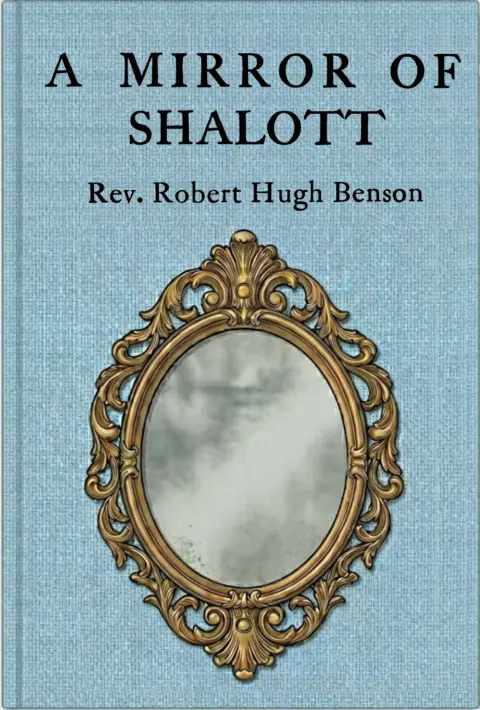
A mirror of Shalott
Robert Hugh Benson
THE CLASSIC COLLECTION · 1911
"The Dawn of All" by Robert Hugh Benson is a speculative fiction novel written in the early 20th century. The book explores the potential future of humanity through a parable that contrasts the outcomes of modern thought against ancient religious traditions. The central character, Monsignor Masterman, is introduced in a state of confusion and amnesia, awakening in a strange world where he has lost touch with his identity, exposing the conflict between faith and contemporary ideas. At the start of the narrative, Monsignor Masterman gradually regains awareness while lying in an unfamiliar setting, slowly piecing together his surroundings and memories. As he reflects on his fragmented thoughts, he realizes he has been thrust into a future society that is radically different from his previous life, notably seeing elements like state-supported Catholicism and advanced technology. Through vivid descriptions of his environment and encounters with mysterious characters, including priests and government officials, the reader witnesses his struggle to understand this new world, setting the stage for deeper explorations of faith, identity, and societal change amidst the backdrop of a seemingly Christian-dominated civilization.
Introduction adapted from the source catalogue; source summaries may be automatically generated.
Free to read · English · 87,706 words · No account needed
MAKE TIME FOR A GOOD BOOK
On by default. Untick to stop anonymous reading totals. Each page counts after 10 seconds in view. How this works.
Anonymous counting is on unless you have switched it off.
He dressed as before and breakfasted. Then, as the monk did not come, he went out to the tribune to pray and to prepare himself.
Ten minutes later the door opened quietly, and the lay-brother
who had attended on him bowed to him as he turned, in sign that
he was to come.
The monk was standing by the fireplace as he came in; he bowed very slightly. Then the two sat down.
"Tell me why you have come here, Monsignor."
The prelate moistened his lips. He was aware again of an emotion that was partly terror and partly confidence. And there was mixed with it, too, an extraordinary sense of simplicity. Conventionalities were useless here, he saw; he was expected to say what was in his heart, but at first he dared not.
"I . . . I was recommended to come," he said. "My friends thought
I needed a little rest."
The other nodded gently. He was no longer looking straight at him, the secular priest was relieved to see.
"Yes? And what form does it take?"
Still the patient hesitated. He began a sentence or two,
and stopped again.
Then the monk lifted his great head and looked straight at him.
"Be quite simple, Monsignor," he said, "you need fear nothing. You are here to be helped, are you not? Then tell me plainly."
Monsignor got up suddenly. It seemed to him that he must move about. He felt restless, as a man who has lived in twilight might feel upon coming out into sudden brilliant and healthful sunlight. He began to walk to and fro. The other said nothing, but the restless man felt that the eyes were watching and following every movement. He reflected that it was unfair to be stared at by eyes that were grey, outlined in black, and crossed by straight lids. Then he summoned his resolution.
"Father," he said, "I am unhappy altogether."
"Yes? (Sit down, please, Monsignor.)"
He sat down, and leaned his forehead on his hands.
"You are unhappy altogether," repeated the monk. "And what form
does that unhappiness take?"
Monsignor lifted his face.
"Father," he said, "you know about me? You know about my
history? . . . My memory?"
"Yes, I know all that. But it is not that which makes you unhappy?"
"No," cried the priest suddenly and impulsively, "it is not
that. I wish to God it were! I wish to God my memory would
leave me again!"
"Quietly, please."
But the other paid no attention.
"It is . . . it is the world I am living in--this brutal
world.... Father, help me."
Your reading position is saved on this browser. Take it to another device with a library code. Reading pages adapt to text, rather than matching a printed edition.
Robert Hugh Benson
Robert Hugh Benson
Robert Hugh Benson
Robert Hugh Benson
BEHIND THE BOOK
This eBook is for the use of anyone anywhere in the United States and most other parts of the world at no cost and with almost no restrictions whatsoever. You may copy it, give it away or re-use it under the terms of the Project Gutenberg License included with this eBook or online at www.gutenberg.org. If you are not located in the United States, you will have to check the laws of the country where you are located before using this eBook. Read the source licence.
The original source file, including credits and licence, is retained by this library. Request an original-format copy at no charge. Please include the book title and Project Gutenberg identifier #11626.
KEEP YOUR CURIOSITY GOING

David Patterson (Spirit) Hatch

David Patterson (Spirit) Hatch

David Patterson (Spirit) Hatch
Coulson Kernahan

Maurice Baring
Frances Wright