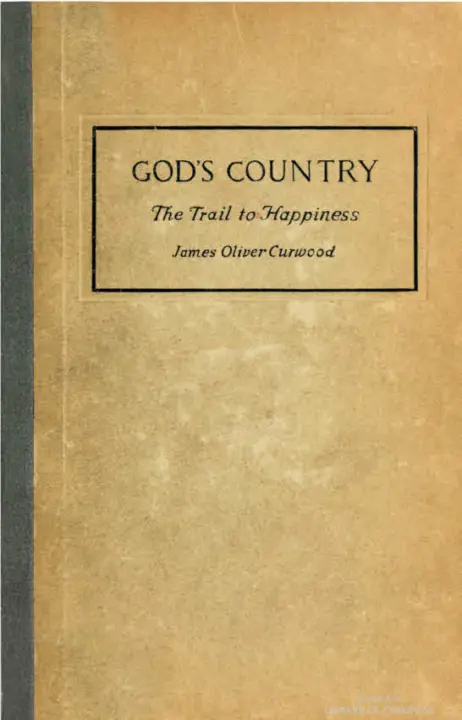
God’s Country: The Trail to Happiness
James Oliver Curwood
THE CLASSIC COLLECTION · 1910
"The Danger Trail" by James Oliver Curwood is a novel written during the early 20th century. The story revolves around Jack Howland, an ambitious engineer, as he embarks on a pioneering railroad project in the wild and treacherous landscapes of northern Canada. The narrative explores themes of danger, romance, and self-discovery amid the harsh beauty of the wilderness, bringing Howland face-to-face with mysteries, peril, and a captivating woman named Meleese. At the start of the novel, we are introduced to Jack Howland who experiences a thrilling sense of adventure and dreams of success as he stands on the brink of a significant project—the building of the Hudson Bay Railroad. His journey quickly becomes complicated when he encounters a mysterious girl, Meleese, whose presence stirs unexpected emotions within him. The opening chapters depict Howland's excitement, his ambitious plans, and the sense of danger that looms as he becomes entangled in deeper mysteries surrounding Meleese, his life being threatened by unknown adversaries. The tension escalates further when he narrowly escapes an attack in the wilderness, pushing him into a whirlwind of danger and romance that challenges his pragmatic outlook on life.
Introduction adapted from the source catalogue; source summaries may be automatically generated.
Free to read · English · 51,814 words · No account needed
MAKE TIME FOR A GOOD BOOK
On by default. Untick to stop anonymous reading totals. Each page counts after 10 seconds in view. How this works.
Anonymous counting is on unless you have switched it off.
He stood silent, eyes partly closed, still as if in prayer. When he sank into his chair again the look of hatred had gone from his face.
"It was the father, and I killed him, M'seur--killed him slowly, telling him of what he had done as I choked the life from him; and then, a little at a time, I let the life back into him, forcing him to tell me where I would find his son, the slayer of Meleese's father. And after that I closed on his throat until he was dead, and my dogs dragged his body through three hundred miles of snow that the others might look on him and know that he was dead. That was six years ago, M'seur."
Howland was scarcely breathing.
"And the other--the son--" he whispered densely. "You found him,
Croisset? You killed him?"
"What would you have done, M'seur?"
Howland's hands gripped those that guarded the little parcel.
"I would have killed him, Jean."
He spoke slowly, deliberately.
"I would have killed him," he repeated.
"I am glad of that, M'seur."
Jean was unwrapping the buckskin, fold after fold of it, until at last there was revealed a roll of paper, soiled and yellow along the edges.
"These pages are taken from the day-book at the post where the woman lived," he explained softly, smoothing them under his hands. "Each day the Factor of a post keeps a reckoning of incidents as they pass, as I have heard that sea captains do on shipboard. It has been a company law for hundreds of years. We have kept these pages to ourselves, M'seur. They tell of what happened at our post sixteen years ago this winter."
As he spoke the half-breed came to Howland's side, smoothing the first page on the table in front of him, his slim forefinger pointing to the first few lines.
"They came on this day," he said, his breath close to the engineer's ear. "These are their names, M'seur--the names of the two who destroyed the paradise that our Blessed Lady gave to us many years ago."
In an instant Howland had read the lines. His blood seemed to dry in his veins and his heart to stand still. For these were the words he read: "On this day there came to our post, from the Churchill way, John Howland and his son."
With a sharp cry he sprang to his feet, overturning the stool, facing Croisset, his hands clenched, his body bent as if about to spring. Jean stood calmly, his white teeth agleam. Then, slowly, he stretched out a hand.
Your reading position is saved on this browser. Take it to another device with a library code. Reading pages adapt to text, rather than matching a printed edition.
James Oliver Curwood
James Oliver Curwood
James Oliver Curwood
James Oliver Curwood
BEHIND THE BOOK
This eBook is for the use of anyone anywhere in the United States and most other parts of the world at no cost and with almost no restrictions whatsoever. You may copy it, give it away or re-use it under the terms of the Project Gutenberg License included with this eBook or online at www.gutenberg.org. If you are not located in the United States, you will have to check the laws of the country where you are located before using this eBook. Read the source licence.
The original source file, including credits and licence, is retained by this library. Request an original-format copy at no charge. Please include the book title and Project Gutenberg identifier #10696.
KEEP YOUR CURIOSITY GOING
Coulson Kernahan

Maurice Baring
Frances Wright
Cécile Tormay

Frederic Jesup Stimson

W. H. P. (William Henry Pope) Jarvis