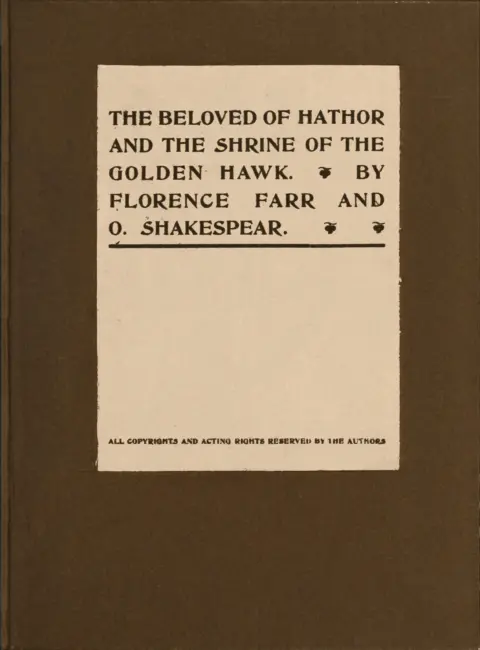
The beloved of Hathor, and The shrine of the Golden Hawk
Florence Farr & Olivia Shakespear
THE CLASSIC COLLECTION · 1894
"The Dancing Faun" by Florence Farr is a novel written in the late 19th century. The story explores the complexities of social relationships, personal desires, and moral dilemmas through the interactions of a cast of characters, particularly focusing on Lady Geraldine and George Travers. Their discussions reveal themes such as the nature of truth, the facades of society, and the tension between appearances and reality. At the start of the novel, various characters gather in a drawing-room, setting the stage for a dynamic exploration of societal norms and individual aspirations. The opening conversation hints at Lady Geraldine's restlessness as she navigates her first season in high society, while Mr. Travers embodies a more cynical worldview. As the narrative unfolds, the arrival of Travers introduces an intriguing element of danger and attraction that will undoubtedly complicate the lives of the characters. The depiction of Lady Geraldine's relationships, particularly her growing affection for Travers, foreshadows deeper conflicts involving societal expectations, trust, and the pursuit of one's desires.
Introduction adapted from the source catalogue; source summaries may be automatically generated.
Free to read · English · 26,863 words · No account needed
MAKE TIME FOR A GOOD BOOK
On by default. Untick to stop anonymous reading totals. Each page counts after 10 seconds in view. How this works.
Anonymous counting is on unless you have switched it off.
‘No, I will not suffer for you,’ she whispered, as if replying to their silent menace, and she put the pistol into his hand and closed the fingers round it. They would not keep as she placed them. At last she left the thing on the ground by his side, then she walked rapidly away. Before she had got far she remembered the compromising letters she had written: she must go back and get them at any price. She found his pocket-book; she found her three letters in it; she took them, and replaced the pocket-book. Then she went. Just as she was leaving the wood, the fox-terrier, which had been off on a hunting expedition, ran up to her, smelling her dress. She put down her hand to pat its head. It licked off a little spot of blood that soiled her first finger. She tried to speak to it, to tell it to go to its master, but she found her mouth was parched and dry. She could not utter a word. But it went all the same, following the track of her footsteps into the wood.
She went through what would probably occur. He would be found alone with a pistol. She thought of what would happen if the pistol was identified. She had taken it from the gun-room at home; she had thought it would add to the romance of the situation. Two of them had been hanging on the wall; she remembered them all her life. Sometimes her father had allowed her and her sisters to practise with them on Sunday afternoons, much to the scandal of the neighbourhood. Kirkdale would go to look at the body; he would be sure to recognise the pistol. She got into the house unobserved just as the clock struck eleven. First she went up to her bedroom and dusted her shoes; her feet were covered with dust. She took off her stockings and wiped them clean as well as she could without making a mess. Then she went downstairs. She had sent her maid to bed. Nobody seemed to be up except Kirkdale and Clausen, whom she could hear playing billiards as she passed the door. She went down the passage, entered the gun-room, and examined the window. She saw it was accessible from the outside. It was one of the old-fashioned hasp bolts, so she took a rusty pocket-knife she found lying in a forgotten heap of odds and ends and passed it between the crack of the window. She scratched the bolt as best she could to make it appear as if it had been opened from the outside; then she dropped the knife outside the window, closed the door, and went to bed. She lay awake wondering if there was any precaution she had forgotten to take; and when at last she slept, she dreamed that she was a child again, and that her father was alive. He was in one of his rarely affectionate moods, dancing her on his knee and calling her his own dear little girl. He called her mother and sisters and little Stephen to look at her as he stood her upon the table--Mr. Clausen was there too,--and then her father laughed and clapped his hands, and said, ‘She’s the flower of the flock, she’s my very own daughter,’ and he rushed at the others and chased them out of the room. Then it seemed to her they were afraid of her as they had been of him. She saw their faces peeping in at the window at her, as if she was a terror to them. She looked at her father for explanation, but he no longer spoke or moved; his face was cold and lifeless, as if formed from damp yellow clay; and she went and touched his fingers, which closed on hers, and she felt she was becoming clay too. The cold crept up her arm; she could not stir hand or foot. Just as the cold reached her heart she woke and tried to scream, but once again she could utter no sound, and lay there motionless. At last the morning came. The horror of the dream had taken all her attention: she thought of nothing else; she felt she must speak of it, yet feared that in some vague way it might betray her. She could not bear to stay in the house waiting. She ordered the pony-carriage, and drove herself over to Lyndhurst, where she found some friends at home. They got her to put up there, and she did not return to Ringwood until dinner-time. Driving home she went over in her mind every possible thing that could happen: they would know the pistol; they would find it was impossible for the gun-room to have been entered from the outside; he would have boasted that he was going to meet her; somebody had seen her in the wood with him. She had gone to her room with a headache at nine o’clock, and asked not to be disturbed; perhaps Elizabeth had brought her something just before going to bed, and had discovered her absence. She imagined herself being driven away handcuffed between two policemen. She went through all the horrors of the last scene of all, when she would go blindfold into eternity. She shuddered terribly, then suddenly remembered the groom was sitting behind her, and was probably taking notes of her behaviour, and that he would be able to give his evidence too. As she drove over the bridge a train was arriving at the station. She pulled up a moment and watched the passengers alight. She saw a girl get out of a carriage and a tall man meeting her, and, leading her tenderly through the station, put her into a closed carriage. She saw that it was Kirkdale. Then she understood everything had been found out, and they had sent for the wife.
Your reading position is saved on this browser. Take it to another device with a library code. Reading pages adapt to text, rather than matching a printed edition.
Florence Farr & Olivia Shakespear
Florence Farr
BEHIND THE BOOK
This eBook is for the use of anyone anywhere in the United States and most other parts of the world at no cost and with almost no restrictions whatsoever. You may copy it, give it away or re-use it under the terms of the Project Gutenberg License included with this eBook or online at www.gutenberg.org. If you are not located in the United States, you will have to check the laws of the country where you are located before using this eBook. Read the source licence.
The original source file, including credits and licence, is retained by this library. Request an original-format copy at no charge. Please include the book title and Project Gutenberg identifier #75492.
KEEP YOUR CURIOSITY GOING
Coulson Kernahan

Maurice Baring
Frances Wright
Cécile Tormay

Frederic Jesup Stimson

W. H. P. (William Henry Pope) Jarvis