THE CLASSIC COLLECTION✦The dark year of DundeeCLASSIC FREE BOOKS
The dark year of Dundee
Deborah Alcock
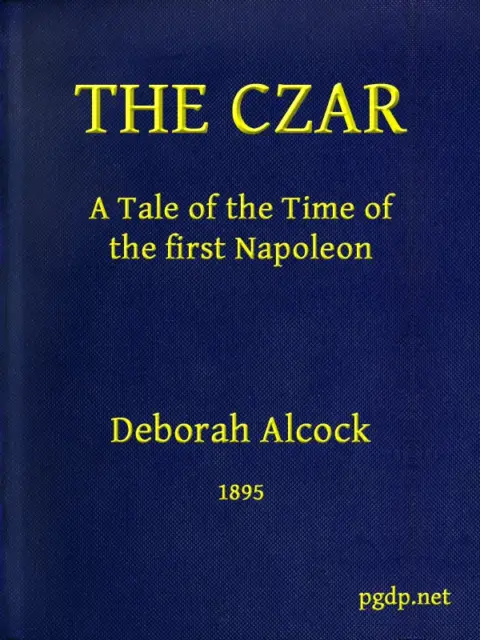
THE CLASSIC COLLECTION · 1885
"The Czar: A Tale of the Time of the First Napoleon" by Deborah Alcock is a historical novel written in the late 19th century. Set against the backdrop of early 19th-century Russia during the Napoleonic Wars, the story centers around Ivan Barrinka, a young boy of noble descent who discovers his true lineage and embarks on a journey of self-discovery while navigating the complexities of class and identity in a peasant village. The narrative presents a vivid tapestry of Russian life, highlighting the struggles of serfs, noble relationships, and the spirit of the time. At the start of the tale, the village of Nicolofsky is portrayed as a typical Russian setting where serfs toil under the watchful eye of their lords, particularly Plato Zoubof, who does not tend to his land. Young Ivan, initially unaware of his noble heritage, experiences life in the village and encounters the implications of his identity in playful exchanges with his peers. The opening chapters reveal Ivan's interactions with other village children, especially the conflict over a girl named Anna, leading him to question his origins. As he learns from the village’s elder that he is the son of a great prince, Ivan's modest beginnings are juxtaposed with the grand ideas of nobility, setting the stage for his subsequent adventures and quests for meaning beyond the confines of his rural existence.
Introduction adapted from the source catalogue; source summaries may be automatically generated.
Free to read · English · 139,959 words · No account needed
MAKE TIME FOR A GOOD BOOK
On by default. Untick to stop anonymous reading totals. Each page counts after 10 seconds in view. How this works.
Anonymous counting is on unless you have switched it off.
“The poor lads who are out on duty miss something.”
“True; but they will have their turn by-and-by. We all must miss something,” he added, smiling. “But then we all have our compensations.”
“I think the want of tidings from our dear ones is our only real trial,” Clémence answered. “I sometimes long to see my mother’s face, Ivan, and to show her our darlings. What a happy little visit that was which she paid us in St. Petersburg before we left! But for that I should have felt the long separation far more.”
“It was very good of her to come such a distance on such short notice; and it sent us on our way with lightened hearts. And does not the thought that Henri is at Tobolsk help to break the sense of separation?”
“Really it does: compared with Paris, or even with St. Petersburg, Tobolsk seems close at hand.”
“How well he is getting on there, too,” said Ivan. “In a year or two, God willing, he may settle near us in Moscow or in St. Petersburg; and our dear mother can then divide her time between her son and daughter.”
“What a happy dream!” said Clémence. “And yet not a dream, but a sober, practicable plan, a hope that may soon be realized. How good God is to us, Ivan!”
A handsome boy of eight or nine bounded into the room, his fair hair streaming over his fur jacket, and his bright face glowing with exercise and excitement. “Softly--softly, my boy,” said his father.
“Papinka, they are coming!--they are coming!” he shouted, confident that the importance of his tidings justified any amount of haste and clamour in their delivery.
“Who are coming, my dear boy?”
“Sledges, papinka, sledges! Three of them!” he cried breathlessly.
“From the south!”
“Do not let us be too sure,” Ivan said quickly to Clémence. “They may be only, after all, from some neighbouring settlement.”
“They are from the south, papinka,” the boy repeated. “They have signal-flags. Matvei saw them in the moonlight, quite plainly.”
“I must see them too,” said Ivan, hastily putting on his furs again.
It was true. Their long isolation was over. Tidings and letters and friends from the outer world had reached them at last. Much more and better--Clémence sprang forward with a cry of joy as a rough, sealskin-coated figure entered the room.
“Is it thou,--is it really thou, Henri?” she asked between smiles and
tears.
“Yes, my own sweet sister, it is I,” said Henri de Talmont. “My work in Tobolsk is finished, so I have come to visit you.”
Your reading position is saved on this browser. Take it to another device with a library code. Reading pages adapt to text, rather than matching a printed edition.
Deborah Alcock
Deborah Alcock
Deborah Alcock
Deborah Alcock
BEHIND THE BOOK
This eBook is for the use of anyone anywhere in the United States and most other parts of the world at no cost and with almost no restrictions whatsoever. You may copy it, give it away or re-use it under the terms of the Project Gutenberg License included with this eBook or online at www.gutenberg.org. If you are not located in the United States, you will have to check the laws of the country where you are located before using this eBook. Read the source licence.
The original source file, including credits and licence, is retained by this library. Request an original-format copy at no charge. Please include the book title and Project Gutenberg identifier #49782.
KEEP YOUR CURIOSITY GOING
Cécile Tormay

Moritz Busch
Coulson Kernahan
John L. Ransom

Maurice Baring
Frances Wright