THE CLASSIC COLLECTION✦The dark year of DundeeCLASSIC FREE BOOKS
The dark year of Dundee
Deborah Alcock
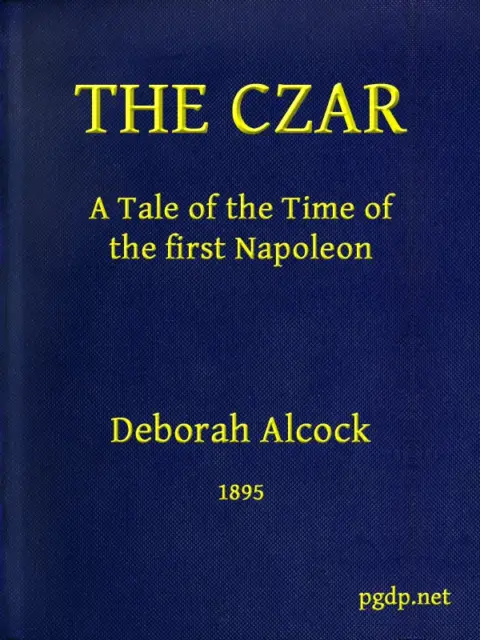
THE CLASSIC COLLECTION · 1885
"The Czar: A Tale of the Time of the First Napoleon" by Deborah Alcock is a historical novel written in the late 19th century. Set against the backdrop of early 19th-century Russia during the Napoleonic Wars, the story centers around Ivan Barrinka, a young boy of noble descent who discovers his true lineage and embarks on a journey of self-discovery while navigating the complexities of class and identity in a peasant village. The narrative presents a vivid tapestry of Russian life, highlighting the struggles of serfs, noble relationships, and the spirit of the time. At the start of the tale, the village of Nicolofsky is portrayed as a typical Russian setting where serfs toil under the watchful eye of their lords, particularly Plato Zoubof, who does not tend to his land. Young Ivan, initially unaware of his noble heritage, experiences life in the village and encounters the implications of his identity in playful exchanges with his peers. The opening chapters reveal Ivan's interactions with other village children, especially the conflict over a girl named Anna, leading him to question his origins. As he learns from the village’s elder that he is the son of a great prince, Ivan's modest beginnings are juxtaposed with the grand ideas of nobility, setting the stage for his subsequent adventures and quests for meaning beyond the confines of his rural existence.
Introduction adapted from the source catalogue; source summaries may be automatically generated.
Free to read · English · 139,959 words · No account needed
MAKE TIME FOR A GOOD BOOK
On by default. Untick to stop anonymous reading totals. Each page counts after 10 seconds in view. How this works.
Anonymous counting is on unless you have switched it off.
“Of suffering for us, of glory for you. How you must triumph, you Russians! Five months ago Napoleon crossed your border with half a million of men; and now the miserable remains of that splendid host are dying in your hospitals, pensioners of your bounty. Surely such an overthrow was never seen since Pharaoh and his armies perished in the waters of the Red Sea!”
“How we triumph, we Russians!” Ivan repeated. “Should you like to know how? Our Emperor said the other day in confidence to a friend, ‘This miserable campaign has cost me ten years of my life!’”
“Miserable! when it has been for him and his one long glorious
victory!”
“True; but the sufferings he has witnessed have well-nigh broken his
heart.”
“The sufferings of his enemies,” said Henri, as tears filled his eyes.
“They have so cast our own into the shade, that we ourselves almost forget them. Yet you must not think we have suffered nothing. Remember Moscow, our beautiful, our holy city; remember Borodino and the other battles in which the best blood of our country was poured out like water. Moreover, the ice-king has thinned our ranks as well as yours.”
“Ah! not so fatally.”
“No; we had wholesome food, and warm clothing, and care and comforts for the sick. As a rule, our invalids recovered, while yours died. Yes, oh yes, God has surely given us a great deliverance; would it had been at less cost to others! Look here, monsieur,”--Ivan took a silver medal, new and bright, from his neck, where it hung attached to a sky-blue ribbon. “The Czar has just given one of these to every man who has borne part in this winter’s campaign, from the general to the youngest recruit.”
Henri examined it with interest. One side bore a Triangle surrounded by rays, and in its centre an Eye.
“What does that mean?” he inquired.
“It is, with us, the symbol of the Divine Presence,” Ivan answered, crossing himself. “It typifies the All-seeing and Ever-present--the Three in One. Beneath, you read ‘1812,’ the ever-memorable year when He himself interposed to deliver us. Now, turn the other side.”
Henri did so, and saw, though he could not read, an inscription in the
old Slavonic tongue.
“That is, translated literally, ‘Not us! not us! but His Name!’ In your French Bible--the same which I use also--the verse reads thus:--‘Not unto us, O Lord, not unto us, but unto thy name give glory.’”
“Beautiful!” said Henri; and as he gave back the medal, he looked with interest at the brilliant young Guardsman, who spoke in such a simple, manly, unaffected way of God’s Word and Providence.
Your reading position is saved on this browser. Take it to another device with a library code. Reading pages adapt to text, rather than matching a printed edition.
Deborah Alcock
Deborah Alcock
Deborah Alcock
Deborah Alcock
BEHIND THE BOOK
This eBook is for the use of anyone anywhere in the United States and most other parts of the world at no cost and with almost no restrictions whatsoever. You may copy it, give it away or re-use it under the terms of the Project Gutenberg License included with this eBook or online at www.gutenberg.org. If you are not located in the United States, you will have to check the laws of the country where you are located before using this eBook. Read the source licence.
The original source file, including credits and licence, is retained by this library. Request an original-format copy at no charge. Please include the book title and Project Gutenberg identifier #49782.
KEEP YOUR CURIOSITY GOING
Cécile Tormay

Moritz Busch
Coulson Kernahan
John L. Ransom

Maurice Baring
Frances Wright