THE CLASSIC COLLECTION✦The dark year of DundeeCLASSIC FREE BOOKS
The dark year of Dundee
Deborah Alcock
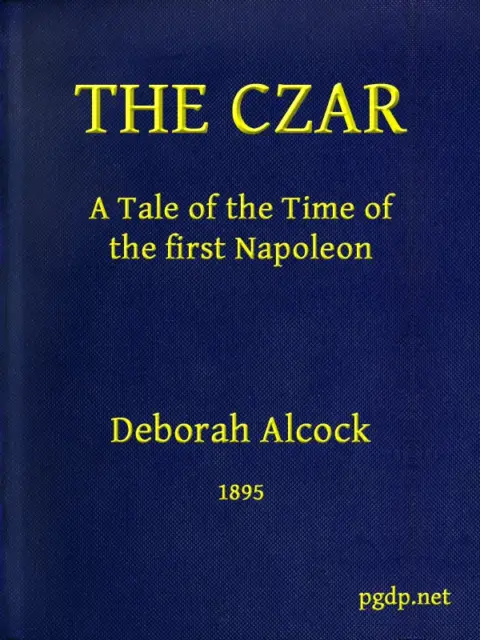
THE CLASSIC COLLECTION · 1885
"The Czar: A Tale of the Time of the First Napoleon" by Deborah Alcock is a historical novel written in the late 19th century. Set against the backdrop of early 19th-century Russia during the Napoleonic Wars, the story centers around Ivan Barrinka, a young boy of noble descent who discovers his true lineage and embarks on a journey of self-discovery while navigating the complexities of class and identity in a peasant village. The narrative presents a vivid tapestry of Russian life, highlighting the struggles of serfs, noble relationships, and the spirit of the time. At the start of the tale, the village of Nicolofsky is portrayed as a typical Russian setting where serfs toil under the watchful eye of their lords, particularly Plato Zoubof, who does not tend to his land. Young Ivan, initially unaware of his noble heritage, experiences life in the village and encounters the implications of his identity in playful exchanges with his peers. The opening chapters reveal Ivan's interactions with other village children, especially the conflict over a girl named Anna, leading him to question his origins. As he learns from the village’s elder that he is the son of a great prince, Ivan's modest beginnings are juxtaposed with the grand ideas of nobility, setting the stage for his subsequent adventures and quests for meaning beyond the confines of his rural existence.
Introduction adapted from the source catalogue; source summaries may be automatically generated.
Free to read · English · 139,959 words · No account needed
MAKE TIME FOR A GOOD BOOK
On by default. Untick to stop anonymous reading totals. Each page counts after 10 seconds in view. How this works.
Anonymous counting is on unless you have switched it off.
“The Kremlin?--Impossible!” cried Adrian, who was dressing for parade.
“Too possible, and too true,” said his informant. “A messenger from the city has just arrived to bring the tidings to the marshal and the count.”
Meanwhile Ivan, who had been suddenly awakened, started up in horror, exclaiming, “The Czar! oh, what will it be to him?”
“Blown into fragments, did you say?” returned Adrian. “Utterly impossible! The masonry is as solid as the rocks beneath our feet, and the walls of the arsenal are three yards in thickness.”
“Those walls are now level with the ground,” said the officer; “and the palace--the Czar’s ancient palace--is in ruins.”
Ivan uttered a bitter cry, and Adrian asked breathlessly, “What of the
churches?”
“One of them, I have not heard which, is thrown down. The mines were fired by slow-consuming fusees; and our men, who arrived just before the messenger left, were beginning a perilous search for powder, to prevent further mischief, if they could.”
“But,” said Ivan, who had risen now,--“but there must be a mistake somewhere; for the French kept their own sick and wounded in the Kremlin, and I happen to know that those unfit to be moved were still there when I left the city. That Napoleon could have exposed them to a horrible death is simply inconceivable.”
“Yet too true,” the officer answered. “He has sacrificed his own helpless followers to his revenge and hatred. For this barbarous deed can have had no other motive. There was nothing to be gained by it.”
Adrian laid his hand upon Ivan’s shoulder. “Do not go to St Petersburg,” he said. “Stay with us, and fight. We will pay this Napoleon double for all his atrocities.”
“I wish his neck were there,” said Adrian’s comrade, grinding the earth with his strong heel. “But I would not kill him,” he added, after a pause. “No. I would drag him in chains to the feet of the Czar, and let him kill him with his own hand.”
“I think,” said Ivan slowly and with deliberation,--“I think every Russian, from the Czar himself down to the lowest mujik, should swear a solemn oath not to sheathe the sword until we have taken such vengeance upon Napoleon and his Frenchmen as the world has never yet seen.”
“So be it,” said Michael, who came in while he was speaking. “I, a mujik, will be the first to swear.--Barrinka, what is the name of Napoleon’s great city, where he has his palace and all his treasures? Suppose the Czar were to make a blaze of that some day! It may be. God is just!”
Your reading position is saved on this browser. Take it to another device with a library code. Reading pages adapt to text, rather than matching a printed edition.
Deborah Alcock
Deborah Alcock
Deborah Alcock
Deborah Alcock
BEHIND THE BOOK
This eBook is for the use of anyone anywhere in the United States and most other parts of the world at no cost and with almost no restrictions whatsoever. You may copy it, give it away or re-use it under the terms of the Project Gutenberg License included with this eBook or online at www.gutenberg.org. If you are not located in the United States, you will have to check the laws of the country where you are located before using this eBook. Read the source licence.
The original source file, including credits and licence, is retained by this library. Request an original-format copy at no charge. Please include the book title and Project Gutenberg identifier #49782.
KEEP YOUR CURIOSITY GOING
Cécile Tormay

Moritz Busch
Coulson Kernahan
John L. Ransom

Maurice Baring
Frances Wright