THE CLASSIC COLLECTION✦An outlaw’s diary: the CommuneCLASSIC FREE BOOKS
An outlaw’s diary: the Commune
Cécile Tormay
THE CLASSIC COLLECTION · 1845
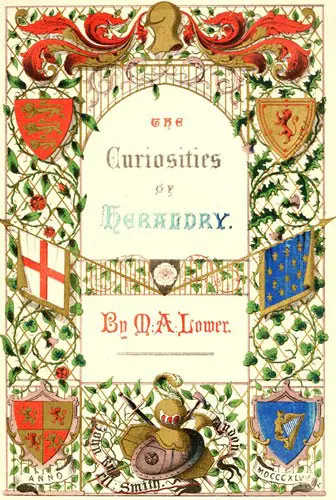
"The Curiosities of Heraldry" by Mark Antony Lower is a historical account written in the mid-19th century. This work delves into the principles and practices of heraldry, a system that denotes family lineage and nobility through intricate symbols and designs. The book aims to shed light on the often-overlooked significance and utility of heraldic study, enlivened by historical anecdotes and examples. The opening of the text presents a preface where Lower establishes the value of heraldry as an essential study for understanding not only genealogy but also the broader historical context of the Middle Ages. He reflects on the misconceptions surrounding heraldry, countering the view that it is merely an outdated collection of symbols. He emphasizes the poetic and practical aspects of heraldry, asserting that it is a rich field worthy of attention. The introduction sets the stage for a detailed exploration of the science of heraldry, hinting at its deep historical roots and its role in the social fabric of medieval society, ultimately preparing the reader for a thorough investigation into the subject throughout the subsequent chapters.
Introduction adapted from the source catalogue; source summaries may be automatically generated.
Free to read · English · 86,967 words · No account needed
MAKE TIME FOR A GOOD BOOK
On by default. Untick to stop anonymous reading totals. Each page counts after 10 seconds in view. How this works.
Anonymous counting is on unless you have switched it off.
Of SABLE the derivation is very uncertain. It seems unlikely to have been taken from the colour of the diminutive animal now known by this name, first, because it would then rank under the category of furs; and, secondly, because that animal is far from black. Indeed, the best sable is of a light brown or sand colour. Dallaway quotes a line, however, which might be adduced in support of this derivation:
"Sables, ermines, vair et gris."
Guillim derives it from sabulum, gross sand or gravel, but this seems very improbable, although I have nothing better to substitute. It is curious that 'sable' and 'azure' should have been selected from the 'jargon' of heraldry for poetical use, to the exclusion of other similar terms:
"By this the drooping daylight 'gan to fade,
And yield his room to sad succeeding night,
Who with her sable mantle 'gan to shade
The face of earth, and ways of living wight."
Faerie Queen.
"Thus replies
Minerva, graceful, with her azure eyes."
Pope.
PURPURE (purple) is not common in English armory: still less so are the stainant or disgraceful colours, TENNY (orange) and MURREY, which Dr. Johnson defines as "darkly red," deriving it through the French moree, and the Italian morello. The fine cherry designated by this last word is, when ripe, of the exact colour intended by murrey. Bacon says, "Leaves of some trees turn a little murrey, or reddish;" and "a waistcoat of murrey-coloured satin" occurs in the writings of Arbuthnot.
By these terms were the arms of gentlemen described; but for the arms of nobility they were not sufficiently lofty. These were blazoned by the precious stones, as topaz for yellow, ruby for red, &c. For the arms of princes it was necessary to go a step higher, namely, to the heavenly bodies, Sol, Luna, Mars, &c. Sir John Ferne enumerates several other sets of terms, in all thirteen, which he classifies thus: 1, planets; 2, precious stones; 3, vertues; 4, celestiall signes; 5, months; 6, days of the week; 7, ages of man; 8, flowers; 9, elements; 10, sesons of the yeer; 11, complexions; 12, numbers; 13, mettailes. What would those who are disgusted with the 'jargon' of our science say to such blazon as the following?--
He beareth Sunday, a lion rampant Tuesday. He beareth Faith, a wolf salient Loyalty. He beareth Marigold, a bear passant, Blue Lily, muzzled White Rose. He beareth, Infancy, three grasshoppers Virility. He beareth, Melancholy, three asses' heads, Flegmatique!
Your reading position is saved on this browser. Take it to another device with a library code. Reading pages adapt to text, rather than matching a printed edition.
BEHIND THE BOOK
This eBook is for the use of anyone anywhere in the United States and most other parts of the world at no cost and with almost no restrictions whatsoever. You may copy it, give it away or re-use it under the terms of the Project Gutenberg License included with this eBook or online at www.gutenberg.org. If you are not located in the United States, you will have to check the laws of the country where you are located before using this eBook. Read the source licence.
The original source file, including credits and licence, is retained by this library. Request an original-format copy at no charge. Please include the book title and Project Gutenberg identifier #38951.
KEEP YOUR CURIOSITY GOING
Cécile Tormay

Moritz Busch
John L. Ransom
Frances Wright
Cécile Tormay

Mabel Potter Daggett