THE CLASSIC COLLECTION✦An outlaw’s diary: the CommuneCLASSIC FREE BOOKS
An outlaw’s diary: the Commune
Cécile Tormay
THE CLASSIC COLLECTION · 1845
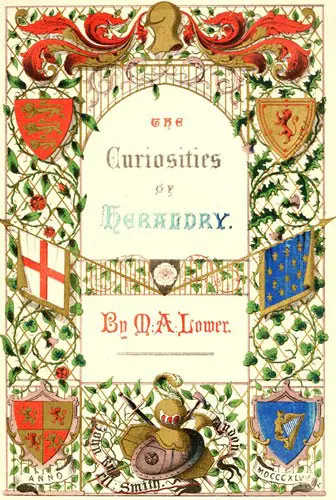
"The Curiosities of Heraldry" by Mark Antony Lower is a historical account written in the mid-19th century. This work delves into the principles and practices of heraldry, a system that denotes family lineage and nobility through intricate symbols and designs. The book aims to shed light on the often-overlooked significance and utility of heraldic study, enlivened by historical anecdotes and examples. The opening of the text presents a preface where Lower establishes the value of heraldry as an essential study for understanding not only genealogy but also the broader historical context of the Middle Ages. He reflects on the misconceptions surrounding heraldry, countering the view that it is merely an outdated collection of symbols. He emphasizes the poetic and practical aspects of heraldry, asserting that it is a rich field worthy of attention. The introduction sets the stage for a detailed exploration of the science of heraldry, hinting at its deep historical roots and its role in the social fabric of medieval society, ultimately preparing the reader for a thorough investigation into the subject throughout the subsequent chapters.
Introduction adapted from the source catalogue; source summaries may be automatically generated.
Free to read · English · 86,967 words · No account needed
MAKE TIME FOR A GOOD BOOK
On by default. Untick to stop anonymous reading totals. Each page counts after 10 seconds in view. How this works.
Anonymous counting is on unless you have switched it off.
[Illustration: Henry Dering, frater junior Ricardi.[325]]
[Illustration: John Dering, Dns. de Evering-acre in Pluckley, ao 1 Hen. 5 et Ricus filius ejus, occis apd. Bosworth.[326]]
[Illustration: Wm. Dering de Petworth in co. Sussex, et de Lisse in co. Hants, Arm. T Hen. 7.[327]]
To these ten may be added two very antient, whose order gave them a diversification, being Knights-Templers, and three other moderne, assigned by Sir Wm. Segar, Garter.
[Illustration: Dns. Robtus. Dering, Miles ordinis militiae sci. Templi ad dissolut. ejus ap{d}. Ewell.[328]]
The three modern ones assigned by Sir Wm. Segar are as follows:
[Illustration: Xtopher Dering, of Wickins.[329]]
[Sidenote: So in old chartularies of abbeys I have often observed that one and the same man varied his own name of addition by the change of places where he made his abode.]
Besides the variations of arms, here is much change of sirname to be observed, which among antiquaries is nothing new. Here are Dering, Wimond, Dereman, De la Hell, Wrotham, Cuckeston, Pevington, Pirefield, Cheriton, Ash, and de Fraxino, whereof the first three are assumed from forenames or Xtian names, as have done the families of Herding, Herbert, Aucher, Bagot, Bardolph, Hasting, Durand, Hubert, Oughtred, Leonard, and very many more; all the others here were assumed by reason of lands possessed of that name. Norman Fitz-Dering being Lord of Ash was called Norman de Fraxino, de Fresne, and de Ash. Arnold, a son of another Norman Fitz-Dering, being Lord of Cuckeston, was called Arnold de Cuckeston, whose grandchildren were Wm. de Pevington and Wm. de Cheriton, and so the rest had their surnames appropriated from their habitation and possession. In the family of Cobham you have Toneford and Hever of the same blood. Mortimer and Warren were brothers, and the sons of Walter de St. Martin. De Frydon, de Pantley, and de Albdy, were three brothers, the sons of Hugh de Saddington. Wm. Belward, lord of the moiety of Malpas, in Chester, had issue David and Richard; from David came three sons, Wm. de Malpas, Philip Gogh, David Golborne; and from them Egerton and Goodman--Richard, son of Wm. Belward, had issue Thomas de Cotgreve, Wm. de Weston, and Richard Little, father of N. Keneclerk and of John Richardson, (who would conceive without good proof that Malpas, Gough, Golborne, Egerton, Goodman, Cotgrave, Weston, Little, Kenclerk, and Richardson were all in short time the issue of Wm. Belward.) Nay, to make the instance of better impression, the antient earls of Norfolk having also Suffolk within their earldom did write themselves of Norfolk, of Suffolk, and sometimes of Norwich, indifferently, according to the place where they signed or subscribed, or were in any instrument named. The like did the old earls of Dorset and Somerset, using either title indifferently. Four earls of Chester had several sirnames successively one after another--Randolph Meschines had issue Randolph Gemers, father of Hugh Kivilicke, whose son was Randolph Blundeville. If yet you wish a more full president, you have it in Lucas de Hardres, who....
Your reading position is saved on this browser. Take it to another device with a library code. Reading pages adapt to text, rather than matching a printed edition.
BEHIND THE BOOK
This eBook is for the use of anyone anywhere in the United States and most other parts of the world at no cost and with almost no restrictions whatsoever. You may copy it, give it away or re-use it under the terms of the Project Gutenberg License included with this eBook or online at www.gutenberg.org. If you are not located in the United States, you will have to check the laws of the country where you are located before using this eBook. Read the source licence.
The original source file, including credits and licence, is retained by this library. Request an original-format copy at no charge. Please include the book title and Project Gutenberg identifier #38951.
KEEP YOUR CURIOSITY GOING
Cécile Tormay

Moritz Busch
John L. Ransom
Frances Wright
Cécile Tormay

Mabel Potter Daggett