THE CLASSIC COLLECTION✦An outlaw’s diary: the CommuneCLASSIC FREE BOOKS
An outlaw’s diary: the Commune
Cécile Tormay
THE CLASSIC COLLECTION · 1845
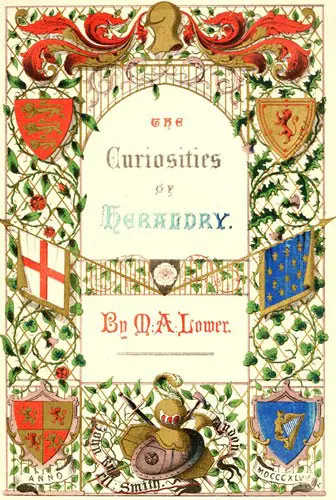
"The Curiosities of Heraldry" by Mark Antony Lower is a historical account written in the mid-19th century. This work delves into the principles and practices of heraldry, a system that denotes family lineage and nobility through intricate symbols and designs. The book aims to shed light on the often-overlooked significance and utility of heraldic study, enlivened by historical anecdotes and examples. The opening of the text presents a preface where Lower establishes the value of heraldry as an essential study for understanding not only genealogy but also the broader historical context of the Middle Ages. He reflects on the misconceptions surrounding heraldry, countering the view that it is merely an outdated collection of symbols. He emphasizes the poetic and practical aspects of heraldry, asserting that it is a rich field worthy of attention. The introduction sets the stage for a detailed exploration of the science of heraldry, hinting at its deep historical roots and its role in the social fabric of medieval society, ultimately preparing the reader for a thorough investigation into the subject throughout the subsequent chapters.
Introduction adapted from the source catalogue; source summaries may be automatically generated.
Free to read · English · 86,967 words · No account needed
MAKE TIME FOR A GOOD BOOK
On by default. Untick to stop anonymous reading totals. Each page counts after 10 seconds in view. How this works.
Anonymous counting is on unless you have switched it off.
Persons not conversant with antiquarian researches often express surprise at the possibility of tracing the annals of a family through the long period of five, six, or seven centuries. It may therefore be interesting to mention the principal sources from which genealogical materials are derived.
1. The several records which go under the general name of Doomsday Books constitute, collectively, one of the most valuable monuments possessed by any nation. They contain the name of every landowner, with the value of his estate, and frequently refer to earlier proprietors antecedently to the Conquest. The 'Great Doomsday Book' in the Chapter House, the 'Exon Doomsday,' and the 'Inquisitio Eliensis,' were compiled between 1066 and 1086; the 'Winton Doomsday,' temp. Hen. I; and the 'Boldon Book' in 1183. 2. The next documents in point of antiquity are Monastic Records, such as Chartularies, Leiger-Books, Chronicles, Obituaries, Registers of Marriages and Burials, and Abbey Rolls. These usually contain much information for the genealogist, particularly in relation to the founders and benefactors of the respective establishments. Of Abbey Rolls the 'Roll of Battel Abbey' is an eminent example. Its authenticity, however, is extremely doubtful, and we have the authority of Camden for declaring that, "Whosoever considereth it well shall find it always to be forged."[310]
It has been asserted that many records of great value were destroyed at the dissolution of the religious houses, and there is probably truth in the allegation; for John Bale, a contemporary observer, writes, that the library books of [some of] the monasteries were reserved by the purchasers of those houses to scour their candlesticks, to rub their boots, and even for still viler uses. Some again, he says, were sold to grocers and soap-sellers, or sent over sea to the book-binders. A merchant bought two noble libraries for forty shillings. Peacham, in his 'Compleat Gentleman,'[311] and several other authors declare that Polydore Vergil, the historian, burnt many of the best and most antient records he could find in the conventual and cathedral libraries;[312] but the learned Italian has been most ably defended against this heavy charge.[313] 3. Antient Charters and Deeds transferring lands, &c. are most excellent authorities for genealogical particulars. Such documents are immensely numerous. By series of these in the muniment-rooms of our nobility and gentry, and other places, both family lines and territorial descent may be clearly established for a great length of time. 4. Monumental Inscriptions are documents of great interest. Many of them are of very high antiquity. That of King Arthur, described by Camden, is, if genuine, more than thirteen centuries old. The legend is, "HIC JACET SEPVLTVS INCLYTVS REX ARTVRIVS IN INSVLA AVALONIA." There are several remains of this description belonging to the Norman period whose genuineness is not questioned. There are two in my own locality; namely, the epitaph on Gundred, wife of William de Warren, and daughter of William the Conqueror (ob. 1085), in the church of Southover, Lewes, and that on Mangnus, a Danish prince of the eleventh or twelfth century, in the wall of St. John sub Castro.[314] Unfortunately most of the monuments of those early times have no inscriptions; so that, without the evidence of concurrent tradition, they can scarcely be regarded as monuments at all. Monumental brasses, a most interesting class of memorials, occur from the thirteenth century to the era of the mural tablets now in use. Regular genealogical series of them are sometimes to be found in our country churches. 5. The Public Records, many of which have been printed at the national expense, contain an inexhaustible mine for the genealogist and historian. Particulars relating to knights' fees and other feudal matters are found in the 'Black and Red Books of the Exchequer,' the 'Testa de Neville,' the 'Nomina Villarum,' and the 'Hundred Rolls.' These are all of very early date. The fine, charter, close, patent, nona, and numerous other rolls, and particularly the Inquisitiones post mortem[315] and Escheat rolls are rich in materials for pedigrees. Lists of English gentry for certain counties occur temp. Edw. II; and the celebrated list of temp. Hen. VI purports to contain the names of all the gentry in thirty counties. 6. The Wills proved in the Prerogative Court of Canterbury at Doctors' Commons commence so early as 1383, and those in several of the local registries are of considerable, though not of equal, antiquity. These are of all documents the most confidently to be relied on, containing as they do much information respecting the family-connexions of the testators. From a single will a descent of four generations can frequently be traced. 7. The Heraldic Records, gathered from documents no longer extant, are most valuable. The Visitation-books, extending from 1528 to 1687, are in the College of Arms; and there are numerous other collections of pedigrees in public and private MS. libraries. The funeral certificates of the nobility and gentry preserved at the College are most authentic and useful documents, though apparently little known even amongst antiquaries. The following is a specimen:
Your reading position is saved on this browser. Take it to another device with a library code. Reading pages adapt to text, rather than matching a printed edition.
BEHIND THE BOOK
This eBook is for the use of anyone anywhere in the United States and most other parts of the world at no cost and with almost no restrictions whatsoever. You may copy it, give it away or re-use it under the terms of the Project Gutenberg License included with this eBook or online at www.gutenberg.org. If you are not located in the United States, you will have to check the laws of the country where you are located before using this eBook. Read the source licence.
The original source file, including credits and licence, is retained by this library. Request an original-format copy at no charge. Please include the book title and Project Gutenberg identifier #38951.
KEEP YOUR CURIOSITY GOING
Cécile Tormay

Moritz Busch
John L. Ransom
Frances Wright
Cécile Tormay

Mabel Potter Daggett