THE CLASSIC COLLECTION✦An outlaw’s diary: the CommuneCLASSIC FREE BOOKS
An outlaw’s diary: the Commune
Cécile Tormay
THE CLASSIC COLLECTION · 1845
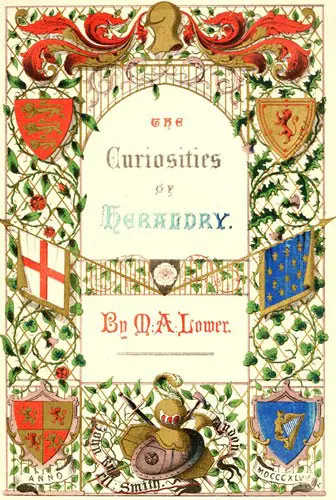
"The Curiosities of Heraldry" by Mark Antony Lower is a historical account written in the mid-19th century. This work delves into the principles and practices of heraldry, a system that denotes family lineage and nobility through intricate symbols and designs. The book aims to shed light on the often-overlooked significance and utility of heraldic study, enlivened by historical anecdotes and examples. The opening of the text presents a preface where Lower establishes the value of heraldry as an essential study for understanding not only genealogy but also the broader historical context of the Middle Ages. He reflects on the misconceptions surrounding heraldry, countering the view that it is merely an outdated collection of symbols. He emphasizes the poetic and practical aspects of heraldry, asserting that it is a rich field worthy of attention. The introduction sets the stage for a detailed exploration of the science of heraldry, hinting at its deep historical roots and its role in the social fabric of medieval society, ultimately preparing the reader for a thorough investigation into the subject throughout the subsequent chapters.
Introduction adapted from the source catalogue; source summaries may be automatically generated.
Free to read · English · 86,967 words · No account needed
MAKE TIME FOR A GOOD BOOK
On by default. Untick to stop anonymous reading totals. Each page counts after 10 seconds in view. How this works.
Anonymous counting is on unless you have switched it off.
This was probably a compliment paid to every subscriber, and it displays, as Mr. Moule observes, the finest illustration extant of the "oeconomy of flattery."
The following extract will give an idea of a large proportion of the contents of this famous 'Storehouse,' which, like many other storehouses, holds much that is of very little value. Honest Randle blazons one of his fictitious bearings for the purpose of introducing the names of the implements and terms employed by that useful personage the barber.
"LVII. He beareth Argent a =Barber bare headed=, with a =pair of Cisers= in his right hand, and a =Comb= in his left, =cloathed= in Russet, his =Apron Cheque= of the first and Azure, &c.
"Instruments of a Barber.
The instrument case, in which are placed these following things in
their several divisions:
The glass or seeing glass.
A set of horn combs, with teeth on one side, and wide.
A set of ivory combs with fine teeth, and toothed on both sides.
An ivory beard comb.
A four square bottle with a screw'd head for sweet water, or Benjamin
water, &c.
The like bottle with sweet powder in; but this is now not used.
A row of razors, &c. &c."
Then follow
"TERMS OR ART used in Barbing and Shaving (!!!)
Take the chair, is for the person to be trimmed to sit down.
Clear the neck, is to unbutton and turn down the collar of the man's
neck.
Cloath him, is to put a trimming cloth before him, and to fasten it
about his neck.
Powder the hair, is to puff sweet powder into it.
Walk your combs, is to use two combs, in each hand one, and so comb the hair with one after the other.
Quever the combs, is to use them as if they were scratting on each
side the temples.
Curle up the hair, is to rowle it about a pair of curling or beard irons, and thrust it under the cap.
Lather the face, is to wash the beard with the suds which the ball maketh by chaffing it in the warm water.
Hand the razor, set it in a right order between the thumb and
fingers.
Shave the beard, is to take off superfluous hairs.
Hold him the glass, to see his new made face, and to give the barber instruction where it is amiss.
Take off the linnens.
Brush his cloaths.
Present him with his hat, and according to his hire, he makes a bow, with your humble servant, Sir."[301].
Your reading position is saved on this browser. Take it to another device with a library code. Reading pages adapt to text, rather than matching a printed edition.
BEHIND THE BOOK
This eBook is for the use of anyone anywhere in the United States and most other parts of the world at no cost and with almost no restrictions whatsoever. You may copy it, give it away or re-use it under the terms of the Project Gutenberg License included with this eBook or online at www.gutenberg.org. If you are not located in the United States, you will have to check the laws of the country where you are located before using this eBook. Read the source licence.
The original source file, including credits and licence, is retained by this library. Request an original-format copy at no charge. Please include the book title and Project Gutenberg identifier #38951.
KEEP YOUR CURIOSITY GOING
Cécile Tormay

Moritz Busch
John L. Ransom
Frances Wright
Cécile Tormay

Mabel Potter Daggett