
Letters to a Friend, Written to Mrs. Ezra S. Carr, 1866-1879
John Muir
THE CLASSIC COLLECTION · 1898
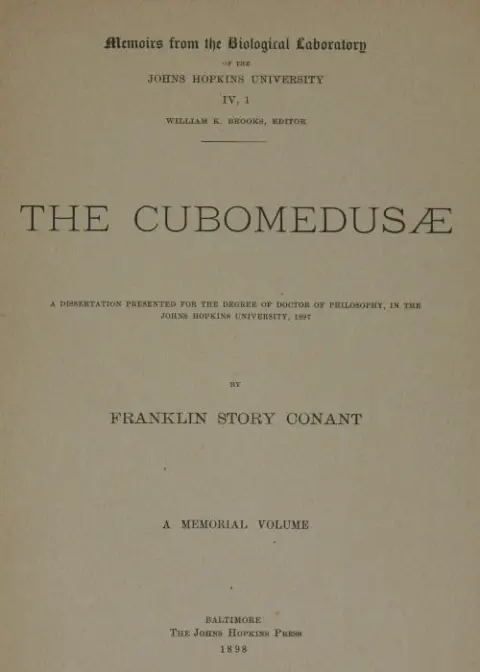
"The Cubomedusæ" by Franklin Story Conant is a scientific treatise written in the late 19th century. The work is a dissertation presented for the degree of Doctor of Philosophy at Johns Hopkins University, focusing on the biology and anatomy of the Cubomedusæ, a group of jellyfish. Through meticulous research, Conant aims to elucidate the systematic classification and anatomical features of these gelatinous creatures, emphasizing their unique characteristics and developmental processes. At the start of the dissertation, the author introduces the Cubomedusæ and their significance within the biological community, highlighting their rarity and advanced nervous system development. Conant shares personal anecdotes about his research, including discoveries made during fieldwork in Jamaica, where he identified two new species of these jellyfish. This opening portion outlines his methodological approach and sets the stage for a deeper exploration of their anatomy, physiology, and ecological conditions, ultimately establishing a solid foundation for the intricate descriptions that follow in the treatise.
Introduction adapted from the source catalogue; source summaries may be automatically generated.
Free to read · English · 26,625 words · No account needed
MAKE TIME FOR A GOOD BOOK
On by default. Untick to stop anonymous reading totals. Each page counts after 10 seconds in view. How this works.
Anonymous counting is on unless you have switched it off.
There is left one more point in reference to the nervous system upon which I wish to say a word. Claus and Schewiakoff both describe the wall of the crystalline sac as structureless, formed by the bare supporting lamella. The credit is due to H. V. Wilson of finding in Chiropsalmus that it has a special lining of epithelial cells, which he figures as a continuous, flattened layer. In both Charybdea and Tripedalia I find traces of the same in nuclei here and there, but whether they are the remains of a once continuous layer or not the sections do not show satisfactorily.
This ends the account of what it seemed worth while to say at present upon the nervous system. In concluding, the writer wishes to express his thanks for the help afforded by Dr. Wilson’s notes, in particular on the subject of the vascular lamellæ, and desires to make especial acknowledgment of his indebtedness to Professor Brooks, whose suggestions, based upon many years of experience with the Medusæ, have been most welcome and helpful, and whose evidences of unfailing kindliness, both in Jamaica at the time the material was obtained and in Baltimore when it was being studied in the laboratory, take a most honored part in the pleasant memories associated with the work.
CLARKE, H. J. ’78. Lucernariæ and their Allies. Washington:
Smithsonian Institution.
CLAUS, C. ’78. Ueber Charybdea marsupialis. Arb. aus d. Zool. Inst. d. Univ. Wien, Band II, Heft 2.
DOFLEIN, F. ’96. Die Eibildung bei Tubularia. Zeitsch. f. wiss.
Zool., Bd. LXII, Heft 1.
HAECKEL, E. ’79. Das System der Medusen. Jena.--’81. Challenger Report on the Deep-sea Medusæ. Vol. IV.
HERTWIG, O. and R. ’78. Das Nervensystem und die Sinnesorgane
der Medusen. Leipzig.
HESSE, R. ’95. Ueber das Nervensystem und die Sinnesorgane von Rhizostoma Cuvieri. Zeitschr. f. wiss. Zool., Bd. LX, Heft 3.
MÜLLER, F. ’59. Zwei neue Quallen von St. Catherina (Brasilien). Abhandlungen der naturf. Gesellschaft zu Halle.
SCHEWIAKOFF, W. ’89. Beiträge zur Kenntniss des Acalephenauges. Morph. Jahrb., Bd. XV, Heft 1.
WILSON, H. V. Unpublished notes.
afr = adradial furrow.
afr´ = furrow in Tripedalia that separates perradial from interrad. regions in lower half of bell. (In Charybdea the same furrow is directly continuous with afr.)
ax = axis of nerve.
c = concretion.
cc = canal underneath ivl, connecting the two adjacent marginal
pockets.
ccl = circular canal.
ci = cilia.
cm = circular muscle.
co = cornea.
cp = capsule of lens.
cs = covering scale of niche.
csc = canal of sensory club.
ct = canal of tentacle.
ct´ = beginning of canals of lateral tentacles in Tripedalia.
ec = ectoderm.
ece = ectoderm of exumbrella.
ecs = ectoderm of subumbrella.
ed = distal paired eye.
el = larger unpaired eye.
en = endoderm.
enc = endoderm of sensory club.
Your reading position is saved on this browser. Take it to another device with a library code. Reading pages adapt to text, rather than matching a printed edition.
BEHIND THE BOOK
This eBook is for the use of anyone anywhere in the United States and most other parts of the world at no cost and with almost no restrictions whatsoever. You may copy it, give it away or re-use it under the terms of the Project Gutenberg License included with this eBook or online at www.gutenberg.org. If you are not located in the United States, you will have to check the laws of the country where you are located before using this eBook. Read the source licence.
The original source file, including credits and licence, is retained by this library. Request an original-format copy at no charge. Please include the book title and Project Gutenberg identifier #54241.
KEEP YOUR CURIOSITY GOING
John Muir

Asa Gray
Asa Gray

Florence Nightingale
Elizabeth Robins Pennell
Denison Olmsted