
Moving the Mountain
Charlotte Perkins Gilman
THE CLASSIC COLLECTION · 1911
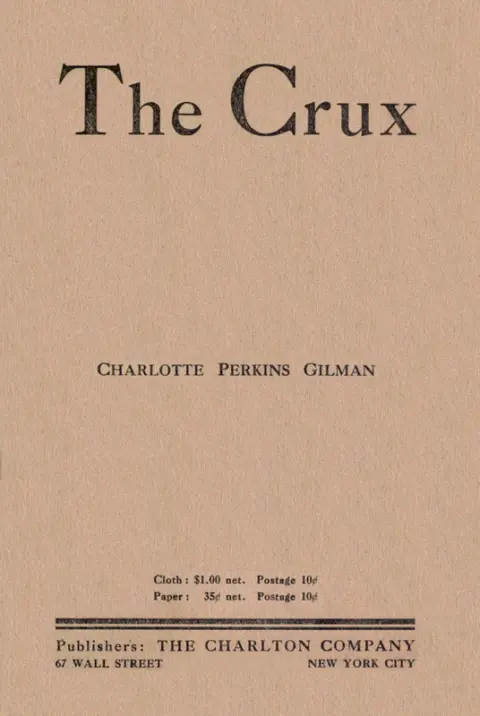
"The Crux: A Novel" by Charlotte Perkins Gilman is a fiction work written in the early 20th century. The story introduces readers to Vivian Lane and her family, delving into themes surrounding societal expectations, personal growth, and women's roles during a time when these were undergoing significant scrutiny and change. The narrative explores Vivian's life in a small New England town and her desire for independence and purpose amid the limitations imposed by her conservative upbringing. The opening of the novel establishes the setting and introduces characters such as the Foote sisters and the Lane family, who are embroiled in local gossip about a young boy named Morton Elder. As discussions unfold around this family and the societal norms of their community, we see Vivian grappling with her own thoughts about education, marriage, and her aspirations—younger than her parents and looking to strike her own path. Despite the conventional expectations of her environment, Vivian's defiance emerges as she longs for more from life than what traditional roles ascribe to her. This sets the stage for her ensuing journey and challenges, drawing readers into her struggle for self-definition against societal limitations.
Introduction adapted from the source catalogue; source summaries may be automatically generated.
Free to read · English · 52,782 words · No account needed
MAKE TIME FOR A GOOD BOOK
On by default. Untick to stop anonymous reading totals. Each page counts after 10 seconds in view. How this works.
Anonymous counting is on unless you have switched it off.
"Never be able to have a child, because I married a man who had gonorrhea. In place of happy love, lonely pain. In place of motherhood, disease. Misery and shame, child. Medicine and surgery, and never any possibility of any child for me."
The girl was pale with horror. "I--I didn't know--" She tried to say something, but the doctor burst out impatiently:
"No! You don't know. I didn't know. Girls aren't taught a word of what's before them till it's too late--not then, sometimes! Women lose every joy in life, every hope, every capacity for service or pleasure. They go down to their graves without anyone's telling them the cause of it all."
"That was why you--left him?" asked Vivian presently.
"Yes, I left him. When I found I could not be a mother I determined to be a doctor, and save other women, if I could." She said this with such slow, grave emphasis that Vivian turned a sudden startled face to her, and went white to the lips.
"I may be wrong," the doctor said, "you have not given me your confidence in this matter. But it is better, a thousand times better, that I should make this mistake than for you to make that. You must not marry Morton Elder."
Vivian did not admit nor deny. She still wore that look of horror.
"You think he has--That?"
"I do not know whether he has gonorrhea or not; it takes a long microscopic analysis to be sure; but there is every practical assurance that he's had it, and I know he's had syphilis."
If Vivian could have turned paler she would have, then.
"I've heard of--that," she said, shuddering.
"Yes, the other is newer to our knowledge, far commoner, and really more dangerous. They are two of the most terrible diseases known to us; highly contagious, and in the case of syphilis, hereditary. Nearly three-quarters of the men have one or the other, or both."
But Vivian was not listening. Her face was buried in her hands. She crouched low in agonized weeping.
"Oh, come, come, my dear. Don't take it so hard. There's no harm done you see, it's not too late."
"Oh, it is too late! It is!" wailed the girl. "I have promised to
marry him."
"I don't care if you were at the altar, child; you haven't married
him, and you mustn't."
"I have given my word!" said the girl dully. She was thinking of Morton now. Of his handsome face, with it's new expression of respectful tenderness; of all the hopes they had built together; of his life, so dependent upon hers for its higher interests.
Your reading position is saved on this browser. Take it to another device with a library code. Reading pages adapt to text, rather than matching a printed edition.
Charlotte Perkins Gilman

Charlotte Perkins Gilman

Charlotte Perkins Gilman

Charlotte Perkins Gilman
BEHIND THE BOOK
This eBook is for the use of anyone anywhere in the United States and most other parts of the world at no cost and with almost no restrictions whatsoever. You may copy it, give it away or re-use it under the terms of the Project Gutenberg License included with this eBook or online at www.gutenberg.org. If you are not located in the United States, you will have to check the laws of the country where you are located before using this eBook. Read the source licence.
The original source file, including credits and licence, is retained by this library. Request an original-format copy at no charge. Please include the book title and Project Gutenberg identifier #38551.
KEEP YOUR CURIOSITY GOING
Coulson Kernahan

Maurice Baring
Frances Wright
Cécile Tormay

Frederic Jesup Stimson

W. H. P. (William Henry Pope) Jarvis