
Moving the Mountain
Charlotte Perkins Gilman
THE CLASSIC COLLECTION · 1911
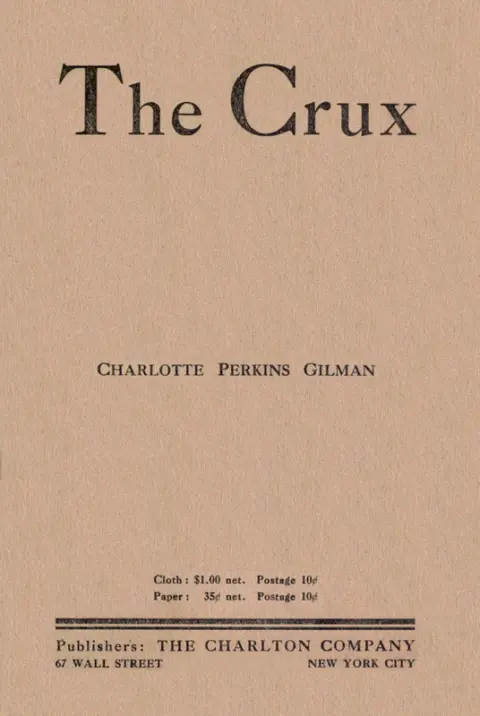
"The Crux: A Novel" by Charlotte Perkins Gilman is a fiction work written in the early 20th century. The story introduces readers to Vivian Lane and her family, delving into themes surrounding societal expectations, personal growth, and women's roles during a time when these were undergoing significant scrutiny and change. The narrative explores Vivian's life in a small New England town and her desire for independence and purpose amid the limitations imposed by her conservative upbringing. The opening of the novel establishes the setting and introduces characters such as the Foote sisters and the Lane family, who are embroiled in local gossip about a young boy named Morton Elder. As discussions unfold around this family and the societal norms of their community, we see Vivian grappling with her own thoughts about education, marriage, and her aspirations—younger than her parents and looking to strike her own path. Despite the conventional expectations of her environment, Vivian's defiance emerges as she longs for more from life than what traditional roles ascribe to her. This sets the stage for her ensuing journey and challenges, drawing readers into her struggle for self-definition against societal limitations.
Introduction adapted from the source catalogue; source summaries may be automatically generated.
Free to read · English · 52,782 words · No account needed
MAKE TIME FOR A GOOD BOOK
On by default. Untick to stop anonymous reading totals. Each page counts after 10 seconds in view. How this works.
Anonymous counting is on unless you have switched it off.
Another thing counted, too, counted heavily, though Vivian never dreamed of it and would have hotly repudiated the charge. She was a woman of full marriageable age, with all the unused powers of her woman's nature calling for expression, quite unrecognized.
He was a man who loved her, loved her more deeply than he had ever loved before, than he had even known he could love; who quite recognized what called within him and meant to meet the call. And he was near her every day.
After that one fierce outbreak he held himself well in check. He knew he had startled her then, almost lost her. And with every hour of their companionship he felt more and more how much she was to him. Other women he had pursued, overtaken, left behind. He felt that there was something in Vivian which was beyond him, giving a stir and lift of aspiration which he genuinely enjoyed.
Day by day he strove to win her full approval, and day by day he did not neglect the tiny, slow-lapping waves of little tendernesses, small affectionate liberties at well-chosen moments, always promptly withdrawing when forbidden, but always beginning again a little further on.
Dr. Bellair went to Dr. Hale's office and sat herself down solidly in
the patient's chair.
"Dick," she said, "are you going to stand for this?"
"Stand for what, my esteemed but cryptic fellow-practitioner?"
She eyed his calm, reserved countenance with friendly admiration. "You are an awfully good fellow, Dick, but dull. At the same time dull and transparent. Are you going to sit still and let that dangerous patient of yours marry the finest girl in town?"
"Your admiration for girls is always stronger than mine, Jane; and I have, if you will pardon the boast, more than one patient."
"All right, Dick--if you want it made perfectly clear to your understanding. Do you mean to let Morton Elder marry Vivian Lane?"
"What business is it of mine?" he demanded, more than
brusquely--savagely.
"You know what he's got."
"I am a physician, not a detective. And I am not Miss Lane's father, brother, uncle or guardian."
"Or lover," added Dr. Bellair, eyeing him quietly. She thought she saw a second's flicker of light in the deep gray eyes, a possible tightening of set lips. "Suppose you are not," she said; "nor even a humanitarian. You are a member of society. Do you mean to let a man whom you know has no right to marry, poison the life of that splendid girl?"
He was quite silent for a moment, but she could see the hand on the farther arm of his chair grip it till the nails were white.
Your reading position is saved on this browser. Take it to another device with a library code. Reading pages adapt to text, rather than matching a printed edition.
Charlotte Perkins Gilman

Charlotte Perkins Gilman

Charlotte Perkins Gilman

Charlotte Perkins Gilman
BEHIND THE BOOK
This eBook is for the use of anyone anywhere in the United States and most other parts of the world at no cost and with almost no restrictions whatsoever. You may copy it, give it away or re-use it under the terms of the Project Gutenberg License included with this eBook or online at www.gutenberg.org. If you are not located in the United States, you will have to check the laws of the country where you are located before using this eBook. Read the source licence.
The original source file, including credits and licence, is retained by this library. Request an original-format copy at no charge. Please include the book title and Project Gutenberg identifier #38551.
KEEP YOUR CURIOSITY GOING
Coulson Kernahan

Maurice Baring
Frances Wright
Cécile Tormay

Frederic Jesup Stimson

W. H. P. (William Henry Pope) Jarvis