
Moving the Mountain
Charlotte Perkins Gilman
THE CLASSIC COLLECTION · 1911
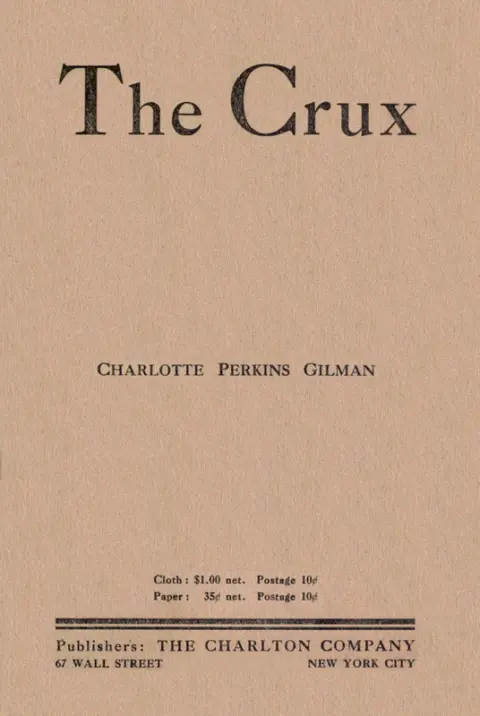
"The Crux: A Novel" by Charlotte Perkins Gilman is a fiction work written in the early 20th century. The story introduces readers to Vivian Lane and her family, delving into themes surrounding societal expectations, personal growth, and women's roles during a time when these were undergoing significant scrutiny and change. The narrative explores Vivian's life in a small New England town and her desire for independence and purpose amid the limitations imposed by her conservative upbringing. The opening of the novel establishes the setting and introduces characters such as the Foote sisters and the Lane family, who are embroiled in local gossip about a young boy named Morton Elder. As discussions unfold around this family and the societal norms of their community, we see Vivian grappling with her own thoughts about education, marriage, and her aspirations—younger than her parents and looking to strike her own path. Despite the conventional expectations of her environment, Vivian's defiance emerges as she longs for more from life than what traditional roles ascribe to her. This sets the stage for her ensuing journey and challenges, drawing readers into her struggle for self-definition against societal limitations.
Introduction adapted from the source catalogue; source summaries may be automatically generated.
Free to read · English · 52,782 words · No account needed
MAKE TIME FOR A GOOD BOOK
On by default. Untick to stop anonymous reading totals. Each page counts after 10 seconds in view. How this works.
Anonymous counting is on unless you have switched it off.
The girl, sympathetic and admiring, thought hotly of how other people misunderstood this noble, lovely soul; how they even hinted that she "tried to attract men," a deadly charge in Bainville.
"No," Mrs. St. Cloud had told her, "he might love you better than all the world--yet not write to you--till he was ready to say 'come.' And, of course, he wouldn't say anything in his letters to his aunt."
So Vivian sat there, silent, weaving frail dreams out of "remember me to Viva--unless she's married." That last clause might mean much.
Dr. Bellair's voice sounded clear and insistent in the next room.
"She's trying to persuade Aunt Rella to go West!" said Susie.
"Wouldn't it be funny if she did!"
In Susie's eyes her Aunt's age was as the age of mountains, and also her fixity. Since she could remember, Aunt Rella, always palely pretty and neat, like the delicate, faintly-colored Spring flowers of New England, had presided over the small white house, the small green garden and the large black and white school-room. In her vacation she sewed, keeping that quiet wardrobe of hers in exquisite order--and also making Susie's pretty dresses. To think of Aunt Orella actually "breaking up housekeeping," giving up her school, leaving Bainville, was like a vision of trees walking.
To Dr. Jane Bellair, forty-one, vigorous, successful, full of new plans and purposes, Miss Elder's life appeared as an arrested girlhood, stagnating unnecessarily in this quiet town, while all the world was open to her.
"I couldn't think of leaving Susie!" protested Miss Orella.
"Bring her along," said the doctor. "Best thing in the world for her!"
She rose and came to the door. The two girls make a pretty picture. Vivian's oval face, with its smooth Madonna curves under the encircling wreath of soft, dark plaits, and the long grace of her figure, delicately built, yet strong, beside the pink, plump little Susie, roguish and pretty, with the look that made everyone want to take care of her.
"Come in here, girls," said the doctor. "I want you to help me. You're young enough to be movable, I hope."
They cheerfully joined the controversy, but Miss Orella found small
support in them.
"Why don't you do it, Auntie!" Susie thought it an excellent joke. "I suppose you could teach school in Denver as well as here. And you could Vote! Oh, Auntie--to think of your Voting!"
Miss Elder, too modestly feminine, too inherently conservative even to be an outspoken "Anti," fairly blushed at the idea.
Your reading position is saved on this browser. Take it to another device with a library code. Reading pages adapt to text, rather than matching a printed edition.
Charlotte Perkins Gilman

Charlotte Perkins Gilman

Charlotte Perkins Gilman

Charlotte Perkins Gilman
BEHIND THE BOOK
This eBook is for the use of anyone anywhere in the United States and most other parts of the world at no cost and with almost no restrictions whatsoever. You may copy it, give it away or re-use it under the terms of the Project Gutenberg License included with this eBook or online at www.gutenberg.org. If you are not located in the United States, you will have to check the laws of the country where you are located before using this eBook. Read the source licence.
The original source file, including credits and licence, is retained by this library. Request an original-format copy at no charge. Please include the book title and Project Gutenberg identifier #38551.
KEEP YOUR CURIOSITY GOING
Coulson Kernahan

Maurice Baring
Frances Wright
Cécile Tormay

Frederic Jesup Stimson

W. H. P. (William Henry Pope) Jarvis