
Moving the Mountain
Charlotte Perkins Gilman
THE CLASSIC COLLECTION · 1911
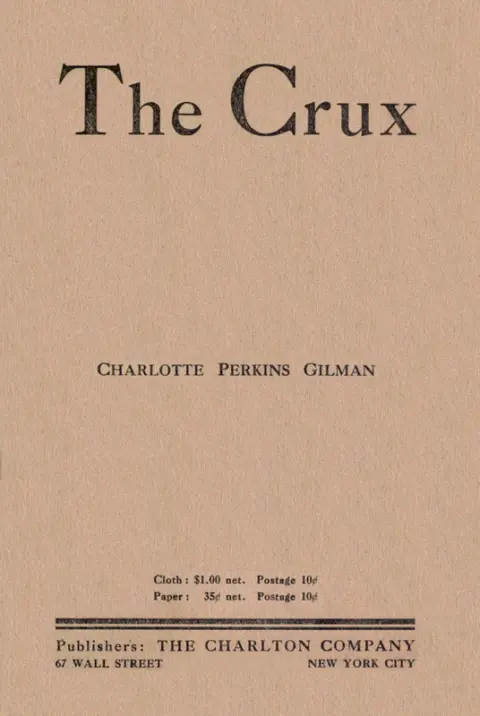
"The Crux: A Novel" by Charlotte Perkins Gilman is a fiction work written in the early 20th century. The story introduces readers to Vivian Lane and her family, delving into themes surrounding societal expectations, personal growth, and women's roles during a time when these were undergoing significant scrutiny and change. The narrative explores Vivian's life in a small New England town and her desire for independence and purpose amid the limitations imposed by her conservative upbringing. The opening of the novel establishes the setting and introduces characters such as the Foote sisters and the Lane family, who are embroiled in local gossip about a young boy named Morton Elder. As discussions unfold around this family and the societal norms of their community, we see Vivian grappling with her own thoughts about education, marriage, and her aspirations—younger than her parents and looking to strike her own path. Despite the conventional expectations of her environment, Vivian's defiance emerges as she longs for more from life than what traditional roles ascribe to her. This sets the stage for her ensuing journey and challenges, drawing readers into her struggle for self-definition against societal limitations.
Introduction adapted from the source catalogue; source summaries may be automatically generated.
Free to read · English · 52,782 words · No account needed
MAKE TIME FOR A GOOD BOOK
On by default. Untick to stop anonymous reading totals. Each page counts after 10 seconds in view. How this works.
Anonymous counting is on unless you have switched it off.
Mrs. Pettigrew set her lips so tightly that they quite disappeared, leaving only a thin dented line in her smoothly pale face. She was called by the neighbors "wonderfully well preserved," a phrase she herself despised. Some visitor, new to the town, had the hardihood to use it to her face once. "Huh!" was the response. "I'm just sixty. Henry Haskins and George Baker and Stephen Doolittle are all older'n I am--and still doing business, doing it better'n any of the young folks as far as I can see. You don't compare them to canned pears, do you?"
Mr. Williams knew her value in church work, and took no umbrage at her somewhat inimical expression; particularly as just then Mrs. Lane appeared and asked them to walk out to supper.
Vivian sat among them, restrained and courteous, but inwardly at war with her surroundings. Here was her mother, busy, responsible, serving creamed codfish and hot biscuit; her father, eating wheezily, and finding fault with the biscuit, also with the codfish; her grandmother, bright-eyed, thin-lipped and silent. Vivian got on well with her grandmother, though neither of them talked much.
"My mother used to say that the perfect supper was cake, preserves, hot bread, and a 'relish,'" said Mr. Williams genially. "You have the perfect supper, Mrs. Lane."
"I'm glad if you enjoy it, I'm sure," said that lady. "I'm fond of a
bit of salt myself."
"And what are you reading now, Vivian," he asked paternally.
"Ward," she answered, modestly and briefly.
"Ward? Dr. Ward of the Centurion?"
Vivian smiled her gentlest.
"Oh, no," she replied; "Lester F. Ward, the Sociologist."
"Poor stuff, I think!" said her father. "Girls have no business to
read such things."
"I wish you'd speak to Vivian about it, Mr. Williams. She's got beyond me," protested her mother.
"Huh!" said Mrs. Pettigrew. "I'd like some more of that quince, Laura."
"My dear young lady, you are not reading books of which your parents disapprove, I hope?" urged the minister.
"Shouldn't I--ever?" asked the girl, in her soft, disarming manner.
"I'm surely old enough!"
"The duty of a daughter is not measured by years," he replied sonorously. "Does parental duty cease? Are you not yet a child in your father's house?"
"Is a daughter always a child if she lives at home?" inquired the girl, as one seeking instruction.
He set down his cup and wiped his lips, flushing somewhat.
"The duty of a daughter begins at the age when she can understand the distinction between right and wrong," he said, "and continues as long as she is blessed with parents."
"And what is it?" she asked, large-eyed, attentive.
Your reading position is saved on this browser. Take it to another device with a library code. Reading pages adapt to text, rather than matching a printed edition.
Charlotte Perkins Gilman

Charlotte Perkins Gilman

Charlotte Perkins Gilman

Charlotte Perkins Gilman
BEHIND THE BOOK
This eBook is for the use of anyone anywhere in the United States and most other parts of the world at no cost and with almost no restrictions whatsoever. You may copy it, give it away or re-use it under the terms of the Project Gutenberg License included with this eBook or online at www.gutenberg.org. If you are not located in the United States, you will have to check the laws of the country where you are located before using this eBook. Read the source licence.
The original source file, including credits and licence, is retained by this library. Request an original-format copy at no charge. Please include the book title and Project Gutenberg identifier #38551.
KEEP YOUR CURIOSITY GOING
Coulson Kernahan

Maurice Baring
Frances Wright
Cécile Tormay

Frederic Jesup Stimson

W. H. P. (William Henry Pope) Jarvis