
Billy Topsail, M.D.: A Tale of Adventure With Doctor Luke of the Labrador
Norman Duncan
THE CLASSIC COLLECTION · 1907
"The Cruise of the Shining Light" by Norman Duncan is a novel written in the early 20th century. The story revolves around a young boy named Dannie, who is raised by his eccentric uncle, Nicholas Top, in the coastal community of Twist Tickle. It explores themes of family, identity, and the complexities of human nature as Nick attempts to instill values of gentility and self-worth in Dannie, despite his own questionable character and the shadows of his past. At the start of the book, we are introduced to Uncle Nicholas, a physically scarred and somewhat grotesque man, who has a complicated relationship with his past and his nephew. The narrative reveals their life together, filled with moments of both affection and confusion. As they navigate their peculiar existence, Uncle Nick imparts lessons about life, wealth, and morality, all while grappling with his own flaws and a sense of duty as a guardian. The beginning sets the stage for an evocative exploration of their bond and the adventures that lie ahead amidst the rugged beauty of their coastal surroundings.
Introduction adapted from the source catalogue; source summaries may be automatically generated.
Free to read · English · 83,367 words · No account needed
MAKE TIME FOR A GOOD BOOK
On by default. Untick to stop anonymous reading totals. Each page counts after 10 seconds in view. How this works.
Anonymous counting is on unless you have switched it off.
"I wisht, Dannie," said he, in a break of feeling for me, "that you
had a mother."
"I wisht I had," said I.
"I wisht," said he, in the way of all men with mothers, as God knows why, "that you had one--just like mine."
We were come to the turn in the road, where the path descended at haphazard, over the rocks and past the pigpen, to the cottage of Eli Flack, builded snugly in a lee from the easterly gales. For a moment, in the pause, the fool of Twist Tickle let his hand rest upon my shoulder, which never before had happened in all our intercourse, but withdrew it, as though awakened from this pitying affection to a sense of his presumption, which never, God witness! did I teach him.
"Tis a grand sunset," said he. "Look, Dannie; 'tis a sunset with
gates!"
'Twas so: great black gates of cloud, edged with glowing color, with the quiet and light of harbor beyond.
"With gates!" he whispered.
'Twas the fancy of a fool; nay, 'twas the fancy (as chanced his need)
of some strange wisdom.
"Dannie," said he, "they's times when I sees mother's face peerin' at me from them clouds--her own dear face as 'twas afore she died. She's keepin' watch from the windows o' heaven--keepin' watch, jus' like she used t' do. You'll never tell, will you, lad? You'll not shame me, will you? They'd laugh, out there on the grounds, an you told: for they're so wonderful fond o' laughter--out there on the grounds. I lives, somehow," said he, brushing his hand in bewilderment over his eyes, "in the midst o' laughter, but have no call t' laugh. I wonder why, for mother didn't laugh; an' I wonder why they laughs so much. They'd laugh, Dannie, an you told un she was keepin' watch; an' so you will not: for I've growed, somehow, wonderful tired o' laughter--since mother died. But 'tis so: I knows 'tis so! I sees her face in the light o' sunsets--just as it used t' be. She comes t' the gate, when the black clouds arise t' hide the mystery we've no call t' know, an' the dear Lord cares not what we fathom; an' I sees her, Dannie, from my punt, still keepin' watch upon me, just like she done from the window, afore she went an' died. She was a wonderful hand, somehow, at keepin' watch at the window. She'd watch me go an' watch me come. I've often wondered why she done it. I've wondered, Dannie, an' wondered, but never could tell why. Why, Dannie, I've knowed her t' run out, by times, an' say: 'Come, dear, 'tis time you was within. Hush, lad, never care. They'll never hurt you, dear,' says she, 'when you're within--with me.' An', Dannie, t' this day I'm feared t' look into the sky, at evening, when I've been bad, lest I sees her saddened by my deeds; but when I'm good, I'm glad t' see her face, for she smiles, lad, just like she used t' do from the window--afore they buried her."
Your reading position is saved on this browser. Take it to another device with a library code. Reading pages adapt to text, rather than matching a printed edition.
Norman Duncan
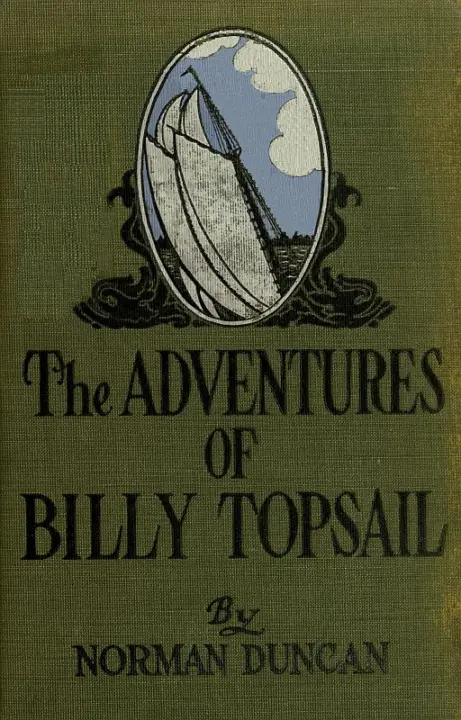
Norman Duncan
Norman Duncan
Norman Duncan
BEHIND THE BOOK
This eBook is for the use of anyone anywhere in the United States and most other parts of the world at no cost and with almost no restrictions whatsoever. You may copy it, give it away or re-use it under the terms of the Project Gutenberg License included with this eBook or online at www.gutenberg.org. If you are not located in the United States, you will have to check the laws of the country where you are located before using this eBook. Read the source licence.
The original source file, including credits and licence, is retained by this library. Request an original-format copy at no charge. Please include the book title and Project Gutenberg identifier #29696.
KEEP YOUR CURIOSITY GOING
Coulson Kernahan

Maurice Baring
Frances Wright
Cécile Tormay

Frederic Jesup Stimson

W. H. P. (William Henry Pope) Jarvis