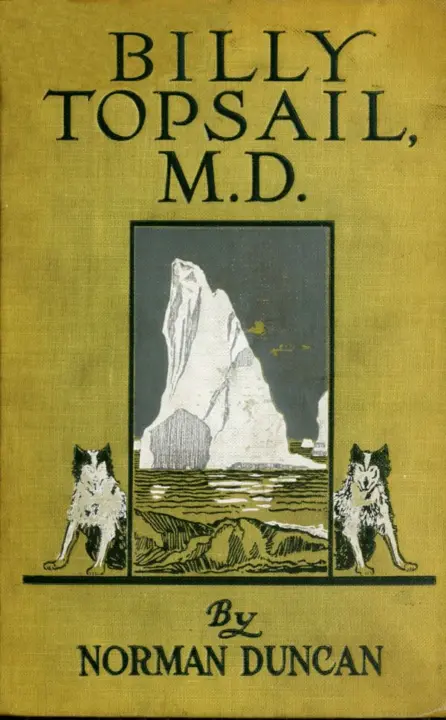
Billy Topsail, M.D.: A Tale of Adventure With Doctor Luke of the Labrador
Norman Duncan
THE CLASSIC COLLECTION · 1907
"The Cruise of the Shining Light" by Norman Duncan is a novel written in the early 20th century. The story revolves around a young boy named Dannie, who is raised by his eccentric uncle, Nicholas Top, in the coastal community of Twist Tickle. It explores themes of family, identity, and the complexities of human nature as Nick attempts to instill values of gentility and self-worth in Dannie, despite his own questionable character and the shadows of his past. At the start of the book, we are introduced to Uncle Nicholas, a physically scarred and somewhat grotesque man, who has a complicated relationship with his past and his nephew. The narrative reveals their life together, filled with moments of both affection and confusion. As they navigate their peculiar existence, Uncle Nick imparts lessons about life, wealth, and morality, all while grappling with his own flaws and a sense of duty as a guardian. The beginning sets the stage for an evocative exploration of their bond and the adventures that lie ahead amidst the rugged beauty of their coastal surroundings.
Introduction adapted from the source catalogue; source summaries may be automatically generated.
Free to read · English · 83,367 words · No account needed
MAKE TIME FOR A GOOD BOOK
On by default. Untick to stop anonymous reading totals. Each page counts after 10 seconds in view. How this works.
Anonymous counting is on unless you have switched it off.
I observed my uncle: he was gone with the need of rum--exhausted and unnerved: his face all pallid and splotched. 'Twas a ghastly thing to watch him stump the gravelled walk of our garden in the gray light of that day.
"Uncle Nicholas, sir," says I, for the moment forgetting the woe of Judith's hapless state in this new alarm, "do you come within an' have a dram."
"Ye're not knowin' how t' search," he complained. "Ye're but a pack
o' dunderheads!"
"Come, sir!" I pleaded.
"Is ye been t' Skeleton Droch?" he demanded. "She've a habit o' readin' there. No!" he growled, in a temper; "you isn't had the sense t' go t' Skeleton Droch."
"A dram, sir," I ventured, "t' comfort you."
"An' ye bide here, ye dunderhead!" he accused.
I put my hand on his shoulder: he flung it off. I took his arm: he wrenched himself free in an indignant passion.
"Ye're needin' it, sir," says I.
"For God's sake, child!" he cried; "do you go find the maid an' leave me be. God knows I've trouble enough without ye!"
The maid was not at Skeleton Droch: neither on the hills, nor in the hiding-places of the valleys, nor lying broken on the ledges of the cliffs, nor swinging in the sea beneath--nor was she anywhere on the land of Twin Islands or in the waters that restlessly washed the boundary of gray rock. 'Twas near evening now, and a dreary, angrily windy time. Our men gathered from shore and inland barren--and there was no Judith, nor cold, wet body of Judith, anywhere to be found. 'Twas unthinkingly whispered, then, that the maid had fled with John Cather on the mail-boat: this on Tom Tulk's Head, in its beginning, and swiftly passed from tongue to tongue. Being overwrought when I caught the surmise--'twas lusty young Jack Bluff that uttered it before me--I persuaded the youth of his error, which, upon rising, he admitted, as did they all of that group, upon my request, forgiving me, too, I think, the cruel abruptness of my argument, being men of feeling, every one. The maid was not gone with John Cather, she was not on the hills of Twin Islands; she was then fled to Topmast Harbor for self-support, that larger settlement, whence many Labradormen put out at this season for the northerly fishing. And while, sheltered from the rising wind, the kind men-folk of our harbor talked with my uncle and me on Eli Flack's stage, there came into the tickle from Topmast Harbor, in quest of water, a punt and a man, being bound, I think, for Jimmie Tick's Cove. 'Twas by him reported that a maid of gentle breeding had come alone in a punt to Topmast in the night. And her hair? says I. She had hair, and a wonderful sight of it, says he. And big, blue eyes? says I. She had eyes, says he; an' she had a nose, so far as he could tell, which had clapped eyes on the maid, an' she had teeth an' feet, himself being able to vouch for the feet, which clipped it over the Topmast roads quite lively, soon after dawn, in search of a schooner bound down the Labrador.
Your reading position is saved on this browser. Take it to another device with a library code. Reading pages adapt to text, rather than matching a printed edition.
Norman Duncan
Norman Duncan
Norman Duncan
Norman Duncan
BEHIND THE BOOK
This eBook is for the use of anyone anywhere in the United States and most other parts of the world at no cost and with almost no restrictions whatsoever. You may copy it, give it away or re-use it under the terms of the Project Gutenberg License included with this eBook or online at www.gutenberg.org. If you are not located in the United States, you will have to check the laws of the country where you are located before using this eBook. Read the source licence.
The original source file, including credits and licence, is retained by this library. Request an original-format copy at no charge. Please include the book title and Project Gutenberg identifier #29696.
KEEP YOUR CURIOSITY GOING
Coulson Kernahan

Maurice Baring
Frances Wright
Cécile Tormay

Frederic Jesup Stimson

W. H. P. (William Henry Pope) Jarvis