
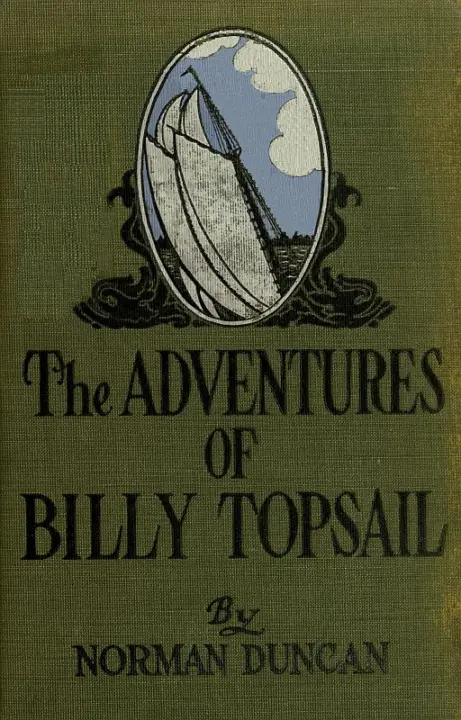
Billy Topsail, M.D.: A Tale of Adventure With Doctor Luke of the Labrador
Norman Duncan
THE CLASSIC COLLECTION · 1907
"The Cruise of the Shining Light" by Norman Duncan is a novel written in the early 20th century. The story revolves around a young boy named Dannie, who is raised by his eccentric uncle, Nicholas Top, in the coastal community of Twist Tickle. It explores themes of family, identity, and the complexities of human nature as Nick attempts to instill values of gentility and self-worth in Dannie, despite his own questionable character and the shadows of his past. At the start of the book, we are introduced to Uncle Nicholas, a physically scarred and somewhat grotesque man, who has a complicated relationship with his past and his nephew. The narrative reveals their life together, filled with moments of both affection and confusion. As they navigate their peculiar existence, Uncle Nick imparts lessons about life, wealth, and morality, all while grappling with his own flaws and a sense of duty as a guardian. The beginning sets the stage for an evocative exploration of their bond and the adventures that lie ahead amidst the rugged beauty of their coastal surroundings.
Introduction adapted from the source catalogue; source summaries may be automatically generated.
Free to read · English · 83,367 words · No account needed
MAKE TIME FOR A GOOD BOOK
On by default. Untick to stop anonymous reading totals. Each page counts after 10 seconds in view. How this works.
Anonymous counting is on unless you have switched it off.
"Dannie," says my uncle, feigning a relief he dared not entertain, "you was wantin' a drop o' water, wasn't you?" He pushed the little brown jug towards me. "I 'lowed 'twas water," says he, hopefully, "when you up an' spoke about gettin' a glass from the pantry." He urged the jug in my direction. "Ay," he repeated, not hopefully now at all, but in a whisper more like despair, "I jus' 'lowed 'twas a drop o' water."
The jug remained in its place.
"Dannie," he entreated, with a thick forefinger still urging the jug on its course, "you is thirsty, I knows you is!"
I would not touch the jug.
"You been havin' any trouble, shipmate?" he gently asked.
"Yes, sir," I groaned. "Trouble, God knows!"
"Along o' Judy?"
'Twas along o' Judy.
"A drop o' water," says he, setting the glass almost within my hand,
"will do you good."
'Twas so anxiously spoken that my courage failed me. I splashed water into the glass and swallowed it.
"That's good," says he; "that's very good."
I pushed the glass away with contempt for its virtue of comfort; and I laughed, I think, in a disagreeable way, so that the old man, unused to manifestations as harsh and irreligious as this, started in dismay.
"Good," he echoed, staring, unconvinced and without hope; "that's very
good."
And now, a miserable determination returning, I fixed my eyes again on the square, black bottle of rum. 'Twas a thing that fairly fascinated my attention. The cure of despair was legendary, the palatable quality a thing of mere surmise: I had never experienced either; but in my childhood I had watched my uncle's fearsome moods vanish, as he downed his drams, one by one, giving way to a grateful geniality, which sent my own bogies scurrying off, and I had fancied, from the smack of his lips, and from the eager lifting of the glasses at the Anchor and Chain, the St. John's tap-room we frequented, that a drop o' rum was a thing to delight the dry tongue and gullet of every son of man. My uncle sat under the lamp: I remember his countenance, aside from the monstrous scars and disfigurements which the sea had dealt him--its anxious regard of me, its intense concern, its gathering purpose, the last of which I did not read at that moment, but now recall and understand. 'Twas quiet and orderly in the room: the geometrical gentlemen were there riding the geometrically tempestuous sea in a frame beyond my uncle's gargoylish head, and the tidied rocking-chair, which I was used to addressing as a belted knight o' the realm, austerely abode in a shadow. I was in some saving way, as often happens in our lives, conscious of these familiar things, to which we return and cling in the accidents befalling us and in the emergencies of feeling we must all survive. The room was as our maid-servant had left it, bright and warm and orderly: there was as yet no disarrangement by the conviviality we were used to. 'Tis not at all my wish to trouble you with the despair I suffered that night, with Judith gone from me: I would not utter it--'twas too deep and unusual and tragical to disturb a world with. But still I stared at that square, black bottle of rum, believing, as faith may be, in the surcease it contained.
Your reading position is saved on this browser. Take it to another device with a library code. Reading pages adapt to text, rather than matching a printed edition.
Norman Duncan
Norman Duncan
Norman Duncan
Norman Duncan
BEHIND THE BOOK
This eBook is for the use of anyone anywhere in the United States and most other parts of the world at no cost and with almost no restrictions whatsoever. You may copy it, give it away or re-use it under the terms of the Project Gutenberg License included with this eBook or online at www.gutenberg.org. If you are not located in the United States, you will have to check the laws of the country where you are located before using this eBook. Read the source licence.
The original source file, including credits and licence, is retained by this library. Request an original-format copy at no charge. Please include the book title and Project Gutenberg identifier #29696.
KEEP YOUR CURIOSITY GOING
Coulson Kernahan

Maurice Baring
Frances Wright
Cécile Tormay

Frederic Jesup Stimson

W. H. P. (William Henry Pope) Jarvis