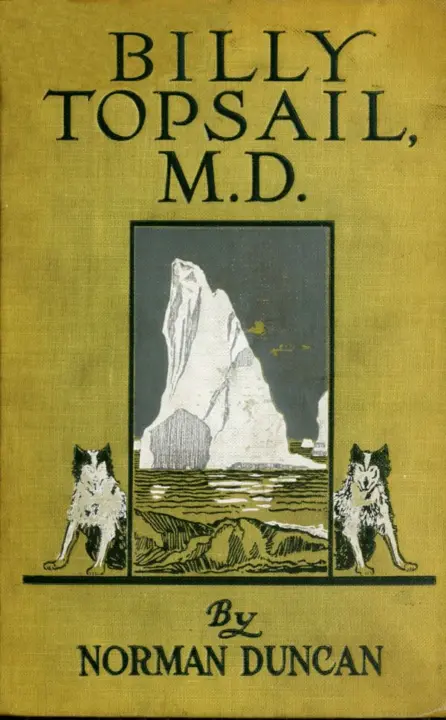
Billy Topsail, M.D.: A Tale of Adventure With Doctor Luke of the Labrador
Norman Duncan
THE CLASSIC COLLECTION · 1907
"The Cruise of the Shining Light" by Norman Duncan is a novel written in the early 20th century. The story revolves around a young boy named Dannie, who is raised by his eccentric uncle, Nicholas Top, in the coastal community of Twist Tickle. It explores themes of family, identity, and the complexities of human nature as Nick attempts to instill values of gentility and self-worth in Dannie, despite his own questionable character and the shadows of his past. At the start of the book, we are introduced to Uncle Nicholas, a physically scarred and somewhat grotesque man, who has a complicated relationship with his past and his nephew. The narrative reveals their life together, filled with moments of both affection and confusion. As they navigate their peculiar existence, Uncle Nick imparts lessons about life, wealth, and morality, all while grappling with his own flaws and a sense of duty as a guardian. The beginning sets the stage for an evocative exploration of their bond and the adventures that lie ahead amidst the rugged beauty of their coastal surroundings.
Introduction adapted from the source catalogue; source summaries may be automatically generated.
Free to read · English · 83,367 words · No account needed
MAKE TIME FOR A GOOD BOOK
On by default. Untick to stop anonymous reading totals. Each page counts after 10 seconds in view. How this works.
Anonymous counting is on unless you have switched it off.
By this I was again offended.
"Judy," says my uncle, when we were within, "fetch the bottle. Fetch the bottle, maid!" cries he; "for 'tis surely an occasion."
Judith went to the pantry.
"Dannie," my uncle inquired, leaning eagerly close when she was gone from the room, "is ye been good?"
'Twas a question put in anxious doubt: I hesitated--wondering whether
or not I had been good.
"Isn't ye?" says he. "Ye'll tell me, won't ye? I'll love ye none the less for the evil ye've done."
Still I could not answer.
"I've been wantin' t' know," says he, his three-fingered fist softly beating the table, shaking in an intense agitation of suspense. "I've been waitin' an' waitin' for months--jus' t' hear ye say!"
I was conscious of no evil accomplished.
"Ye've a eye, Dannie!" says he.
I exposed my soul.
"That's good," says he, emphatically; "that's very good. I 'low I've
fetched ye up very well."
Judith came with the bottle and little brown jug: she had displaced me
from this occupation.
"O' course," says my uncle, in somewhat doubtful and ungenerous invitation, "ye'll be havin' a little darn ol' rum with a ol' shipmate. Ye've doubtless learned manners abroad," says he.
'Twas a delight to hear the fond fellow tempt me against his will: I
smiled.
"Jus' a little darn, Dannie," he repeated, but in no convivial way. "Jus' a little nip--with a ol' shipmate?"
I laughed most heartily to see Judith's sisterly concern for me.
"A wee drop?" my uncle insisted, more confidently.
"I'm not used to it, sir," says I.
"That's good," he declared; "that's very good. Give the devil his due, Dannie: I've fetched ye up very well."
'Twas with delight he challenged a disputation....
After this ceremony I sat with Judith on the peak of the Lost Soul. My uncle paced the gravelled walk, in the gathering dusk below, whence, by an ancient courtesy, he might benignantly spy upon the love-making. We were definite against the lingering twilight: I smiled to catch the old man pausing in the path with legs spread wide and glowing face upturned. But I had no smile for the maid, poor child! nor any word to say, save only to express a tenderness it seemed she would not hear. 'Twas very still in the world: there was no wind stirring, no ripple upon the darkening water, no step on the roads, no creak of oar-withe, no call or cry or laugh of humankind, no echo anywhere; and the sunset clouds trooped up from the rim of the sea with ominous stealth, throwing off their garments of light as they came, advancing, grim and gray, upon the shadowy coast. Across the droch, lifted high above the maid and me, his slender figure black against the pale-green sky, stood John Cather on the brink of Tom Tulk's cliff, with arms extended in some ecstasy to the smouldering western fire. A star twinkled serenely in the depths of space beyond, seeming, in the mystery of that time, to be set above his forehead; and I was pleased to fancy, I recall, that 'twas a symbol and omen of his nobility. Thus the maid and I: thus we four folk, who played the simple comedy--unknowing, every one, in the departing twilight of that day.
Your reading position is saved on this browser. Take it to another device with a library code. Reading pages adapt to text, rather than matching a printed edition.
Norman Duncan
Norman Duncan
Norman Duncan
Norman Duncan
BEHIND THE BOOK
This eBook is for the use of anyone anywhere in the United States and most other parts of the world at no cost and with almost no restrictions whatsoever. You may copy it, give it away or re-use it under the terms of the Project Gutenberg License included with this eBook or online at www.gutenberg.org. If you are not located in the United States, you will have to check the laws of the country where you are located before using this eBook. Read the source licence.
The original source file, including credits and licence, is retained by this library. Request an original-format copy at no charge. Please include the book title and Project Gutenberg identifier #29696.
KEEP YOUR CURIOSITY GOING
Coulson Kernahan

Maurice Baring
Frances Wright
Cécile Tormay

Frederic Jesup Stimson

W. H. P. (William Henry Pope) Jarvis