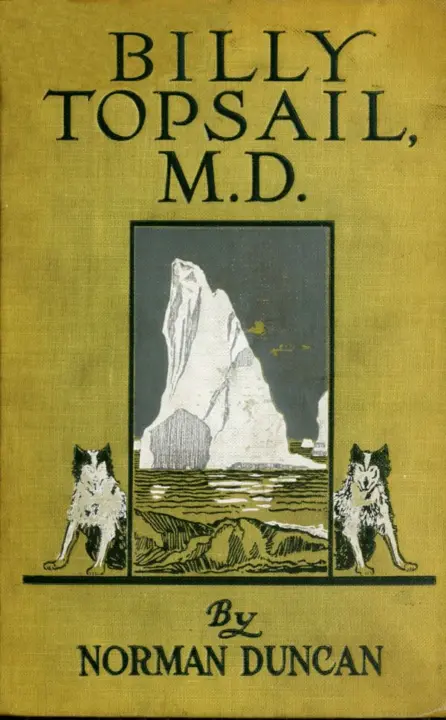
Billy Topsail, M.D.: A Tale of Adventure With Doctor Luke of the Labrador
Norman Duncan
THE CLASSIC COLLECTION · 1907
"The Cruise of the Shining Light" by Norman Duncan is a novel written in the early 20th century. The story revolves around a young boy named Dannie, who is raised by his eccentric uncle, Nicholas Top, in the coastal community of Twist Tickle. It explores themes of family, identity, and the complexities of human nature as Nick attempts to instill values of gentility and self-worth in Dannie, despite his own questionable character and the shadows of his past. At the start of the book, we are introduced to Uncle Nicholas, a physically scarred and somewhat grotesque man, who has a complicated relationship with his past and his nephew. The narrative reveals their life together, filled with moments of both affection and confusion. As they navigate their peculiar existence, Uncle Nick imparts lessons about life, wealth, and morality, all while grappling with his own flaws and a sense of duty as a guardian. The beginning sets the stage for an evocative exploration of their bond and the adventures that lie ahead amidst the rugged beauty of their coastal surroundings.
Introduction adapted from the source catalogue; source summaries may be automatically generated.
Free to read · English · 83,367 words · No account needed
MAKE TIME FOR A GOOD BOOK
On by default. Untick to stop anonymous reading totals. Each page counts after 10 seconds in view. How this works.
Anonymous counting is on unless you have switched it off.
Once I watched him stagger, white and bent with weather and labor, from the ice of Ship's Run, his bag on his back, to the smoking roofs of Twist Tickle, which winter had spread with a snowy blanket and tucked in with anxious hands. 'Twas a bitter day, cold, windy, aswirl with the dust of snow, blinding as a mist. I sat with Judith in the wide, deeply cushioned window-seat of my lib'ry, as my uncle called the comfortable, book-shelved room he had, by advice o' Sir Harry, provided for my youth. John Cather was not about; and I caressed, I recall, the long, slender fingers of her hand, which unfailingly and without hesitation gave themselves to my touch. She would never deny me that, this maid; 'twas only kisses she would hold me from. She would snuggle close and warmly, when John Cather was not about, but would call her God to witness that kisses were prohibited where happiness would continue.
"'Tis not 'lowed, child," says she.
Her cheek was so close, so round and soft and delicately tinted, that I touched my lips to it, quite unable to resist.
"I don't mind that," says she.
'Twas vastly encouraging.
"'Twas so brotherly," she added.
"Judy," I implored, "I'm in need of another o' that same kind."
"No, no!" she cried. "You'd never find the spot!"
'Twas with the maid, then, I sat in the window-seat of my warm room, content with the finger-tips I might touch and kiss as I would, lifted into a mood most holy and aspiring by the weight of her small head upon my shoulder, the bewildering light and mystery of her great, blue eyes, the touch and sweet excitement of her tawny hair, which brushed my cheek, as she well knew, this perverse maid! John Cather was not about, and the maid was yielding, as always in his absence; and I was very happy. 'Twas Moses we observed, all this time, doggedly staggering, upon patriotic duty, from the white, swirling weather of that unkind day, in the Queen's service, his bag on his back.
"He've his mother t' guide un," says she.
"An' his father?"
"'Tis said that he was lost," she answered, "in the Year o' the Big Shore Catch; but I'm knowin' nothin' about that."
I remembered the secret Elizabeth would impart to my uncle Nicholas.
"My father," says Judith, in challenge, "was a very good man."
I was not disposed to deny it.
"A very good man," she repeated, eying me sharply for any sign of
incredulity.
'Twas her fancy: I might indulge it.
Your reading position is saved on this browser. Take it to another device with a library code. Reading pages adapt to text, rather than matching a printed edition.
Norman Duncan
Norman Duncan
Norman Duncan
Norman Duncan
BEHIND THE BOOK
This eBook is for the use of anyone anywhere in the United States and most other parts of the world at no cost and with almost no restrictions whatsoever. You may copy it, give it away or re-use it under the terms of the Project Gutenberg License included with this eBook or online at www.gutenberg.org. If you are not located in the United States, you will have to check the laws of the country where you are located before using this eBook. Read the source licence.
The original source file, including credits and licence, is retained by this library. Request an original-format copy at no charge. Please include the book title and Project Gutenberg identifier #29696.
KEEP YOUR CURIOSITY GOING
Coulson Kernahan

Maurice Baring
Frances Wright
Cécile Tormay

Frederic Jesup Stimson

W. H. P. (William Henry Pope) Jarvis