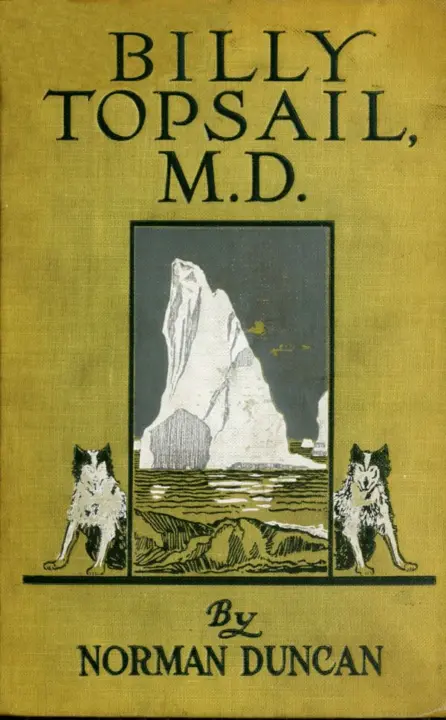
Billy Topsail, M.D.: A Tale of Adventure With Doctor Luke of the Labrador
Norman Duncan
THE CLASSIC COLLECTION · 1907
"The Cruise of the Shining Light" by Norman Duncan is a novel written in the early 20th century. The story revolves around a young boy named Dannie, who is raised by his eccentric uncle, Nicholas Top, in the coastal community of Twist Tickle. It explores themes of family, identity, and the complexities of human nature as Nick attempts to instill values of gentility and self-worth in Dannie, despite his own questionable character and the shadows of his past. At the start of the book, we are introduced to Uncle Nicholas, a physically scarred and somewhat grotesque man, who has a complicated relationship with his past and his nephew. The narrative reveals their life together, filled with moments of both affection and confusion. As they navigate their peculiar existence, Uncle Nick imparts lessons about life, wealth, and morality, all while grappling with his own flaws and a sense of duty as a guardian. The beginning sets the stage for an evocative exploration of their bond and the adventures that lie ahead amidst the rugged beauty of their coastal surroundings.
Introduction adapted from the source catalogue; source summaries may be automatically generated.
Free to read · English · 83,367 words · No account needed
MAKE TIME FOR A GOOD BOOK
On by default. Untick to stop anonymous reading totals. Each page counts after 10 seconds in view. How this works.
Anonymous counting is on unless you have switched it off.
"Hut, Moses!" I maintained; "she'll do very well. Jus' look at her!"
"Mother always 'lowed," says he, "that a craft was like a woman. An' since mother died, I've come t' learn for myself, Dannie," he drawled, "that the more a woman haves in the way o' looks the less weather she'll stand. I've jus' come, now," says he, "from overhaulin' a likely maid at Chain Tickle."
I looked up with interest.
"Jinny Lawless," says he. "Ol' Skipper Garge's youngest by the
third."
My glance was still inquiring.
"Ay, Dannie," he sighed; "she've declined."
"You've took a look," I inquired, "at the maids o' Long Bill Hodge o'
Sampson's Island?"
He nodded.
"An' they've--"
"All declined," says he.
"Never you care, Moses," said I. "Looks or no looks, you'll find the Shining Light stand by when she puts to sea."
"I'll not be aboard," says he.
"You're not so sure about that!" quoth I.
"I wouldn't ship," he drawled. "I'd never put t' sea on she: for mother," he added, "wouldn't like t' run the risk."
"You dwell too much upon your mother," said I.
"She's all I got in the way o' women," he answered. "All I got,
Dannie--yet."
"But when you gets a wife--"
"Oh," he interrupted, "Mrs. Moses Shoos won't mind mother!"
"Still an' all," I gravely warned him, "'tis a foolish thing t' do."
"Well, Dannie," he drawled, in a way so plaintive that I found no answer to his argument, "I is a fool. I'm told so every day, by men an' maids, wherever I goes; an' I jus' can't help bein' foolish."
"God made you," said I.
"An' mother always 'lowed," said Moses, "that He knowed what He was up to. An', Dannie," says he, "she always 'lowed, anyhow, that she was satisfied."
'Twas of a Sunday evening--upon the verge of twilight: with the light of day still abroad, leaving the hills of Twin Islands clear-cut against the blue sky, but falling aslant, casting long shadows. Came, then, straggling from the graveyard in the valley by Thunder Head, the folk of our harbor. 'Twas all over, it seemed; they had buried old Tom Hossie. Moses and I sat together on the hill by Old Wives' Cove, in the calm of the day and weather: there was no wind stirring--no drip of oar to be heard, no noise of hammer, no laughter of children, no cry or call of labor. They had buried old Tom Hossie, whom no peril of that coast, savagely continuing through seventy years, had overcome or daunted, but age had gently drawn away. I had watched them bear the coffin by winding paths along the Tickle shore and up the hill, stopping here to rest and there to rest, for the way was long; and now, sitting in the yellow sunshine of that kind day, with the fool of Twist Tickle for company, I watched them come again, their burden deposited in the inevitable arms. I wondered if the spirit of old Tom Hossie rejoiced in its escape. I wondered if it continued in pitiable age or had returned to youth--to strength for action and wish for love. I wondered, with the passionate curiosity of a lad, as I watched the procession of simple folk disperse, far off, to supper and to the kisses of children, if the spirit of old Tom Hossie had rather sail the seas he had sailed and love the maids of our land or dwell in the brightest glory painted for us by the prophets. I could, then, being a lad, conceive no happier world than that in which I moved, no joy aside from its people and sea and sunlight, no rest apart from the mortal love of Judith; but, now, grown older, I fancy that the spirit of old Tom Hossie, wise with age and vastly weary of the labor and troublous delights of life, hungered and thirsted for death.
Your reading position is saved on this browser. Take it to another device with a library code. Reading pages adapt to text, rather than matching a printed edition.
Norman Duncan
Norman Duncan
Norman Duncan
Norman Duncan
BEHIND THE BOOK
This eBook is for the use of anyone anywhere in the United States and most other parts of the world at no cost and with almost no restrictions whatsoever. You may copy it, give it away or re-use it under the terms of the Project Gutenberg License included with this eBook or online at www.gutenberg.org. If you are not located in the United States, you will have to check the laws of the country where you are located before using this eBook. Read the source licence.
The original source file, including credits and licence, is retained by this library. Request an original-format copy at no charge. Please include the book title and Project Gutenberg identifier #29696.
KEEP YOUR CURIOSITY GOING
Coulson Kernahan

Maurice Baring
Frances Wright
Cécile Tormay

Frederic Jesup Stimson

W. H. P. (William Henry Pope) Jarvis