THE CLASSIC COLLECTION✦Anderby WoldCLASSIC FREE BOOKS
Anderby Wold
Winifred Holtby
THE CLASSIC COLLECTION · 1924
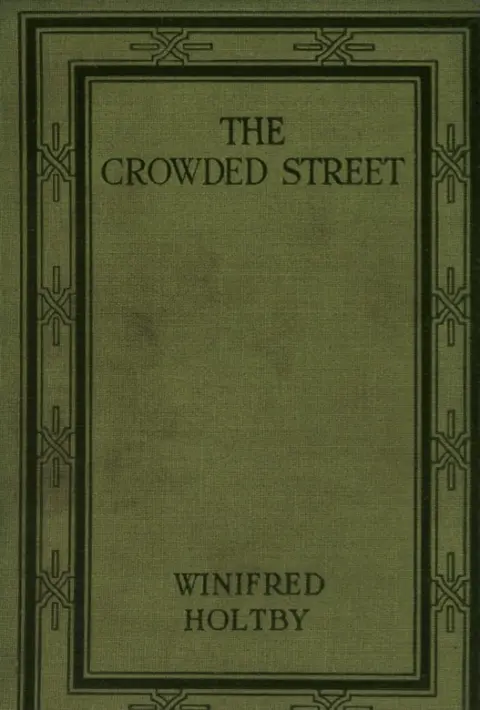
"The Crowded Street" by Winifred Holtby is a novel written in the early 20th century. The story opens with a poignant scene centered around an 11-year-old girl named Muriel Hammond, who struggles with her emotions and self-identity while attending a party. The narrative examines the challenges and pressures faced in her youth, giving insight into the complexities of social interactions and childhood aspirations. At the start of the story, Muriel is at a party that she has long awaited, yet she experiences feelings of shyness and inadequacy. The prose vividly captures her observations and thoughts as she navigates the bustling atmosphere filled with adults and other children. Despite her excitement, Muriel feels overshadowed and anxious, especially about dancing with a boy named Freddy Mason. As the evening unfolds, Muriel's desire to belong clashes with her innate shyness, culminating in an embarrassing moment where she is caught sneaking sweets—a misunderstanding that casts her in a negative light to her peers and more importantly, to her mother. This initial glimpse into Muriel's world sets the stage for her journey of self-discovery and the exploration of her relationships throughout the novel.
Introduction adapted from the source catalogue; source summaries may be automatically generated.
Free to read · English · 99,688 words · No account needed
MAKE TIME FOR A GOOD BOOK
On by default. Untick to stop anonymous reading totals. Each page counts after 10 seconds in view. How this works.
Anonymous counting is on unless you have switched it off.
Above the blackness of the hedge, against the transparent, water-coloured shimmer of the sky, the great horse and his rider thrust up suddenly a black silhouette. They hung for a moment thus, poised between earth and sky, then disappeared.
"Ah, good," whispered Clare, with a little sigh of pure enjoyment.
"But they'll be killed," moaned Muriel.
"Not they," laughed Clare.
The two girls walked in silence down the drive. By the gate the hoof-marks swerved to one side, cutting deeply into the turf, as though Connie had made one desperate effort to pull up. Then they went on again, along the rough, chalk road.
"They've gone a long way," remarked Clare imperturbably. "Your sister is having a good run for her money."
"Oh, Clare, don't joke. What if they are killed?"
"Killed? Nonsense. Why, here they are!"
Over the brow of the rising ground they came, Godfrey leading both the horses, Connie by his side, limping a little, spattered with mud from head to foot, her hair wild, her cheeks flaming.
"I didn't fall off," she announced jubilantly. "Not until right at the very end. Oh, it was glorious. I galloped, and Mr. Neale galloped. We had a race, hadn't we, Mr. Neale? Did you see him jump the hedge? Oh, Muriel, you do look queer. Your eyes are popping out of your head. Were you frightened? I wasn't frightened a bit, although we went at a terrific rate right down the field."
"I was," laughed Godfrey. "I was in a blue funk."
Clare looked at him. "How high is that fence?"
"I don't know. N--nothing much." It confronted them then, laced thick and high with blackthorn, a nasty obstacle under the best conditions.
"With a loose girth and one rein," half-whispered Clare. "That was
great riding, Mr. Neale."
They walked back to the house together, Connie chattering all the way. She was upborne upon the wings of triumph. She had conquered her fear, conquered Muriel's prudishness, and Clare's attractions, and the indifference of the Weare Grange. She was happy.
Muriel saw her happiness with a sudden heartache, for she saw also
what Connie did not see.
She saw that this adventure was not even their adventure. It was Clare's and Godfrey's--Clare's because she had taken upon herself the command of rescue, Godfrey's because her whisper of praise had fallen upon him like an accolade. Connie had been merely a pretext for Godfrey to perform deeds of daring before Clare. At tea-time, though with remorseful attention Godfrey handed to Connie cakes and little biscuits such as she loved, it was Clare to whom, in the intervals of his duties as a host, he turned and smiled.
Your reading position is saved on this browser. Take it to another device with a library code. Reading pages adapt to text, rather than matching a printed edition.
BEHIND THE BOOK
This eBook is for the use of anyone anywhere in the United States and most other parts of the world at no cost and with almost no restrictions whatsoever. You may copy it, give it away or re-use it under the terms of the Project Gutenberg License included with this eBook or online at www.gutenberg.org. If you are not located in the United States, you will have to check the laws of the country where you are located before using this eBook. Read the source licence.
The original source file, including credits and licence, is retained by this library. Request an original-format copy at no charge. Please include the book title and Project Gutenberg identifier #68629.
KEEP YOUR CURIOSITY GOING
Coulson Kernahan

Maurice Baring
Frances Wright
Cécile Tormay

Frederic Jesup Stimson

W. H. P. (William Henry Pope) Jarvis