THE CLASSIC COLLECTION✦Anderby WoldCLASSIC FREE BOOKS
Anderby Wold
Winifred Holtby
THE CLASSIC COLLECTION · 1924
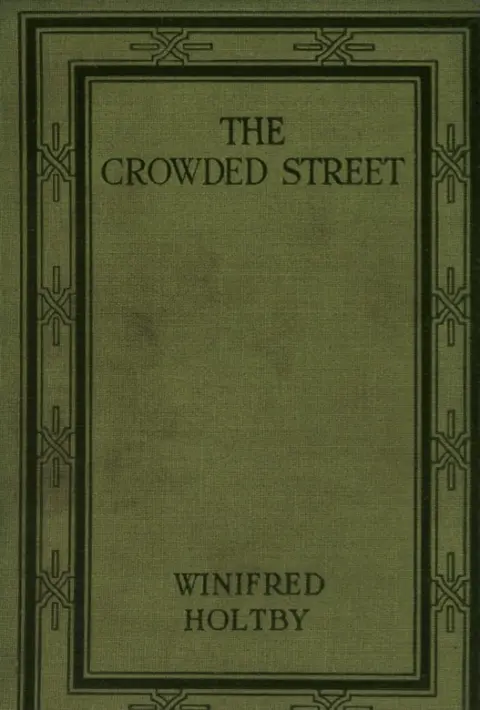
"The Crowded Street" by Winifred Holtby is a novel written in the early 20th century. The story opens with a poignant scene centered around an 11-year-old girl named Muriel Hammond, who struggles with her emotions and self-identity while attending a party. The narrative examines the challenges and pressures faced in her youth, giving insight into the complexities of social interactions and childhood aspirations. At the start of the story, Muriel is at a party that she has long awaited, yet she experiences feelings of shyness and inadequacy. The prose vividly captures her observations and thoughts as she navigates the bustling atmosphere filled with adults and other children. Despite her excitement, Muriel feels overshadowed and anxious, especially about dancing with a boy named Freddy Mason. As the evening unfolds, Muriel's desire to belong clashes with her innate shyness, culminating in an embarrassing moment where she is caught sneaking sweets—a misunderstanding that casts her in a negative light to her peers and more importantly, to her mother. This initial glimpse into Muriel's world sets the stage for her journey of self-discovery and the exploration of her relationships throughout the novel.
Introduction adapted from the source catalogue; source summaries may be automatically generated.
Free to read · English · 99,688 words · No account needed
MAKE TIME FOR A GOOD BOOK
On by default. Untick to stop anonymous reading totals. Each page counts after 10 seconds in view. How this works.
Anonymous counting is on unless you have switched it off.
"Yes," he said, unreasoningly rude. "I do. Decidedly. You, singing for the public, for just any ass----"
She opened her dark eyes very wide. "But why not? Not all the public are asses. Besides, my mother does it. She acts."
"Oh, I did--didn't mean that. I mean, it seems somehow such a waste."
"Waste? Comme vous êtes drôle! Ils sont tous fous, les anglais." She laughed again, teasing him, knowing how much he hated for her to speak French, partly because it was a foreign language, partly because he dreaded more than anything in the world that she should make a fool of him. "Why a waste? Is it not better to sing for the many than for the few?"
"No, no. It is not." He fumbled indignantly with his ideas, only knowing that he could not bear the thought of her, standing on show for any fool to gape at, any ill-bred, foreign fool, greasy Germans, nincompoop Frenchmen, Italians--ugh!
"How very English you are, Mr. Neale. That proprietary instinct. You want everything for yourself, land, ladies, music. You would like to put up a notice on me like you put up on your woods. 'Trespassers will be prosecuted.'"
"When did you see my woods?"
"Hush, I want to hear Mr. Smallwood sing."
Godfrey could not sing. He disliked fellows who chirruped inanely in drawing-rooms; but he had to sit there, consoling himself by watching Clare's intent, uplifted face.
"O flower of all the world, O flower of all, I see thee in my garden and I dare To love thee, and though my deserts be small, Thou art the only flower I would wear."
"O flower of all the world," thought Godfrey, seeing only Clare's glowing dress, her hands, her perfect arms.
"I dare to love thee," triumphed Dennis Smallwood's pleasant baritone
voice.
Clare Duquesne was going back to Germany, to flirt with dapper little
German officers. A good thing that she was going. Godfrey knew her
type.
"A rotten song, that, isn't it?" he growled. "Smallwood plays a decent game of tennis. I wish that he'd stick to it."
"He sings rather well. Ah! Mon Dieu!"
"What is it?" Godfrey was all solicitude.
"Nothing. Except that our friend Connie is going to sing, and I--I
have heard her before."
Her whisper soothed the young man's ruffled feelings. He did what all the evening he had been intending not to do. This connection with the Hammond ménage had gone far enough. He said:
"Look here, do you ever care to ride, Miss Duquesne?"
"When I have a mount," she answered.
"When the birds go north again!" shrilled Connie.
Your reading position is saved on this browser. Take it to another device with a library code. Reading pages adapt to text, rather than matching a printed edition.
BEHIND THE BOOK
This eBook is for the use of anyone anywhere in the United States and most other parts of the world at no cost and with almost no restrictions whatsoever. You may copy it, give it away or re-use it under the terms of the Project Gutenberg License included with this eBook or online at www.gutenberg.org. If you are not located in the United States, you will have to check the laws of the country where you are located before using this eBook. Read the source licence.
The original source file, including credits and licence, is retained by this library. Request an original-format copy at no charge. Please include the book title and Project Gutenberg identifier #68629.
KEEP YOUR CURIOSITY GOING
Coulson Kernahan

Maurice Baring
Frances Wright
Cécile Tormay

Frederic Jesup Stimson

W. H. P. (William Henry Pope) Jarvis