THE CLASSIC COLLECTION✦Anderby WoldCLASSIC FREE BOOKS
Anderby Wold
Winifred Holtby
THE CLASSIC COLLECTION · 1924
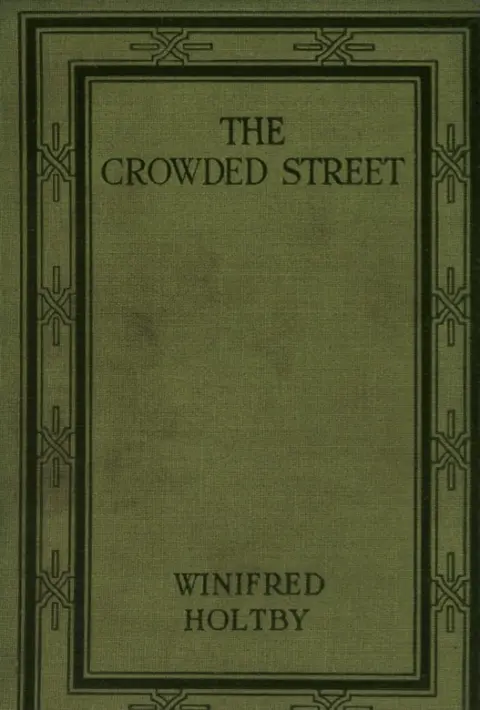
"The Crowded Street" by Winifred Holtby is a novel written in the early 20th century. The story opens with a poignant scene centered around an 11-year-old girl named Muriel Hammond, who struggles with her emotions and self-identity while attending a party. The narrative examines the challenges and pressures faced in her youth, giving insight into the complexities of social interactions and childhood aspirations. At the start of the story, Muriel is at a party that she has long awaited, yet she experiences feelings of shyness and inadequacy. The prose vividly captures her observations and thoughts as she navigates the bustling atmosphere filled with adults and other children. Despite her excitement, Muriel feels overshadowed and anxious, especially about dancing with a boy named Freddy Mason. As the evening unfolds, Muriel's desire to belong clashes with her innate shyness, culminating in an embarrassing moment where she is caught sneaking sweets—a misunderstanding that casts her in a negative light to her peers and more importantly, to her mother. This initial glimpse into Muriel's world sets the stage for her journey of self-discovery and the exploration of her relationships throughout the novel.
Introduction adapted from the source catalogue; source summaries may be automatically generated.
Free to read · English · 99,688 words · No account needed
MAKE TIME FOR A GOOD BOOK
On by default. Untick to stop anonymous reading totals. Each page counts after 10 seconds in view. How this works.
Anonymous counting is on unless you have switched it off.
Muriel felt a little sick. These things simply did not happen. If only she could be a success. If only she could by some miracle play brilliantly. She tried to picture the delight on her mother's face. In a dream she rose, nervously fingering her racket.
"Muriel!" came Connie's hoarse whisper. "Your safety-pin's showing at
the back!"
She clutched at her belt. "Excuse me," she murmured.
"Toss for courts, please," commanded Delia, ignoring her.
"Excuse me," she repeated, measuring the distance between the steps
and the cloak-room door.
"The sun ought to be fairly well behind the roof," said Delia.
"Rough."
"Smooth it is. You'll have to face the sun," cried Godfrey.
"Come along, Miss Hammond."
"But----" protested Muriel weakly, but too late. Dennis gathered up the balls and sauntered leisurely with Delia across the court. Muriel was left, her back and the terrible, indecent safety-pin exposed to the full gaze of Social Marshington in the Pavilion. Once, she had a nightmare that while shopping in Middle Street all her clothes fell off. Even that had not been as embarrassing as this.
Godfrey was measuring the net.
"Bit higher, Smallwood. G--good thing that we won the toss, Miss
Hammond. The sun's awful."
A good thing that they won the toss! Muriel, hearing a burst of laughter from the Pavilion, felt sure that somebody had seen the pin. She gave a sickly smile.
The other courts were deserted. The whole of Marshington was there on the veranda. The whole of Marshington, finishing its tea, had nothing better to do than to watch the set. Muriel felt fifty eyes boring holes into her humiliated back.
Her mother would see. Her mother would see the pin. And the first time
was so important.
She made a despairing effort to recapture her self-possession. At Heathcroft she had been counted as quite a steady player. Well, now she would show Marshington. She would show them that, in spite of the safety-pin, she could at least play tennis. If Godfrey Neale liked girls because they played well, then he should have no cause to dislike her.
"Service!" called Delia.
Muriel steeled herself for effort.
The first ball came driving, clean and straight, across the court. Muriel, dazed but optimistic, put out her racket. The ball sped on unchecked and bounded against the Pavilion steps.
"Fifteen love!" called Dennis.
"Hard luck," consoled Godfrey.
"I'm so sorry," murmured Muriel.
Godfrey returned the second serve to Delia. She flashed it back to him. Really, it wasn't nice for a girl to drive so straight and so efficiently. Delia's tall, white figure became to Muriel something malevolent and ruthless.
Your reading position is saved on this browser. Take it to another device with a library code. Reading pages adapt to text, rather than matching a printed edition.
BEHIND THE BOOK
This eBook is for the use of anyone anywhere in the United States and most other parts of the world at no cost and with almost no restrictions whatsoever. You may copy it, give it away or re-use it under the terms of the Project Gutenberg License included with this eBook or online at www.gutenberg.org. If you are not located in the United States, you will have to check the laws of the country where you are located before using this eBook. Read the source licence.
The original source file, including credits and licence, is retained by this library. Request an original-format copy at no charge. Please include the book title and Project Gutenberg identifier #68629.
KEEP YOUR CURIOSITY GOING
Coulson Kernahan

Maurice Baring
Frances Wright
Cécile Tormay

Frederic Jesup Stimson

W. H. P. (William Henry Pope) Jarvis