THE CLASSIC COLLECTION✦Anderby WoldCLASSIC FREE BOOKS
Anderby Wold
Winifred Holtby
THE CLASSIC COLLECTION · 1924
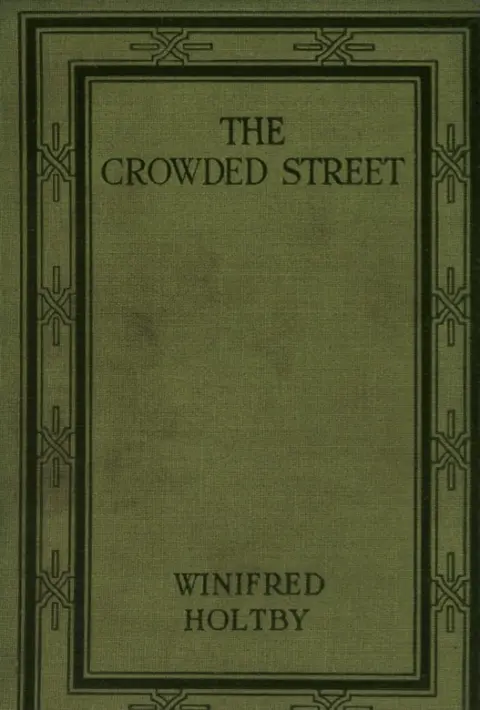
"The Crowded Street" by Winifred Holtby is a novel written in the early 20th century. The story opens with a poignant scene centered around an 11-year-old girl named Muriel Hammond, who struggles with her emotions and self-identity while attending a party. The narrative examines the challenges and pressures faced in her youth, giving insight into the complexities of social interactions and childhood aspirations. At the start of the story, Muriel is at a party that she has long awaited, yet she experiences feelings of shyness and inadequacy. The prose vividly captures her observations and thoughts as she navigates the bustling atmosphere filled with adults and other children. Despite her excitement, Muriel feels overshadowed and anxious, especially about dancing with a boy named Freddy Mason. As the evening unfolds, Muriel's desire to belong clashes with her innate shyness, culminating in an embarrassing moment where she is caught sneaking sweets—a misunderstanding that casts her in a negative light to her peers and more importantly, to her mother. This initial glimpse into Muriel's world sets the stage for her journey of self-discovery and the exploration of her relationships throughout the novel.
Introduction adapted from the source catalogue; source summaries may be automatically generated.
Free to read · English · 99,688 words · No account needed
MAKE TIME FOR A GOOD BOOK
On by default. Untick to stop anonymous reading totals. Each page counts after 10 seconds in view. How this works.
Anonymous counting is on unless you have switched it off.
Muriel opened her eyes and stared as if to discover some connection between this remark and her own disgraceful exhibition of childishness. But there was none. Clare, astounding, incalculable Clare, had not even noticed the tragedy of Muriel. She had taken it for granted that if you couldn't climb, you couldn't, and that was your affair. She continued meditatively:
"You must know what I mean, for you are different." Oh, glorious triumph! Mrs. Hancock forgotten, Muriel glowed at the delightful thought that she was different. "Have you not observed? How many of them have had affaires de cœur? But very few!"
"Affaires de cœur?" It is hard to grope with a meagre French vocabulary when one has just emerged from one physical and two spiritual crises. Affaires! Muriel's knowledge of Marshington phraseology assisted her. De Cœur--of the heart. Of course.
"Why, Clare, you can't mean being in love!"
"And why not?" asked Clare serenely. "I have had five affairs. There was the student at the Sorbonne, and the man who played with Mamma in New York, and my cousin Michael at Eppleford, and, and----"
"But were you in love with them?"
"My dear child, no! Why should I be?"
"Then, how?"
"Dear me, chérie, have you never observed that I am very attractive?"
Her laugh rang out, merry and spontaneous.
"What a solemn face! Muriel, do you ever smile? No, no, I shan't fall in love for years. Perhaps never. But crowds and crowds of men will fall in love with me. That's why Félix decided that I had better come to school. 'They're beginning too soon,' he said. 'You mustn't cut out your mother yet, child.' And he sighed. He's terribly sentimental, my Félix. I'm sure I didn't mind. On the whole it bores me. Men in love are so terribly alike, I think, don't you?"
Fascinating, incredible conversation!
"Of course, really, I'm rather grateful to Félix," Clare continued sagely. "It's no use getting it all over too soon. And of course one day one might go too far, and really I don't want to marry yet, however rich he was. What do you think?"
"But, Clare, do--do men fall in love with all women if we let them?"
"Why, of course. Else why be a woman?" Clare responded with tranquility. "Of course there are some, poor dears, like Miss Reeve, I suppose, and most schoolmistresses, and missionaries, and things, but they are hardly women, are they?"
"I--I don't know. I----"
Your reading position is saved on this browser. Take it to another device with a library code. Reading pages adapt to text, rather than matching a printed edition.
BEHIND THE BOOK
This eBook is for the use of anyone anywhere in the United States and most other parts of the world at no cost and with almost no restrictions whatsoever. You may copy it, give it away or re-use it under the terms of the Project Gutenberg License included with this eBook or online at www.gutenberg.org. If you are not located in the United States, you will have to check the laws of the country where you are located before using this eBook. Read the source licence.
The original source file, including credits and licence, is retained by this library. Request an original-format copy at no charge. Please include the book title and Project Gutenberg identifier #68629.
KEEP YOUR CURIOSITY GOING
Coulson Kernahan

Maurice Baring
Frances Wright
Cécile Tormay

Frederic Jesup Stimson

W. H. P. (William Henry Pope) Jarvis