
Affirmations
Havelock Ellis
THE CLASSIC COLLECTION · 1890
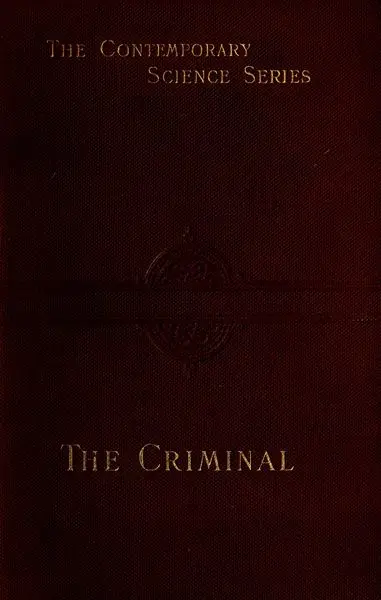
"The Criminal" by Havelock Ellis is a book published in 1890. This groundbreaking work introduces criminal anthropology to British readers, exploring whether criminals are born with physical abnormalities that predict their behavior. Drawing heavily on Cesare Lombroso's controversial theories, Ellis examines skull shapes, facial features, moral sensibility, and hereditary traits to understand criminal nature. The book addresses fundamental questions about punishment and whether criminality stems from physical destiny or personal choice, challenging Victorian assumptions about crime and justice.
Introduction adapted from the source catalogue; source summaries may be automatically generated.
Free to read · English · 95,745 words · No account needed
MAKE TIME FOR A GOOD BOOK
On by default. Untick to stop anonymous reading totals. Each page counts after 10 seconds in view. How this works.
Anonymous counting is on unless you have switched it off.
s. d. To the Governor, plaintiff, one loaf of sugar 2 0 " " defendant, " " 2 0 " two policemen who took them to gaol 0 9½ " " " them out of gaol 0 9½ " gaoler 0 4¼ " " for use of prison lavatory 0 4¼ ----- 6 3½
It frequently happens that the prisoner is unable to settle his bill, and is compelled, therefore, to remain a prisoner.
[94] Jottings from Jail (1887), pp. 186, 190. Judge Willert (Das Postulat der Abschaffung des Straffmasses mit der dagegen Erhobenen Einwendung), as quoted by Garofalo, uses the same simile to show the absurdity of this system.
[95] Leaves from a Prison Diary, pp. 173, 174.
[96] In Russian and French Prisons (1887), pp. 263-283.
[97] “Le Monde des Prisons,” Archives de l’Anthropologie Criminelle,
1888.
[98] Sketches from Shady Places, by Thor. Fredur (1879), pp. 206-7.
[99] Enquête Parlementaire, tome v., pp. 345, 381, 542, quoted by Joly.
[100] Adolphe Prins, Criminalité et Répression, 1885.
[101] Le Criminologie (1888), p. 220.
“Cu dici male di la Vicaria
Cei farrissi la faccia feddi-feddi.
Cu dici cà la carcere castia
Comu v’ ingannati, puvireddi!”
“Qua sol trovi i fratelli e qua gli amici,
Danari, ben mangiare e allegra pace;
Fuori sei sempre in mezzo ai tuoi nemici;
Se non puoi lavorai muori di fame.”
[104] American Prisons, by the Rev. F. H. Wines, the able secretary of the National Prison Association. A great amount of valuable information is compressed into this little pamphlet. Mr. Wines has endeavoured to ascertain if the variation in usual length of sentence in different states has any relation with amount of crime in that state. He was not able to find any connection. “Apparently, the length of jail sentences pronounced by the court has no effect either to increase or to diminish crime.” If this is so, there arises, as he remarks, the question, “What useful purpose do our jails subserve?”
[105] “Remarks on Crime and Criminals,” Journal of Mental Science, July
1888.
[106] It is unnecessary to consider here the relation of solitary confinement to insanity. This is still somewhat of a vexed question. The difficulty lies in the fact that the prisoner is frequently already predisposed to insanity. Everything depends on how the isolation is carried out. There is no question that cellular confinement, if sufficiently prolonged, leads to insanity. There is a very extensive literature dealing with this subject.
[107] H. D. Wey, Physical and Industrial Training of Criminals, p. 55,
New York, 1888.
[108] See Dr. Wey’s Physical and Industrial Training of Criminals, a valuable little work, in which all the details of this and similar experiences are given with care and fulness.
[109] Sufficient attention does not appear to have been given to music in prisons. It is a civilising influence to which the criminal is often very sensitive. An able administrator at the convict prison at Toulon long since recognised this with happy results.
Your reading position is saved on this browser. Take it to another device with a library code. Reading pages adapt to text, rather than matching a printed edition.
Havelock Ellis

Havelock Ellis

Havelock Ellis
Havelock Ellis
BEHIND THE BOOK
This eBook is for the use of anyone anywhere in the United States and most other parts of the world at no cost and with almost no restrictions whatsoever. You may copy it, give it away or re-use it under the terms of the Project Gutenberg License included with this eBook or online at www.gutenberg.org. If you are not located in the United States, you will have to check the laws of the country where you are located before using this eBook. Read the source licence.
The original source file, including credits and licence, is retained by this library. Request an original-format copy at no charge. Please include the book title and Project Gutenberg identifier #44500.
KEEP YOUR CURIOSITY GOING

Charles G. (Charles Griffith) Ross
Hannah Webster Foster

Emily Lawless
Edwin Hamlin Carr

Charles De Lano Hine
Andrew Ure