
Affirmations
Havelock Ellis
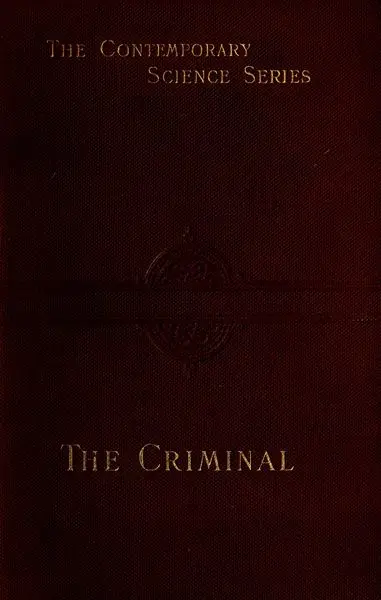
THE CLASSIC COLLECTION · 1890
"The Criminal" by Havelock Ellis is a book published in 1890. This groundbreaking work introduces criminal anthropology to British readers, exploring whether criminals are born with physical abnormalities that predict their behavior. Drawing heavily on Cesare Lombroso's controversial theories, Ellis examines skull shapes, facial features, moral sensibility, and hereditary traits to understand criminal nature. The book addresses fundamental questions about punishment and whether criminality stems from physical destiny or personal choice, challenging Victorian assumptions about crime and justice.
Introduction adapted from the source catalogue; source summaries may be automatically generated.
Free to read · English · 95,745 words · No account needed
MAKE TIME FOR A GOOD BOOK
On by default. Untick to stop anonymous reading totals. Each page counts after 10 seconds in view. How this works.
Anonymous counting is on unless you have switched it off.
Tattoo marks on the two fore-arms: on the right a transfixed heart, a woman’s head, the letters F. and B.; on the left two stars, one large, the other small, the letters L. and A. (his initials), a cross, and nearer the wrist an indistinct sign ending in a B.
On the feet the two little toes are small, especially the left, out of proportion to the development of the rest of the foot.
Hair sparse.
Superficial veins healthy, but varicose in left popliteal region. Genital organs little developed.
Dynamometer.--Right hand, 90; left hand, 85.
Tactile sensibility.--On the tongue the two points of the esthesiometer are perceived only at a distance of five mill. In general the sensibility is very feeble. Localisation very inaccurate; impressions on one side often referred to the other.
Sensibility to pain.--Advanced hypoalgesia, while reiterated punctures fetching blood are felt as slight touches. Burns with a lighted cigar are little if at all felt; but there is some dissimulation on the part of the subject.
Thermal and meteoric sensibility.--Apparently abolished.
There has been no opportunity for electrical examination.
Sight.--Does not distinguish colours well; sees red best. Pupils react
imperfectly.
Hearing.--On the right side says he cannot hear a watch in immediate contact; on the left only at a short distance. In other ways his hearing has been found to be defective.
Smell.--Does not distinguish odours, of which in many cases he has no knowledge. Ammonia alone, deeply inhaled for a few seconds, causes slight lachrymation on the right side.
Taste.--Perceives vinegar, but not salt, bitter or sweet substances. On offering him half a glass of decoction of cinchona, and telling him that it is wine, and then another of vinegar, he swallows it all eagerly without any indication of disagreeable sensations. On giving him a bitter substance, and telling him it is sweet, he repeats that it is sweet, and vice versâ.
Appetite voracious; digestive functions normal. Circulation and
respiration weak.
Ideas very limited. No imagination or æsthetic sense. Memory very weak, limited to the most elementary and primitive cognitions. Will feeble, in the absence of any morbid impulse.
Moral and affective sentiments almost entirely absent.
No disposition to occupy himself in any way; tendency to idleness and
vagabondage.
Unrestrained onanism, to which he formerly gave way four or five times a day, now only about twice a day, because, as he says, he is no longer strong enough. He confesses this without the least shame, with complacency, almost with pleasure.
Your reading position is saved on this browser. Take it to another device with a library code. Reading pages adapt to text, rather than matching a printed edition.
Havelock Ellis

Havelock Ellis

Havelock Ellis
Havelock Ellis
BEHIND THE BOOK
This eBook is for the use of anyone anywhere in the United States and most other parts of the world at no cost and with almost no restrictions whatsoever. You may copy it, give it away or re-use it under the terms of the Project Gutenberg License included with this eBook or online at www.gutenberg.org. If you are not located in the United States, you will have to check the laws of the country where you are located before using this eBook. Read the source licence.
The original source file, including credits and licence, is retained by this library. Request an original-format copy at no charge. Please include the book title and Project Gutenberg identifier #44500.
KEEP YOUR CURIOSITY GOING

Charles G. (Charles Griffith) Ross
Hannah Webster Foster

Emily Lawless
Edwin Hamlin Carr

Charles De Lano Hine
Andrew Ure