THE CLASSIC COLLECTION✦An outlaw’s diary: the CommuneCLASSIC FREE BOOKS
An outlaw’s diary: the Commune
Cécile Tormay
THE CLASSIC COLLECTION · 1906
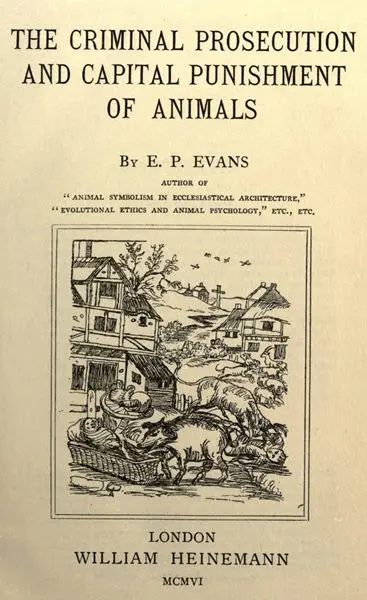
"The Criminal Prosecution and Capital Punishment of Animals" by E. P. Evans is a historical account written in the early 20th century. The book delves into the fascinating, if bizarre, legal practices of prosecuting animals for crimes in medieval and early modern Europe, exploring the absurdity and seriousness with which these cases were handled. It investigates the implications of these trials within the contexts of societal norms, religion, and the evolution of legal thought. The opening of the work outlines the origins of animal trials and the varying perspectives on their legality, notably the distinctions made between different types of prosecutions—those for domestic animals versus vermin. Evans introduces Bartholomew Chassenée, a jurist famous for defending rats charged with crop destruction, illustrating the lengths to which legal arguments were stretched to defend these creatures. He also discusses the interplay between secular and ecclesiastical courts in such cases, underscoring the peculiar belief that animals could be held accountable for their actions as if they were human actors in the legal system. Overall, this section sets the stage for a deeper exploration of the cultural and legal ramifications of treating animals as subjects of criminal law.
Introduction adapted from the source catalogue; source summaries may be automatically generated.
Free to read · English · 87,241 words · No account needed
MAKE TIME FOR A GOOD BOOK
On by default. Untick to stop anonymous reading totals. Each page counts after 10 seconds in view. How this works.
Anonymous counting is on unless you have switched it off.
In the case of a mule condemned to be burned alive together with a man guilty of buggery, at Montpellier, in 1565, as the quadruped was vicious and inclined to kick (vitiosus et calcitrosus), the executioner cut off its feet before consigning it to the flames. This mutilation was an arbitrary and extra-judicial act, dictated solely by considerations of personal convenience. Hangmen often indulged in capricious and supererogatory cruelty in the exercise of their patibulary functions, and mediæval as well as later writers on criminal jurisprudence repeatedly complain of this evil and call for reform. Thus Damhouder, in his Rerum Criminalium Praxis (cap. de carnifice, p. 234), urges magistrates to be more careful in selecting persons for this important office, and not to choose evil-doers, “assiduous gamblers, public whoremongers, malicious back-biters, impious blasphemers, assassins, thieves, murderers, robbers, and other violators of the law as vindicators of justice.” Indeed, these hardened wretches sometimes took the law into their own hands. For example, on the 9th of June, 1576, at Schweinfurt in Franconia, a sow, which had bitten off the ear and torn the hand of a carpenter’s child, was given into custody, whereupon the hangman, without legal authority, took it to the gallows-green (Schindrasen) and there “hanged it publicly to the disgrace and detriment of the city.” For this impudent usurpation of judiciary powers Jack Ketch was forced to flee and never dared return. Hence arose the proverbial phrase Schweinfurter Sauhenker (Schweinfurt sow-hangman), used to characterize a low and lawless ruffian and vile fellow of the baser sort. It was not the mere killing of the sow, but the execution without a judicial decision, the insult and contempt of the magistracy and the judicatory by arrogating their functions, that excited the public wrath and official indignation.
Buggery (offensa cujus nominatio crimen est, as it is euphemistically designated in legal documents) was uniformly punished by putting to death both parties implicated, and usually by burning them alive. The beast, too, is punished and both are burned (punitur etiam pecus et ambo comburuntur), says Guillielmus Benedictinus, a writer on law, who lived about the end of the fourteenth century. Thus, in 1546, a man and a cow were hanged and then burned by order of the parliament of Paris, the supreme court of France. In 1466, the same tribunal condemned a man and a sow to be burned at Corbeil. Occasionally interment was substituted for incremation. Thus in 1609, at Niederrad, a man and a mare were executed and their bodies buried in the same carrion-pit. On the 12th of September, 1606, the mayor of Loens de Chartres, on complaint of the dean, canons, and chapter of the cathedral of Chartres, condemned a man named Guillaume Guyart to be “hanged and strangled on a gibbet in reparation and punishment of sodomy, whereof the said Guyart is declared accused, attainted and convicted.” A bitch, his accomplice, was sentenced to be knocked on the head (assommée) by the executioner of high justice and “the dead bodies of both to be burned and reduced to ashes.” It is furthermore added that if the said Guyart, who seems to have contumaciously given leg-bail, cannot be seized and apprehended in person, the sentence shall, in his case, be executed in effigy by attaching his likeness in painting to the gibbet. It was also decreed that all the property of the absconder should be confiscated and the sum of one hundred and fifty livres be adjudged to the plaintiffs, out of which the costs of the trial were to be defrayed. (Vide Appendix L.) This disgusting crime appears to have been very common; at least Ayrault in his Ordre Judiciaire, published in 1606, states that he has many times (multoties) seen brute beasts put to death for this cause. In his Magnalia Christi Americana (Book VI, (III), London, 1702) Cotton Mather records that “on June 6, 1662, at New Haven, there was a most unparalleled wretch, one Potter by name, about sixty years of age, executed for damnable Bestialities.” He had been a member of the Church for twenty years and was noted for his piety, “devout in worship, gifted in prayer, forward in edifying discourse among the religious, and zealous in reforming the sins of other people.” Yet this monster, who is described as possessed by an unclean devil, “lived in most infandous Buggeries for no less than fifty years together, and now at the gallows there were killed before his eyes a cow, two heifers, three sheep and two sows, with all of which he had committed his brutalities. His wife had seen him confounding himself with a bitch ten years before; and he then excused himself as well as he could, but conjured her to keep it secret.” He afterwards hanged the bitch, probably as a sort of vicarious atonement. According to this account he must have begun to practice sodomy when he was ten years of age, a vicious precocity which the author would doubtless explain on the theory of diabolical possession. In 1681, a habitual sodomite, who had been wont to defile himself with greyhounds, cows, swine, sheep and all manner of beasts, was brought to trial together with a mare, at Wünschelburg in Silesia, where both were burned alive. In 1684, on the 3rd of May, a bugger was beheaded at Ottendorf, and the mare, his partner in crime, knocked on the head; it was expressly enjoined that in burning the bodies the man’s should lie underneath that of the beast. In the following year, fourteen days before Christmas, a journeyman tailor, “who had committed the unnatural deed of carnal lewdness with a mare,” was burned at Striga together with the mare.
Your reading position is saved on this browser. Take it to another device with a library code. Reading pages adapt to text, rather than matching a printed edition.
BEHIND THE BOOK
This eBook is for the use of anyone anywhere in the United States and most other parts of the world at no cost and with almost no restrictions whatsoever. You may copy it, give it away or re-use it under the terms of the Project Gutenberg License included with this eBook or online at www.gutenberg.org. If you are not located in the United States, you will have to check the laws of the country where you are located before using this eBook. Read the source licence.
The original source file, including credits and licence, is retained by this library. Request an original-format copy at no charge. Please include the book title and Project Gutenberg identifier #43286.
KEEP YOUR CURIOSITY GOING
Cécile Tormay

Moritz Busch
John L. Ransom
Frances Wright
Cécile Tormay

Mabel Potter Daggett