THE CLASSIC COLLECTION✦An outlaw’s diary: the CommuneCLASSIC FREE BOOKS
An outlaw’s diary: the Commune
Cécile Tormay
THE CLASSIC COLLECTION · 1906
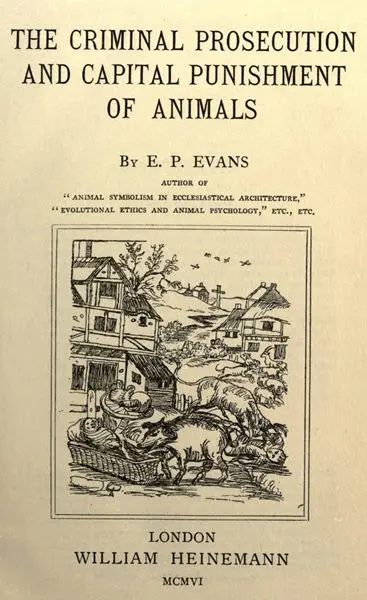
"The Criminal Prosecution and Capital Punishment of Animals" by E. P. Evans is a historical account written in the early 20th century. The book delves into the fascinating, if bizarre, legal practices of prosecuting animals for crimes in medieval and early modern Europe, exploring the absurdity and seriousness with which these cases were handled. It investigates the implications of these trials within the contexts of societal norms, religion, and the evolution of legal thought. The opening of the work outlines the origins of animal trials and the varying perspectives on their legality, notably the distinctions made between different types of prosecutions—those for domestic animals versus vermin. Evans introduces Bartholomew Chassenée, a jurist famous for defending rats charged with crop destruction, illustrating the lengths to which legal arguments were stretched to defend these creatures. He also discusses the interplay between secular and ecclesiastical courts in such cases, underscoring the peculiar belief that animals could be held accountable for their actions as if they were human actors in the legal system. Overall, this section sets the stage for a deeper exploration of the cultural and legal ramifications of treating animals as subjects of criminal law.
Introduction adapted from the source catalogue; source summaries may be automatically generated.
Free to read · English · 87,241 words · No account needed
MAKE TIME FOR A GOOD BOOK
On by default. Untick to stop anonymous reading totals. Each page counts after 10 seconds in view. How this works.
Anonymous counting is on unless you have switched it off.
In the majority of cases adduced there is no evidence that the Church intervened at all with its fulminations, and, even when the anathema was pronounced, the insects appear to have departed of their own free-will after having eaten up every green thing and reduced the inhabitants to the verge of starvation; and yet M. Bailly, supposed to be a man of judicial mind, disciplined by study, accustomed to reason and to know what sound reasoning is, goes on giving accounts of such scourges, as though they proved in some mysterious way the effectiveness of ecclesiastical excommunications and formed a cumulative argument in support of such claims.
The most important portion of M. Bailly’s work is that in which he shows how actions of this kind should be brought and conducted, with specimens of plaints, pleas, replications, rejoinders, and decisions. First in order comes the petition of the inhabitants seeking redress (requeste des habitans), which is followed in regular succession by the declaration or plea of the inhabitants (plaidoyer des habitans), the defensive allegation or plea for the insects (plaidoyer pour les insectes), the replication of the inhabitants (réplique des habitans), the rejoinder of the defendant (réplique du defendeur), the conclusions of the bishop’s proctor (conclusions du procureur episcopal), and the sentence of the ecclesiastical judge (sentence du juge d’église), which is solemnly pronounced in Latin. The pleadings on both sides are delivered in French and richly interlarded with classical allusions and Latin quotations, being even more heavily weighted with the spoils of erudition than the set speech of a member of the British Parliament.
The following abridgment of the plea, in which the prosecuting attorney sets forth the cause of complaint, is a fair specimen of the forensic eloquence displayed on such occasions:
“Gentlemen, these poor people on their knees and with tearful eyes, appeal to your sense of justice, as the inhabitants of the islands Majorica and Minorica formerly sent an embassy to Augustus Cæsar, praying him for a cohort of soldiers to exterminate the rabbits, which were burrowing in their fields and consuming their crops. In the power of excommunication you have a weapon more effective than any wielded by that emperor to save these poor suppliants from impending famine produced by the ravages of little beasts, which spare neither the corn nor the vines, ravages like those of the boar that laid waste the environs of Calydon, as related by Homer in the first book of the Iliad, or those of the foxes sent by Themis to Thebes, which destroyed the fruits of the earth and the cattle and assailed even the husbandmen themselves. You know how great are the evils which famine brings with it, and you have too much kindness and compassion to permit my clients to be involved in such distress, thus constraining them to perpetrate cruel and unlawful deeds; nec enim rationem patitur, nec ulla aequitate mitigatur, nec prece ulla flectitur esuriens populus: for a starving people is not amenable to reason, nor tempered by equity, nor moved by any prayer. Witness the mothers, of whom it is recorded in the Fourth Book of the Kings, that they ate their own children, the one saying to the other: ‘Give thy son that we may eat him to-day, and we will eat my son tomorrow.’” The advocate then discourses at length of the horrors of hunger and its disastrous effects upon the individual and the community, lugging in what Milton calls a “horse-load of citations” from Arianus Marcellinus, Ovid and other Latin prosaists and poets, introduces an utterly irrelevant allusion to Joshua and the crafty Gibeonites, and concludes as follows: “The full reports received as the result of an examination of the fields, made at your command, suffice for your information concerning the damage done by these animals. It remains, therefore, after complying with the usual forms, only to adjudicate upon the case in accordance with the facts stated in the Petition of the Plaintiffs, which is right and reasonable, and, to this effect, to enjoin these animals from continuing their devastations, ordering them to quit the aforesaid fields and to withdraw to the place assigned them, pronouncing the necessary anathemas and execrations prescribed by our Holy Mother, the Church, for which your petitioners do ever pray.”
Your reading position is saved on this browser. Take it to another device with a library code. Reading pages adapt to text, rather than matching a printed edition.
BEHIND THE BOOK
This eBook is for the use of anyone anywhere in the United States and most other parts of the world at no cost and with almost no restrictions whatsoever. You may copy it, give it away or re-use it under the terms of the Project Gutenberg License included with this eBook or online at www.gutenberg.org. If you are not located in the United States, you will have to check the laws of the country where you are located before using this eBook. Read the source licence.
The original source file, including credits and licence, is retained by this library. Request an original-format copy at no charge. Please include the book title and Project Gutenberg identifier #43286.
KEEP YOUR CURIOSITY GOING
Cécile Tormay

Moritz Busch
John L. Ransom
Frances Wright
Cécile Tormay

Mabel Potter Daggett