THE CLASSIC COLLECTION✦An outlaw’s diary: the CommuneCLASSIC FREE BOOKS
An outlaw’s diary: the Commune
Cécile Tormay
THE CLASSIC COLLECTION · 1906
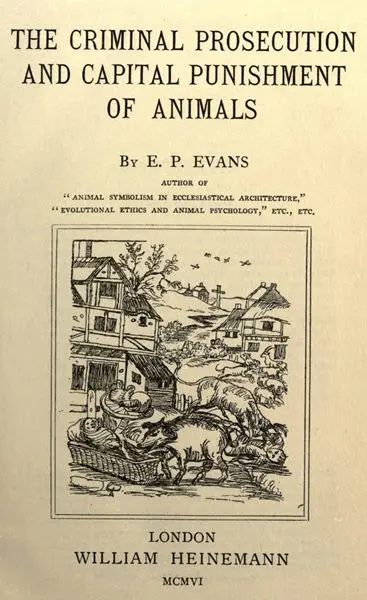
"The Criminal Prosecution and Capital Punishment of Animals" by E. P. Evans is a historical account written in the early 20th century. The book delves into the fascinating, if bizarre, legal practices of prosecuting animals for crimes in medieval and early modern Europe, exploring the absurdity and seriousness with which these cases were handled. It investigates the implications of these trials within the contexts of societal norms, religion, and the evolution of legal thought. The opening of the work outlines the origins of animal trials and the varying perspectives on their legality, notably the distinctions made between different types of prosecutions—those for domestic animals versus vermin. Evans introduces Bartholomew Chassenée, a jurist famous for defending rats charged with crop destruction, illustrating the lengths to which legal arguments were stretched to defend these creatures. He also discusses the interplay between secular and ecclesiastical courts in such cases, underscoring the peculiar belief that animals could be held accountable for their actions as if they were human actors in the legal system. Overall, this section sets the stage for a deeper exploration of the cultural and legal ramifications of treating animals as subjects of criminal law.
Introduction adapted from the source catalogue; source summaries may be automatically generated.
Free to read · English · 87,241 words · No account needed
MAKE TIME FOR A GOOD BOOK
On by default. Untick to stop anonymous reading totals. Each page counts after 10 seconds in view. How this works.
Anonymous counting is on unless you have switched it off.
Doubtless modern science by investigating the laws and forces of nature is gradually diminishing the realm of superstition; but there are vast low-lying plains of humanity that have not yet felt its enlightening and elevating influence. It has been estimated that nine-tenths of the rural population of Europe and ninety-nine hundredths of the peasantry, living in the vicinity of a cloister and darkened by its shadow, believe in the reality of diabolical possession and attribute most maladies of men and murrain in cattle to the direct agency of Satan, putting their faith in the “metaphysical aid” of the conjurer rather than in medical advice and veterinary skill.
Unfortunately this belief is not confined to Catholics and boors, but is held by Protestants, who are considered persons of education and superior culture. Dr. Lyman Abbott asserted in a sermon preached in Plymouth Church, that “what we call the impulses of our lower nature are the whispered suggestions of fiend-like natures, watching for our fall and exultant if they can accomplish it.” But while affirming that “evil spirits exercise an influence over mankind,” and that cranks like Guiteau, the assassin of President Garfield, are diabolically possessed, the reverend divine would hardly risk his reputation for sanity by attempting to exorcise the supposed demon. The Catholic priest holds the same view, but has the courage of his convictions and goes solemnly to work with bell, book and candle to effect the expulsion of the indwelling fiend.
The fact that such methods of healing are sometimes successful is adduced as conclusive proof of their miraculous character; but this inference is wholly incorrect. Professor Dr. Hoppe, in an essay on Der Teufels- und Geisterglaube und die psychologische Erklärung des Besessenseins (Allgemeine Zeitschrift für Psychiatrie, Bd. LV. p. 290), gives a psychological explanation of these puzzling phenomena. “The priest,” he says, “exerts a salutary influence upon the brain through the respect and dignity which he inspires, just as Christ in his day wrought upon those who were sick and possessed with devils.” Indeed, it is expressly stated by the evangelist that Jesus did not attempt to do wonderful works among people who did not believe. According to this theory the exorcism effects a cure by its powerful action on the imagination, just as there are frequent ailments, for which a wise physician administers bread pills and a weak solution of powdered sugar as the safest and best medicaments. Professor Hoppe, therefore, approves of “priestly conjurations for the expulsion of devils as a psychical means of healing,” and thinks that the more ceremoniously the rite can be performed in the presence of grave and venerable witnesses, the more effective it will be. This opinion is endorsed by a Catholic priest, Friedrich Jaskowski, in a pamphlet entitled Der Trierer Rock und seine Patienten vom Jahre 1891 (Saarbrücken: Carl Schmidtke, 1894). The author belongs to the diocese of Trier and is therefore under the jurisdiction of the bishop, Dr. Felix Korum, whose statements concerning the miracles wrought and the evidences of divine mercy manifested during the exhibition of the “holy coat” in 1891 he courageously reviews and conclusively refutes. The bishop had printed what he called “documentary proofs,” consisting of certificates issued by obscure curates and country doctors, that certain persons suffering chiefly from diseases of the nervous system had been healed, and sought to discover in these cures the working of divine agencies. Jaskowski shows that in several instances the persons said to have found relief died shortly afterwards, and maintains that where cures actually occurred they “were not due to a miracle or any direct interference of God with the established order of things, but happened in a purely natural manner.” He quotes the late Professor Charcot, Dr. Forel, and other neuropathologists to establish the fact that hetero-suggestion emanating from a physician or priest, or auto-suggestion originating in the person’s own mind, may often be the most effective remedy for neurotic disorders of every kind. In auto-suggestion the patient is possessed with the fixed idea that the doing of a certain thing, which may be in itself absolutely indifferent, will afford relief. As an example of this faith-cure Jaskowski refers to the woman who was diseased with an issue of blood, and approaching Jesus said within herself: “If I may but touch his garment, I shall be whole.” This is precisely the position taken by Jesus himself, who turned to the woman and said: “Daughter, be of good comfort; thy faith hath made thee whole.” Jaskowski also quotes the declaration of the evangelist referred to above, that in a certain place the people’s lack of faith prevented Jesus from doing many wondrous works, and does not deny that on this principle, which is now recognized by the most eminent physicians, some few of the hundreds of pilgrims may have been restored to health by touching the holy coat of Trier; and there is no doubt that the popular belief in Bishop Korum’s assertion that it is the same garment which Jesus wore and the woman touched, would greatly increase its healing efficacy through the force of auto-suggestion (see my article on “Recent Recrudescence of Superstition” in Appleton’s Popular Science Monthly for Oct. 1895, pp. 762-66).
Your reading position is saved on this browser. Take it to another device with a library code. Reading pages adapt to text, rather than matching a printed edition.
BEHIND THE BOOK
This eBook is for the use of anyone anywhere in the United States and most other parts of the world at no cost and with almost no restrictions whatsoever. You may copy it, give it away or re-use it under the terms of the Project Gutenberg License included with this eBook or online at www.gutenberg.org. If you are not located in the United States, you will have to check the laws of the country where you are located before using this eBook. Read the source licence.
The original source file, including credits and licence, is retained by this library. Request an original-format copy at no charge. Please include the book title and Project Gutenberg identifier #43286.
KEEP YOUR CURIOSITY GOING
Cécile Tormay

Moritz Busch
John L. Ransom
Frances Wright
Cécile Tormay

Mabel Potter Daggett